
Best Night Sky Events for January
JOHN TAYLOR / Contributing Writer | Coeur d'Alene Press | UPDATED 2 months, 3 weeks AGO
First off, Happy New Year to all. Secondly, the new year brings a whole new list of events to experience. Now we may only get a few clear January winter nights, but there are plenty of events to witness.
January is a cold but object-packed month to observe the cosmos because our nights are still long, giving us plenty of opportunities to spot celestial wonders, including the wolf moon, a major meteor shower, a few conjunctions and a comet. Our cold temperatures mean the atmosphere is a little steadier and, if cold enough, all the water has frozen out of the sky, making for crystal-clear nights. Both of these elements improve visibility and provide better conditions for astronomical observations.
No matter your observing experience or equipment, January 2026 provides many impressive astronomy events to kick off the new year. So, bundle up, grab your eyeballs, binoculars or telescope and enjoy the celestial objects contained in this month’s night skyline.
Jan. 3 — The full moon — the wolf moon — the first super moon of the year
The moon is now on the opposite side of the Earth and sun, and its face is fully illuminated. This phase occurs at 2:03 a.m. Some Native American tribes knew this full moon as the wolf moon. It's the first super moon of the year. This moon will appear around 10% larger and nearly 20% brighter than a “normal” full moon.
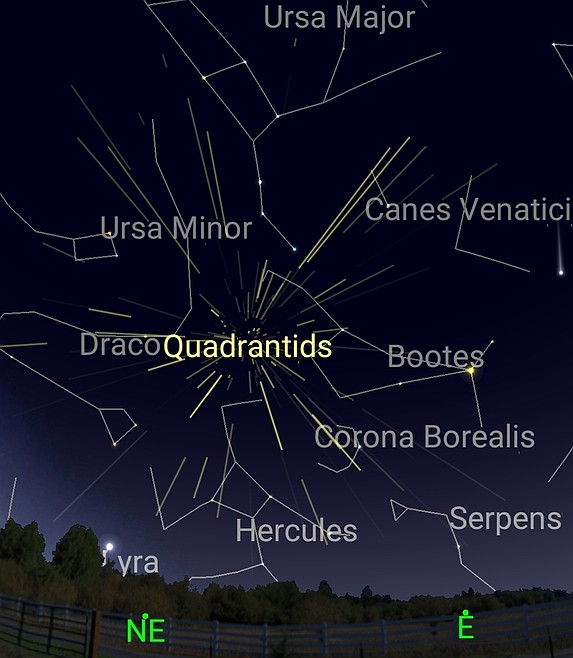
Jan. 3 and 4 — The Quadrantid meteor shower
The Quadrantid meteor shower will be active from Dec. 12 to Jan. 12, producing its peak rate of meteors around the 3rd and 4th of January. Over this period, there will be a chance of seeing Quadrantid meteors whenever the shower's radiant point — in the constellation Bootes — is above the horizon, with the number of visible meteors increasing the higher the radiant point is in the sky. The radiant point is highest in the sky after dawn — at around 8 a.m. — and so the shower is likely to produce its best displays shortly before dawn, when its radiant point is highest.
At its peak, the shower should produce an ideal rate of around 120 meteors per hour. However, this assumes a perfectly dark sky and that the radiant of the shower is situated directly overhead. In practice, because of the full moon, any live meteor observations will fall well short of these ideal conditions. The number of meteors you are likely to see will be significantly lower than this. Realistically, you may see only five but as many as 15 meteors per hour.
On this early evening, the full moon will pass close to Jupiter in the constellation Gemini. They will be within 4 degrees (four finger widths at arm’s length) from each other just after sunset (6 p.m.) in the eastern sky. These are the two brightest objects in the night sky, so they will be hard to miss. You would think that this would be a great time to use your binoculars, but the moon is so bright (when it is full) that it may actually cause some discomfort when viewing it through binoculars. To reiterate, the pair will be visible in the eastern sky after sunset, around 6 p.m. These two objects will be less than 4 degrees apart.
Jan. 7 — Comet 24P/Schaumasse reaches peak brightness
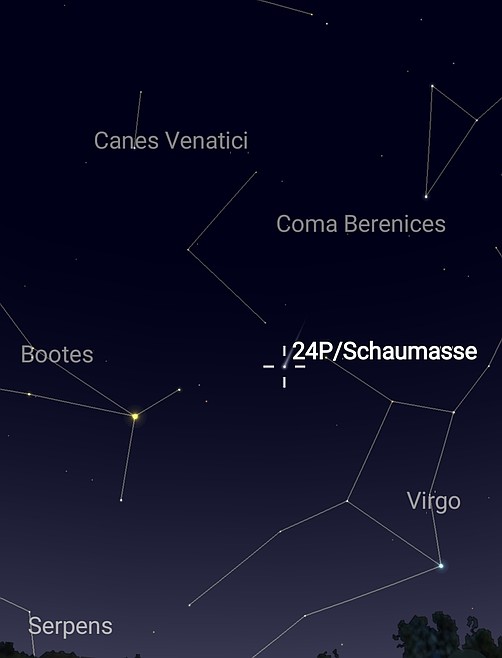
Comet 24P/Schaumasse is forecasted to reach the brightest point in its 2026 apparition Jan. 7. At that time, it will be a mere 55 million miles from Earth. The comet will be visible in the late night sky, becoming observable above the horizon around 1 a.m., when it reaches an altitude of 21 degrees above your eastern horizon. Look toward the constellations of Bootes, Coma Berenices and Virgo. You will need a pair of binoculars to see this comet because it will be a faint eighth-magnitude object. With your binoculars, find the bright star Arcturus and move it to your right and slightly upwards to see this faint fuzzy patch of light. Good luck!
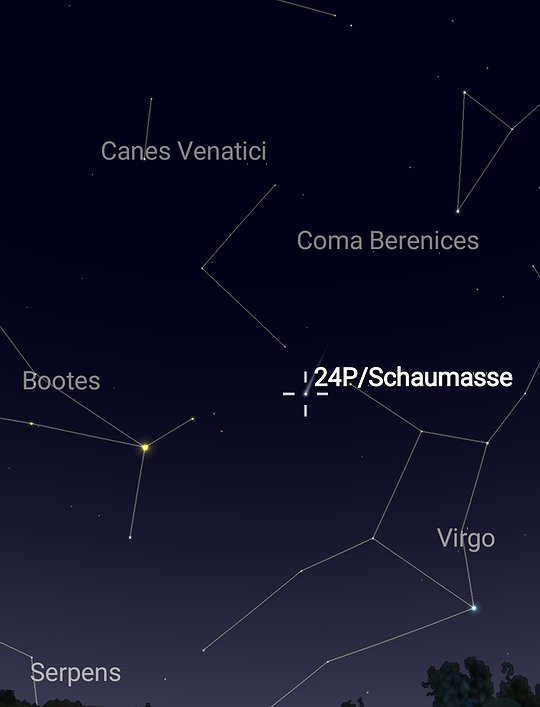 Image courtesy of John Taylor and Sky Safari Pro 6
Jan. 10 — Third quarter moon
At its third (or last) quarter phase at 7:48 a.m., the moon appears half-illuminated on its left side, which is its western, sunward side. It rises around midnight local time and then remains visible until it sets in the western daytime sky in the early afternoon. The dark, moonless evening skies that follow this phase are best for observing deep-sky objects like the Andromeda Galaxy, the brightest galaxy in our sky, which at 7 p.m. is directly overhead.
Jan. 10 — Jupiter at opposition
Jupiter will reach opposition (when the Earth is directly between Jupiter and the sun). It's the optimal time to observe it, because it will be visible all night in the constellation Gemini. At this time, it also appears brightest in the sky and at its largest when viewed through a telescope. When Jupiter is at opposition, it is the fourth-brightest object in the sky, behind the sun, the moon and Venus.
Jan. 18 — The new moon
The moon is on the same side of the Earth as the sun, and so it will not be visible in the night sky. This phase occurs at 11:52 a.m. It's the best time of the month to observe faint objects such as galaxies (Andromeda), nebulae (Orion) and star clusters (like the Perseus double cluster) because there is no moonlight to interfere. A nice pair of 10x50 binoculars is a great tool to observe these objects.
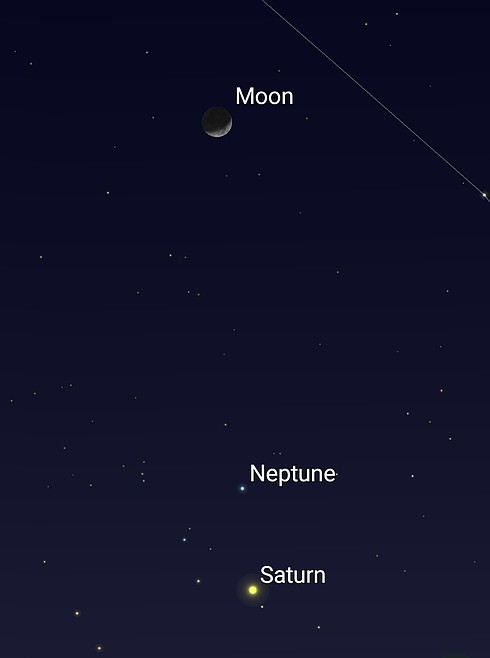
Jan. 23 — Conjunction of the moon, Saturn and Neptune
The moon will pass a little over 4 degrees (four fingers held at arm’s length) to the north of Saturn. The moon will be a crescent, and Neptune will be between them, but much closer to Saturn. Both the moon and Saturn will be naked eye objects, but you will need at least a pair of binoculars to see eighth magnitude Neptune. Neptune will be a distinctly bluish pinpoint.
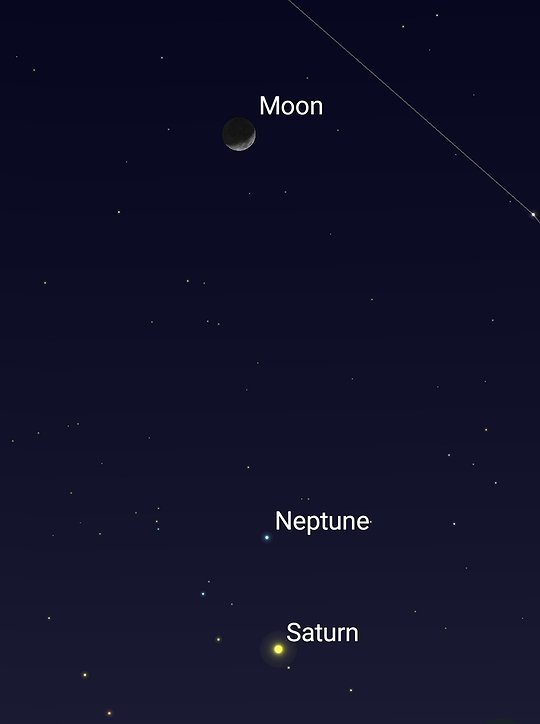 Image courtesy of John Taylor and Sky Safari Pro 6
Jan. 25 — The first quarter moon
When the moon completes the first quarter of its journey around Earth at 8:47 p.m. Its 90-degree angle from the sun will cause us to see the moon half-illuminated on its eastern side, which is its right side. In the first quarter, the moon always rises around midday and sets around midnight, so it is also visible in the daytime sky. The evenings surrounding the first quarter are the best ones for seeing the lunar terrain when it is dramatically lit by low-angled sunlight, especially along the terminator. This pole-to-pole boundary separates the light from the dark hemispheres.
Jan. 27 — Close approach of the moon and M45 (the Pleiades)
The Moon and M45 will make a close approach, passing within 3 ½ degrees of each other. The moon will be a waxing gibbous moon. The pair will be visible in the evening sky, around 5 p.m. Look due south as dusk fades to darkness.
Jan. 30 — Conjunction of the moon and Jupiter
The moon and Jupiter will make a close approach, passing within 4 degrees of each other. The moon will be 13 days old, and the pair will be visible in the evening sky. Look to the east around 7 p.m., as dusk fades to darkness. Both objects will lie within the constellation of Gemini and are too widely separated to fit within the field of view of a telescope, but will be visible to the naked eye or through a pair of binoculars.
That is all till next month. Once again, have a happy and healthy new year.
• • •
John Taylor is an amateur astronomer who lives in Hayden.