
For Foster, it’s been a rewarding career at Glacier National Park
Chris Peterson | Hungry Horse News | UPDATED 5 days, 22 hours AGO
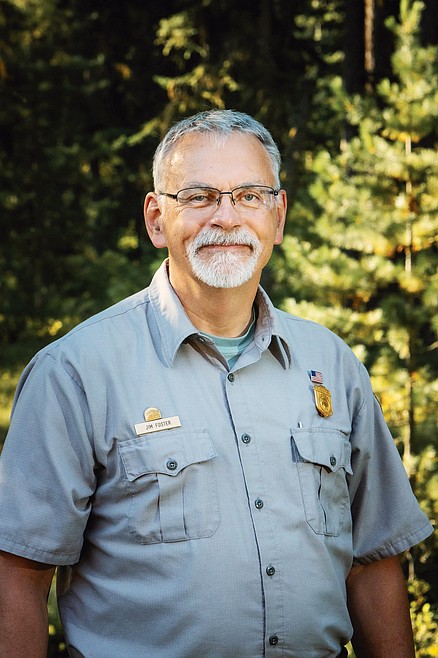
Jim Foster (photo provided)
The complete remodeling of the Many Glacier Hotel. The rebuilding of the Going-to-the-Sun Road; numerous water and infrastructure projects and two notable toilets.
It’s been a rewarding career for Jim Foster after nearly 23 years as an engineer and then the Chief of Facility management in Glacier National Park.
Foster retired at the end of 2025. He is 68.
Foster wasn’t even sure he would ever work for the Park Service. Back in 2002, after working as an engineer with Missionary TECH he decided a career change was in order and applied for two engineering jobs in the Park Service, one at Yosemite and the other in Glacier.
He never heard back from Yosemite, but John Kilpatrick, Glacier’s then facility chief, called him in for an interview some four months later.
He got a job as engineer in the park and then in January 2009 he was named Chief of Facility management after being the acting chief in 2008 when Kilpatrick left Glacier.
Foster also served more than 25 years in the Army National Guard. From 1987 to 1993 he served in the Colorado Army National Guard in Longmont as both Battalion Administrative Officer and Battalion Executive Officer. During this time, Foster received the Meritorious Service Medal for active service with the Battalion. He became a Lieutenant Colonel in January 1999 and retired from military service in November 2004.
Foster’s tenure in Glacier included the complete rehabilitation of the Going-to-the-Sun Road and the remodeling and rehabilitation of the Many Glacier Hotel. The Hotel alone was a $30 million project. The Sun Road more than $200 million, though he said the Sun Road was primarily Jack Gordon’s project. Gordon designed many of the modern elements of the Sun Road, including some fantastic “crow’s nest” turnouts along the highway and a complete overhaul of Rising Sun, which turned it into a placer to behold, Foster noted.
“We (Kilpatrick and Foster) were admirals steering the ship,” Foster said.
But Foster also had his own touch on the road. He designed the bathroom at the Loop and the bathroom at Big Bend. Both facilities blend into the landscape by design while paying homage to Thomas Vint, the original landscape architect that designed many of the Sun Road’s elements, such as the much coveted Loop.
Foster recalled carrying rocks he would find along the road in his rig to use to build the wall for the Loop bathroom, which is tucked along the highway in such a way that if one isn’t looking for it, you might not know it’s even there.
The same idea was at Big Bend. Foster recalled originally they considered a bathroom with a removable top, but that seemed untenable, so he designed a facility that would fit into the cliffside, which protected it from avalanches. In addition, it has a “living” roof, festooned with native dirt, rock and native plants, making it fit in into the landscape.
“It’s really starting to look nice,” he said.
He said his only regret was that he couldn’t find round doors which would have made it look like a Hobbit Shire home.
The Many Glacier Hotel was also a great challenge. The hotel prior to reconstruction was leaning toward Swiftcurrent Lake. It had to first be straightened and then bolted down into a new foundation.
The project was a technical and aesthetic feat and the hotel is one of the Glacier’s crown jewel’s today.
Foster also oversaw reconstruction of the Sperry Chalet after the Sprague Fire of 2018 gutted the main dormitory and he’s done many infrastructure projects no one will ever see. For example, over the past year or so Glacier has upgraded the water system in the Swiftcurrent Valley, which had been leaking more than 20,000 gallons of water per day.
The parking area was also revamped, adding more legal parking while not increasing the footprint of the lot.
Work this fall also started on another project in Two Medicine. Crews replaced a failing culvert in the road that was causing a large slump. They replaced it with a much larger culvert that wildlife can use as a crossing. More work in Two Medicine in slated for this year.
Another rewarding achievement was spearheading the School to Park program at Columbia Falls High School back in 2018. Woking with then Columbia Falls superintendent Steve Bradshaw and with support from the Glacier National Park Conservancy and the Park Service, they built a program where high school students would learn to build cabins and other structures like entrance stations for Glacier.
It was modeled after a similar program in Denali National Park.
Today, students have built seven cabins as well as the entrance station at Camas Road and Two Medicine. The Two Medicine station should be installed this year, with plans to have the students build the service building as well.
All told, they have projects to go to at least 2032 and the school is hoping to transform the program into a charter school with the state.
“It’s a fantastic success story,” Foster said. “I’m so proud of it. Something to hang my flat hat on.”
There are challenges ahead for Glacier. Climate change means that long standing ice and snow fields are rapidly diminishing. Logan Pass all but ran out of water this year, with just enough to run water fountains at the visitor center by the end of the summer season and Sperry Chalet has similar challenges. Granite Park has been good so far, Foster noted.
The Park’s shuttle system should see some new buses to replace about a half dozen of the older buses in the fleet and Glacier could use more. He noted a shuttle service into Many Glacier worked well last summer, but the park needs more buses in its fleet to continue such a service.
The park is also considering moving the west entrance closer to the T intersection with the Camas Road. It would ease congestion and allow more traffic into the park on the busy days. He said the pedestrian light in West Glacier has helped with that as well, as it releases traffic in pulses, rather than one long line that backs onto Highway 2.
Foster also spent plenty of time in the backcountry during his tenure. He has climbed 111 of Glacier’s peaks.
Longtime park engineer John Lucke is acting facilities chief until a permanent replacement can be hired.