
Noxious Weeds gives annual report
CHLOE COCHRAN | Hagadone News Network | UPDATED 2 months, 3 weeks AGO

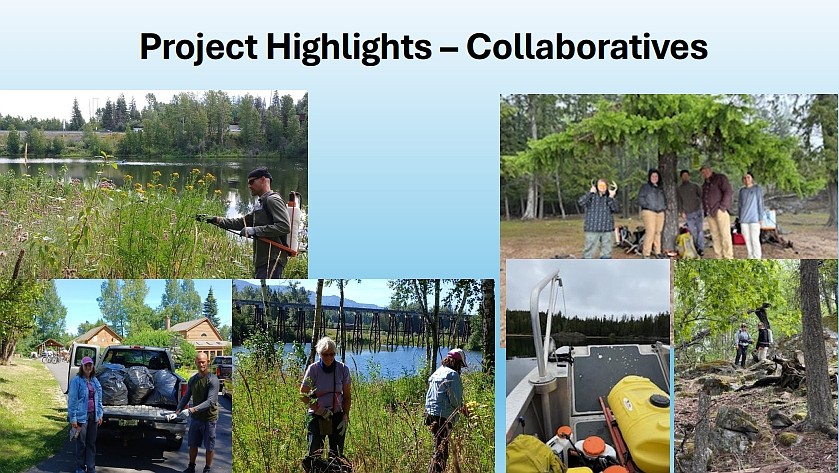
SANDPOINT — In its annual report presented Monday, the Bonner County Noxious Weed Department outlined the status of several noxious weed types while reporting on areas where treatments have been maintained.
The annual report was presented by Noxious Weed Director Chase Youngdahl to Bonner County commissioners, where he shared the 2025 inventory of early detection, rapid response for seven noxious weed types.
By comparing 2024 treatments with 2025 treatments, Youngdahl determined that responses to Scotch broom, large knotweeds (Bohemian, giant and Japanese) and yellow flag iris remained consistent. Responses to tansy ragwort, common reed and leafy spurge increased, while responses to Scotch thistle decreased.
Youngdahl also reported that the following noxious weeds have been controlled or contained: houndstongue, perennial sowthistle, field bindweed, hoary alyssum, hoary cress, purple loosestrife, rush skeletonweed, Canada thistle, hawkweeds, toadflaxes, oxeye daisy and spotted knapweed.
“I have common reed and leafy spurge marked as an increase but asterisked. And that's because those two were considered eradicated in 2024, so the common read infestation was one-tenth of an acre. and the leafy spurge was a twentieth of an acre. So, they were discovered and taken care of within the growing season,” Youngdahl said.
The director also highlighted a treatment summary of the department, noting 27.5 acres of county property that was a part of a noxious weed targeted treatment — most of which was at the Sandpoint Airport.
Additionally, 4.5 acres were treated for vegetation control at several Solid Waste sites under an agreement between the two departments. Solid Waste staff assist the Noxious Weed Department with renting herbicide application equipment, while the Noxious Weed Department provides vegetation management services.
Beyond weed treatment, Youngdahl also shared collaborative efforts that the department is a part of, including weed and pest seminars, speaking at the Idaho Noxious Weeds Conference, guest speaking for the homeowner's association, writing columns in the CO-OP County Roundup, among other things.
Youngdahl also presented a budget update, noting the department’s budget has remained consistent in recent years and includes an 8% reserve. He said the proposed 2026 budget is approximately $20,000 higher than previous years to cover the failure of a waste oil furnace heater.
In a 2026 preview, Youngdahl shared that the department has been awarded a grant for $9,288, which will cover the costs to revise and reprint the Noxious Weed Handbook. The department is also expected to receive two other sources of funding, including a grant for an education, outreach and prevention project and funds from the annual state cost share, which aims to provide financial assistance across the state for the control and eradication of invasive species.
The department is also expected to participate in aggressive treatment projects for Scotch Broom, Tansy Ragwort, Scotch Thistle and Flag Iris.
 Noxious Weeds project highlights
ARTICLES BY CHLOE COCHRAN

Armstrong addresses Careywood closure, wildfire deployment concerns
Misinformation and criticism surrounding local fire services were the subject of Tuesday’s “community chat” as Bonner County Commissioner Asia Williams hosted Northside Fire Chief Jeff Armstrong at the event.

Guzzi enters county clerk race
Long-time public servant JoAnne Guzzi has announced her candidacy for Bonner County Clerk.

Williams addresses jail roof, path forward
During a recent Tuesday business meeting, Commissioner Asia Williams provided clarity on long-standing discussions surrounding repairs to the Bonner County jail’s leaking roof.