
Little urges fiscal 'restraint'
ROYCE MCCANDLESS / Coeur d'Alene Press | Bonner County Daily Bee | UPDATED 2 days, 21 hours AGO
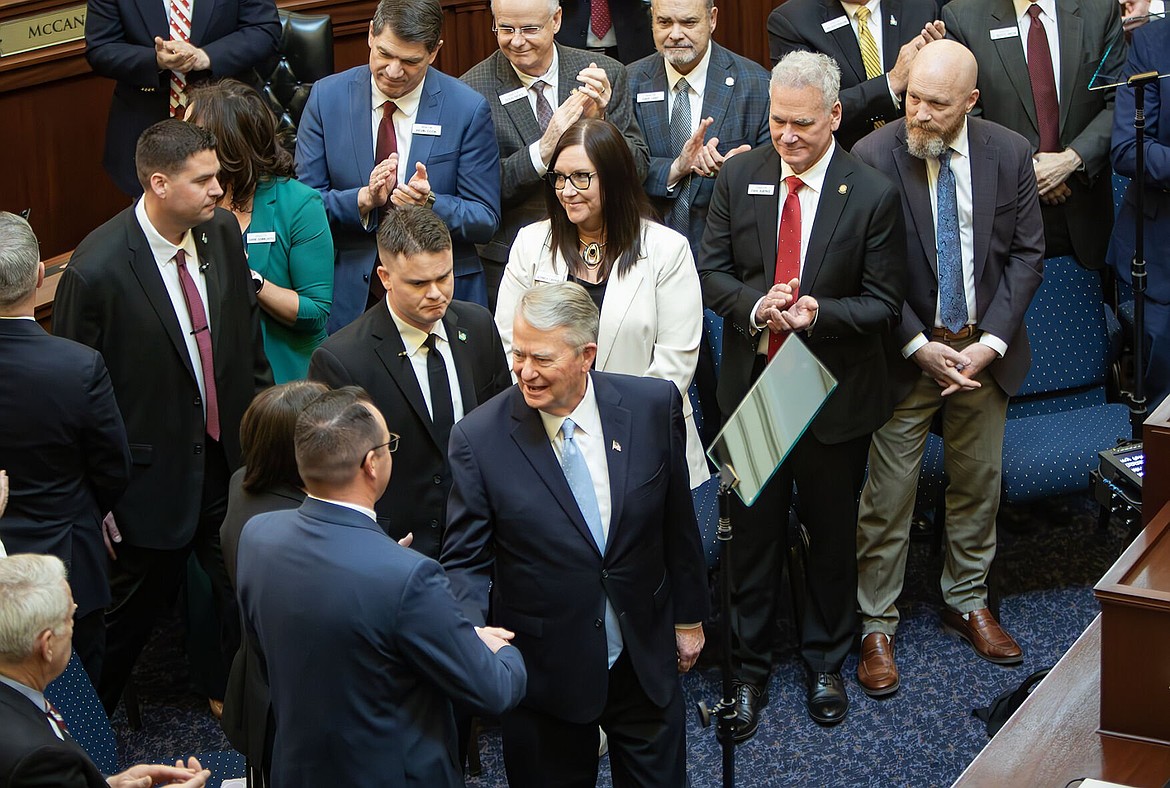
Idaho Gov. Brad Little smiles and shakes hands after delivering his State of the State address on Monday.
Brian Myrick/Idaho Press
BOISE — Gov. Brad Little’s State of the State address made clear that, above all else, this year’s legislative session would be marked by cuts for Medicaid, online schooling and a myriad of state agencies, centering a new “Enduring Idaho” plan around a theme of belt-tightening and persistence.
The address, delivered in the Idaho State Capitol on Monday, contrasts sharply with Little’s “Keeping Promises” just a year ago, which laid out tax cuts as well as investment in a number of state programs. With years of large budget surpluses now past and revenues in some areas falling, Little’s budget plan recommends wide-ranging budget cuts to ensure the state is not running a deficit for this fiscal year and the next.
“Idaho is evolving,” Little said. “However, through the change we must commit ourselves to preserving our state as the place where opportunity thrives. We must dedicate ourselves to carrying forward the values that define us, making sure they endure for generations to come.”
Much of Little’s address highlighted improvements made at the state level in recent years, including using COVID-era federal funding on one-time infrastructure investments and passing the Code Cleanup Act last year to direct the repeal of unnecessary and outdated state statute for a more streamlined government.
He also highlighted actions taken at the federal level, including the steps taken by the Trump administration to secure the border and provide tax relief for families through the One Big Beautiful Bill Act, which passed this summer.
In spite of these positives, Little made explicit the last year of his second term will require executive agencies to “tighten their belts.”
“A combination of factors has shifted us from years of record budget surpluses — driven by rapid population growth, business expansion, and one-time federal funds — to a period ahead that demands restraint,” Little said.
He noted last year the state’s revenue forecast decreased by nearly 14% in a matter of months, a shift driven by a different approach to revenue forecasting from the Idaho Legislature, “historic tax cuts, softer sales tax collections” as well as “ongoing uncertainty around interest rates and the national economy.”
With these headwinds in mind, Little’s “Enduring Idaho” plan brings forward recommendations that will maintain a balanced budget through fiscal year 2027 through spending cuts that will notably exclude K-12 public schools, protect Idaho LAUNCH: a state workforce training program and maintain water infrastructure investments passed last year.
In a change from past addresses, this year’s state of the state included the attendance of Idaho's past three governors and first ladies: former Gov. Butch Otter and first lady Lori; current U.S. State Senator and former Gov. Jim Risch and first lady Vicki; and former Gov. Dirk Kempthorne and first lady Patricia. In highlighting the work of these past administrations, Little underscored the success of the state would be built upon the foundation laid by these former leaders.
"That spirit of limited, efficient government is woven into our ethos here in Idaho,” Little said, “and it is one of the enduring values that will help us navigate the budget pressures before us.”
BUDGET BALANCE THROUGH CUTS
To avoid a deficit, as is required by the Idaho State Constitution, Little’s plan will be incorporating both “one-time and ongoing spending reductions” across the state’s executive agencies. In fiscal year 2026, which runs from July 1, 2025, to June 30, 2026, the largest single spending reduction came from Little’s previous executive agency holdback order, which cut $64.2 million in general fund spending reductions, or 3% of executive state agency budgets.
The proposed cuts are far larger in fiscal year 2027, which runs from July 1, 2026, to June 30, 2027. According to budget documents, the scope of Little’s proposed budget cuts for the coming fiscal year totals $642 million, above the $550 million spending gap the Joint Finance-Appropriations Committee previously projected for fiscal year 2027 if executive agency spending was left unchanged.
In a continuation from last year, Little’s budget recommendations make the 3% budget holdback request from the fall permanent, a measure estimated to save about $120 million each year in reductions that will continue to hold Idaho K-12 public schools harmless.
Idaho’s healthcare systems will also continue to be impacted.
The Department of Health and Welfare previously implemented 4% Medicaid provider rate adjustment cuts, a course of action that will continue into fiscal year 2027, yielding $23 million in savings. This will come alongside a recommendation from Little to decrease Medicaid spending by an additional $22 million through general fund spending reductions, though a repeal of Medicaid Expansion is not among the options proposed by Little in his list of reduction options.
Other one-time cuts are also coming in the next fiscal year. Little is recommending the Idaho Transportation Department's $275 million Strategic Initiatives Fund be cut in its entirety on a one-time basis, including $110 million in funds intended for local highway districts.
He is also recommending the one-time transfer of $100 million in interest earned between the budget stabilization, millennium fund, SIF, and the Department of Environmental Quality’s Water Pollution Control Fund to go back into the general fund instead of being used by these respective funds at a later date.
With several of the largest fiscal year 2027 budget cuts being one-time, it remains unclear whether the state will have to make these changes ongoing if state revenues do not match projections in the coming fiscal year, as was the case in fiscal year 2026. The feeling among leadership is that the next fiscal year will not be a repeat of this one.
“We’re betting on Idaho’s economy,” Lori Wolff, the Idaho Division of Financial Management’s chief budget officer, said Monday. Little similarly said “there’s no question” the state will see a rebound in revenues in a follow-up press conference after his address.
Notably absent from Little’s proposals was a recommended change in state employee compensation.
“I do want to be clear that this does not reflect our priorities for state employees,” Wolff said. “We know state employees are still paid behind market. This was simply the revenue situation and prioritizing making sure we keep our benefit package whole.”
All of these changes initiated in the state come alongside the impending implementation cost of the One Big Beautiful Bill Act, which passed this summer. Little said in a preview event last week he will recommend updating Idaho’s tax code to conform with federal tax cuts for income taxes as well as business expensing changes.
The estimated revenue cost of these changes has been estimated at $155 million by the Idaho Tax Commission, though estimates vary. The Tax Foundation, a tax policy nonprofit, estimated the costs to be at least $284.4 million for Tax Year 2026.
Wolff said Monday the value decided upon was in the “middle” of the Tax Commission’s estimates, which ranged from $115 million to $192 million. The ultimate cost of conformity will depend on what aspects of the tax code the legislature chooses to comply to, including changes for expensing research and experimentation and business infrastructure investments.
HOUSE LEADER RESPONSES
Democratic leadership described the current financial picture for the state as being a self-inflicted problem brought by the state Legislature.
"Idaho went from historic surpluses to historic deficits because of bad fiscal decision making,” Sen. James Ruchti, D-Pocatello, said.
Ruchti responded to Little’s address with the caucus’ own spending recommendations, including using a third of the state’s $1.4 billion rainy day funds to avoid the range of cuts proposed for fiscal year 2027, placing a “trigger" on the $450 million in tax cuts passed last session to make them only go into effect when the state could afford them and removing the $50 million private school voucher program which passed last session and opens for applications this week.
House Minority Leader Ilana Rubel said she thought it's unlikely the Legislature would reverse on both the voucher program and tax cuts of last year, even if doing so would right the state’s bottom line.
“I fear that those who drove the car into the ditch are very unlikely to call the tow truck,” Rubel said. “I think we’re more likely to hear about what a beautiful ditch it is and how fortunate we are, but that doesn’t make it reality. The reality is that the people of Idaho are already suffering from the cuts that that have already gone into effect.”
House Republican leadership was comparatively optimistic on Idaho’s future budget picture. House Majority Leader Mike Moyle stated plainly that the revenue picture “isn’t a big deal,” and would require modest, single-digit percent agency cuts and a trimming of whatever is unnecessary.
Moyle said while a buffer of over $400 million was left in the state’s budget when the session concluded last year, the passage of the One Big Beautiful Bill Act in July led to this going away. Moyle said his belief is that the Legislature would conform with “most if not all” of the tax provision changes at the federal level.
Addressing the governor’s proposal for Medicaid changes, Moyle said he believes the state needs to get Medicaid expansion “under control” so it’s not taking from other state budgets.
“We'll wait to see what his proposal is for the 45 (million dollar cuts) and then we can decide how to proceed from there and find a solution,” Moyle said. “We’re going to have to find a solution to it — we’re going to have to have those hard discussions.”