
Mission's deteriorating sewer pipes pose health, safety threat
EMILY MESSER | Hagadone News Network | UPDATED 1 month, 3 weeks AGO
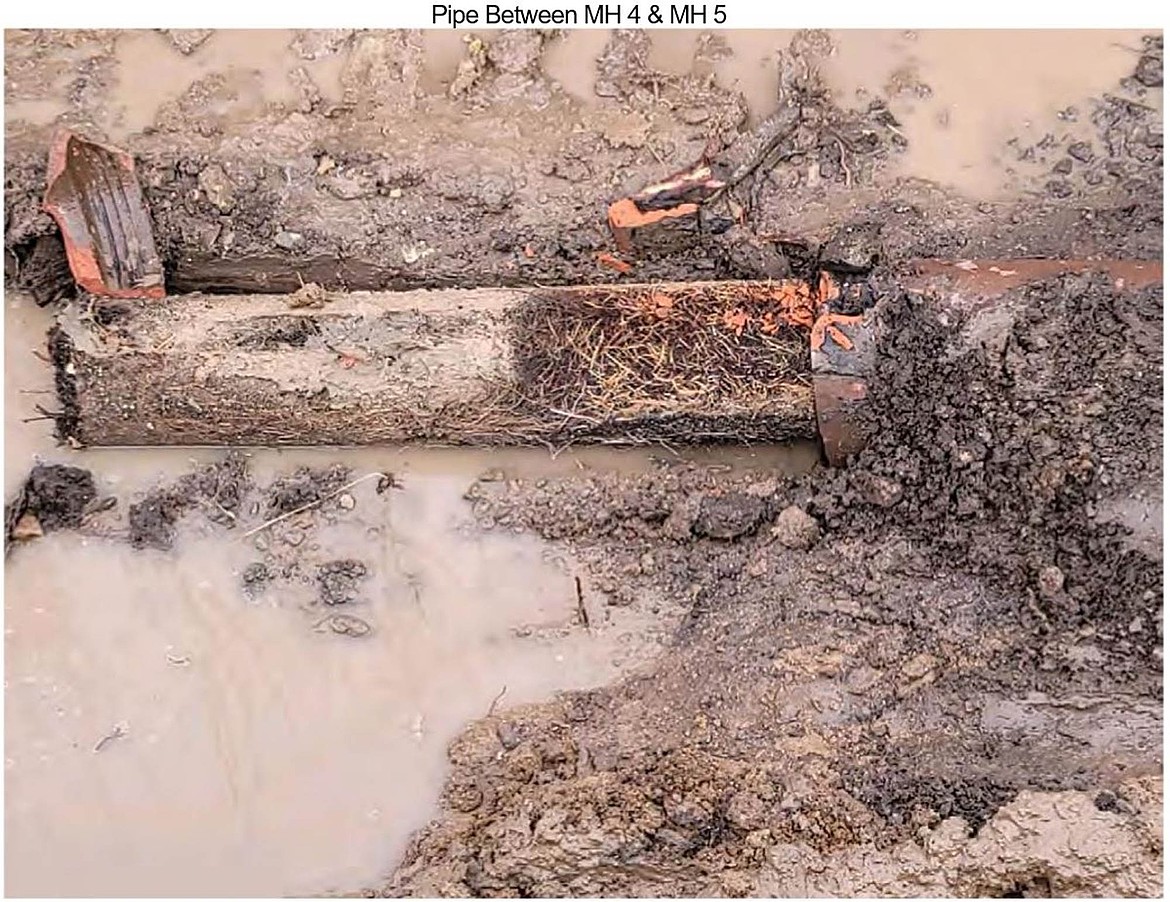
A main pipe blockage of St. Ignatius Sewer lines, which the city engineer, Shari Johnson, included in her 2024 Preliminary Engineering Report. (Courtesy of Shari Johnson & Associates Engineering)
Emily Messer joined the Lake County Leader in July of 2025 after earning a B.A. degree in Journalism from the University of Montana. Emily grew up on a farm in the rolling hills of southeast Missouri and enjoys covering agriculture and conservation. She's lived in Montana since 2022 and honed her reporter craft with the UM J-School newspaper and internships with the RMEF Bugle Magazine and the Missoulian. At the Leader she covers the St. Ignatius Town Council, Polson City Commission and a variety of business, lifestyle and school news. Contact Emily Messer at [email protected] or 406.883.4343 | January 14, 2026 11:00 PM
It was an eventful meeting for the St. Ignatius Town Council on Tuesday, Jan. 6, with a presentation on the town’s dire sewer situation, possible United States Department of Agriculture grant opportunities as well as a discussion of other agenda items (see separate story).
The sewer lines are 80-year-old clay tile pipes beyond their lifespan and failing, paired with a sewer lagoon that “needs attention.” The community, with an estimated general fund revenue of $180,000 annually, is staring down the barrel of a $5.8 million price tag for a new main line system.
Shari Johnson, the town engineer, presented a summary of the 2024 preliminary wastewater engineering report, along with her conclusion and recommendation during the meeting.
“The threat to health and safety from the deteriorated clay tile pipes in St. Ignatius is very serious, real and well-documented,” Johnson’s summary stated. “Sewage is not able to flow down the sewer mains and has a history of flooding homes and alleys.”
Her summary mentioned that the sewer mains have an “alarming amount of exfiltration,” with raw numbers estimating 7,000 gallons seeping from the lines each day. This means that only 10% of wastewater reaches the lagoons, according to the 2024 document.
Johnson said this gallon estimate comes from a theoretical calculation the design engineer made based on an assessment of a few sewer-line sections. She explained that two sections of lines had been repaired since then, and these numbers are a rough estimate, but it could be happening at a higher or lower rate.
Johnson said the Montana Department of Environmental Quality was notified of a previous above-ground sewage spillage, but they are not required to notify DEQ for below-ground leakage.
She explained that Mission relies on a community drinking water system and that the wells for the system are outside of the wastewater system. So, they were unable to document whether the groundwater or the creek was contaminated.
The council selected the option to replace all the clay mains in November of 2023 and passed a resolution the following month to raise water and wastewater rates and to continue increasing them over the following two years.
Mission split this project into digestible pieces and received just shy of $400,000 from federal aid, grants and state funds, which they allocated to the sewer project. However, Johnson pointed out during the meeting that the $5.8 million is an estimate from 2024, and prices may have changed since then, and it doesn’t include the $400,000 already completed.
Ryan Urbanec, the state engineer and environmental coordinator for USDA Rural Development, along with Chelsea Dodd, the finance and administrative specialist for Montana Rural Water Systems and her colleague John Paddock, wastewater technician, joined the meeting to discuss funding options from Rural Development.
An option St. Ignatius is considering is an 80% grant with a 20% loan split through Rural Water. However, Urbanec said the loan interest rate is based on the town's economic conditions. The interest rates are divided into poverty, intermediate and market categories. As of 2021, the median income in Mission was $45,000, which is just above the poverty rate.
Johnson and others were surprised that Mission ranked above the poverty rate, and Urbanec said they could redo the survey. But he called it a double-edged sword because they could then rank at a market interest rate and would take time to complete.
Johnson pointed out that the current survey could be counting residents outside of the area served by the system. She explained she is unsure if there are outlying neighborhoods that are increasing the median income, which are properties that the town’s water and sewer doesn’t serve.
“It’s a gamble. Sometimes you can predict that gamble,” Johnson said.
Along with an increased interest rate, Mission would also be in a 60% grant and 20% loan bracket based off the median income.
Urbanec recommended the town put a grant application in promptly to get the project done “as soon as possible.” But he also said it’s not a short-term thing, and if an application is submitted now, they may be able to break ground in three to four years.
While the grant loan split is an option for Mission, they also requested federal appropriations from U.S. Senator Tim Sheehy. On Sheehy’s website, he has St. Ignatius listed for a $4.6 million request to replace the wastewater collection system.
Mayor Daren Incashola stated in a later email to the Leader that they made requests to U.S. Representative Ryan Zinke, U.S. Senator Steve Daines and Sheehy. Incashola said he received an email from Sheehy’s office on Dec. 3 stating that the CDS grants are competitive, and the committee is attempting to fully fund its project.
The email to Incashola stated that this is a step in the right direction, but they still need to see the bill passed to ensure the U.S. Department of the Interior can distribute the funds.
They are hoping this will be finalized at the end of January when the Continuing Resolution expires, but this process may extend into the spring, the email stated.
With this federal appropriation possibly funding the project, Johnson was curious if they could revise their loan through Rural Development.
“The fact that Rural Development is here, to me, says you have money on the table you could bring to this community,” Johnson said.
But a new wastewater system is just one of Mission’s needs that Ryan may be able to help out with. As the meeting progressed, Police Chief Jason Acheson said the donated patrol car from Bozeman is almost road-ready, and Urbanec jumped in and asked if Acheson wanted a new one.
“I’d love one,” Acheson said.
The USDA offers a Community Facilities Direct Loan & Grant Program that funds safety services such as fire departments, police stations, prisons and police vehicles. Urbanec responded by telling Acheson to chat with him after the meeting.
The community is also in need of a new snowplow truck, which Scott Morton, the Public Works director, asked Urbanec if he could supply as well. Public works vehicles are also listed under the Community Facilities Direct Loan & Grant Program. 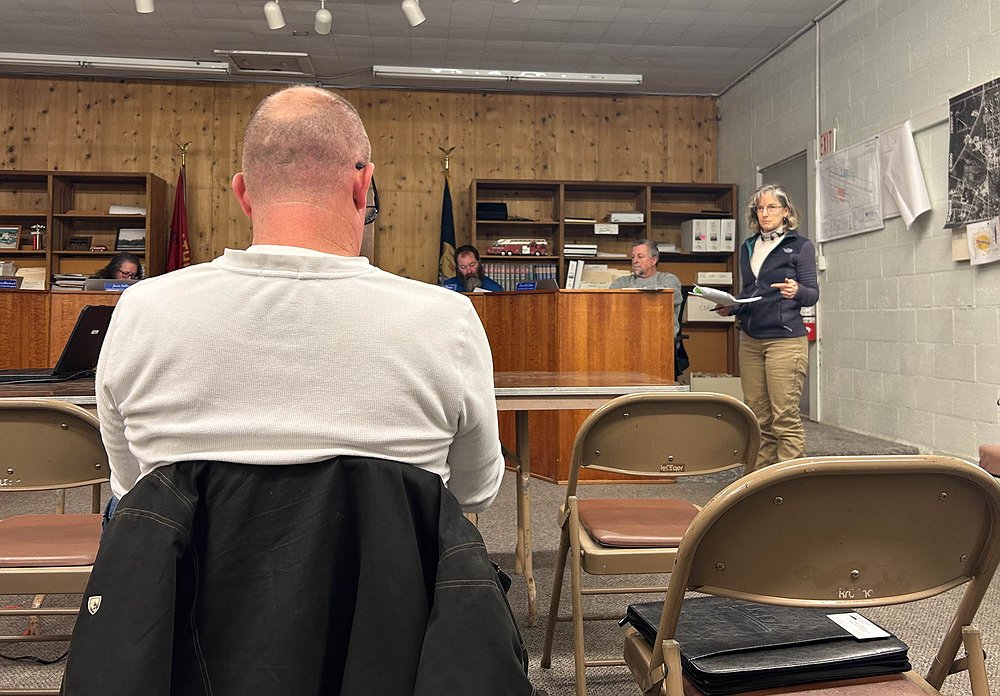 City Engineer Shari Johnson presented a recap of the 2024 Wastewater Preliminary Engineering Report to the council and to Ryan Urbanec, the state engineer and environmental coordinator for USDA Rural Development. (Emily Messer/Leader)
ARTICLES BY EMILY MESSER

Polson commissioners hear plan for reducing E. coli in Flathead Lake
Representatives from the Flathead Lakers and the Polson Bay Golf Course presented a plan to the Polson City Commission last Wednesday to reduce stormwater runoff, which had caused increased levels of E. coli in Flathead Lake near Boettcher Park.

City Commission finalizes Salt Cafe grant, hears from market vendors
The Polson City Commission council chambers were full of support Monday night for Andrew Perkins, owner of Salt Cafe, who has been awaiting funding from the Tax Increment Finance District grant he received nearly three years ago.

Foundation established for Polson Police
A non-profit called the Polson Police Foundation was launched at the end of 2025 to support the department by contributing to training, officer wellness, critical equipment and community initiatives.