
On ‘Wicked’ in print
NANCE BESTON | Hagadone News Network | UPDATED 2 months, 3 weeks AGO
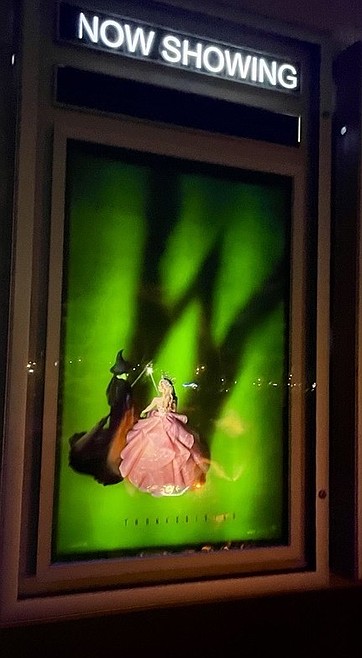
Gregory Maguire’s novel “Wicked: The Life and Times of the Wicked Witch of the West” is not suitable for children, with explicit content woven throughout the novel. However, there are newly released picture books that are better for young lovers of Oz.
NANCE BESTON/COLUMBIA BASIN HERALD
MOSES LAKE — “Wicked” and sequel “Wicked: For Good” have taken over my household. After the first watch at Fairchild Cinemas, I was hooked on the extension of the Oz universe. But, when I went back to the source — Gregory Maguire’s novel — I discovered a world far darker, stranger and more adult than the glittering emerald we see on stage and screen.
A bit shocked
If your journey into Oz began with the Broadway spectacle or the recent film, the novel’s first pages can surprise. The novel “Wicked: The Life and Times of the Wicked Witch of the West,” begins with a mechanical puppet show depicting sexual acts. This opening scene immediately signals that Maguire’s Oz is not a children’s fairy tale but a dark, philosophical reimagining of Baum’s classic.
At 24, I appreciated the depth and complexity of the narrative, but I was unprepared for the explicit content woven throughout the story. Scenes such as the infamous Ozdust Ballroom episode underscore why this book should carry an R-rating in spirit. Parents should be warned: if your children have fallen in love with the magical world of Oz through Wicked’s musical or recent films, the original novel is still likely inappropriate for them. Proceed with caution.
Bottom line for parents: If your kids are newly obsessed with Oz because of the musical or films, stick to child‑friendly retellings — and reserve the novel for mature readers. Thankfully, there are picture books and illustrated editions that preserve the charm of Oz without adult content. Books that would be more suitable for children would include “Wicked: I am Glinda,” “Wicked: I am Elphaba,” Wicked: Defying Gravity” and “Wicked: The Story of Oz.”
Or, simply go to the original, “The Wonderful Wizard of Oz” written by L. Frank Baum.
Adult draw
For mature readers, Wicked is a masterpiece of political and moral complexity. Maguire uses Oz as a lens to explore authoritarianism, propaganda and systemic oppression.
The novel delves into the rise of fascism under the Wizard’s regime, the disenfranchisement of sentient Animals, and the ethical dilemmas that shape Elphaba’s radicalism.
These themes, in my opinion, were impossible to fully address in musical or film adaptations, which prioritize spectacle and emotional resonance over political nuance.
Reading the novel forces us to confront uncomfortable questions: Can a society manufacture its own villains? Is morality absolute, or does it bend under the weight of circumstances? Are people born wicked? Or do they have wickedness thrust upon them?
Novel, musical, movie
The differences between Maguire’s book and its adaptations are striking. The novel is dark, philosophical and often unsettling, while the musical transforms the story into a tale of friendship and redemption with soaring ballads and humor.
Elphaba in the book is intellectually restless, politically radical and deeply flawed — a far cry from the misunderstood heroine portrayed on stage and screen.
Entire subplots, including Elphaba’s family dynamics and the political machinations of Oz, are condensed or omitted in the musical. Even the ending diverges dramatically: Maguire leaves readers with ambiguity and tragedy, whereas the musical offers hope and reconciliation.
The Oz universe
To understand Wicked, we must trace its lineage back to L. Frank Baum’s "The Wonderful Wizard of Oz," published in 1900. Baum’s original novel introduced readers to Dorothy, the Scarecrow and the Tin Woodman in a story that celebrated courage, friendship and home. It spawned 13 sequels and became a cornerstone of American children’s literature.
In 1939, MGM’s film adaptation immortalized Oz on screen, cementing its place in popular culture. Decades later, Gregory Maguire reimagined the tale in Wicked (1995), infusing it with political allegory and moral ambiguity.
The Broadway musical followed in 2003, transforming Maguire’s dark narrative into a global phenomenon of glitter and song. Today, the two-part film adaptation — released in 2024 and 2025 — brings the musical to the big screen, leaning into spectacle and accessibility.
Read if you’re ready
As someone who sings “For Good” in the kitchen and quotes “Defying Gravity” after coffee, I still recommend Maguire’s novel to adults.
It deepens Oz with morally thorny questions and challenges readers to reconsider the nature of evil. Overall, I really enjoyed Maguire’s novel; it forced me to feel uncomfortable, question my beliefs and broaden my understanding of fascism and oppression. Although the themes of the book can be heavy at times, there are several scenes that capture the wonder found on screen.
However, I once again caution parents: this is not a bedtime story for children newly enchanted by the Emerald City. Let younger readers discover Oz through Baum’s classic, or newly released picture books, while older teens and adults tackle Maguire’s hard questions when they are ready.
ARTICLES BY NANCE BESTON
1 arrested after Highway 17 stop; detectives recover fentanyl, firearms
MOSES LAKE — The Moses Lake Street Crimes Unit conducted a traffic stop on Highway 17 near Randolph Road and executed a search warrant Friday morning as part of an ongoing narcotics investigation.
4th-year drought declaration in WA, subtle effects in the Columbia Basin
EPHRATA — Washington’s fourth straight year of drought is expected to hit some regions hard, but in Grant and Adams counties, the impacts will look different – quieter, less visible and centered underground. Statewide, the Department of Ecology issued an emergency drought declaration after a warm winter left Washington with about half its usual snowpack, raising concerns about low summer streamflows, stressed fish populations and heightened wildfire risk. Seven of the past 10 years have included drought somewhere in the state. “If you look at our mountains, the challenge we are facing is clear,” Gov. Bob Ferguson said during a press conference Wednesday. “We’re taking emergency action to protect fish, farmers and communities across Washington.”
Sleep Diagnostic Center to close after doctor’s sentencing
MOSES LAKE — The Central Washington Sleep Diagnostic Center announced it will be closing its doors effective April 30. This includes locations in Moses Lake, Spokane Valley, Brewster and Wenatchee. The announcement follows the March 25 guilty plea from Dr. Eric Edward Haeger, 57, in United States District Court to adulterating and misbranding medical devices with the intent to defraud or mislead, according to a statement from the U.S. Attorney’s Office. “The adulterations by Dr Haeger show a dangerous disregard for the safety of his patients,” Washington Attorney General Nick Brown said in a statement. “This is a win for patient safety, for protecting public dollars from fraud, and for ensuring citizens of Washington get necessary healthcare. This case exemplifies the great work our team is doing in collaboration with our federal partners to fight fraud and protect Washingtonians.”