
No coliforms found following latest Libby water testing
SCOTT SHINDLEDECKER | Hagadone News Network | UPDATED 1 month, 2 weeks AGO
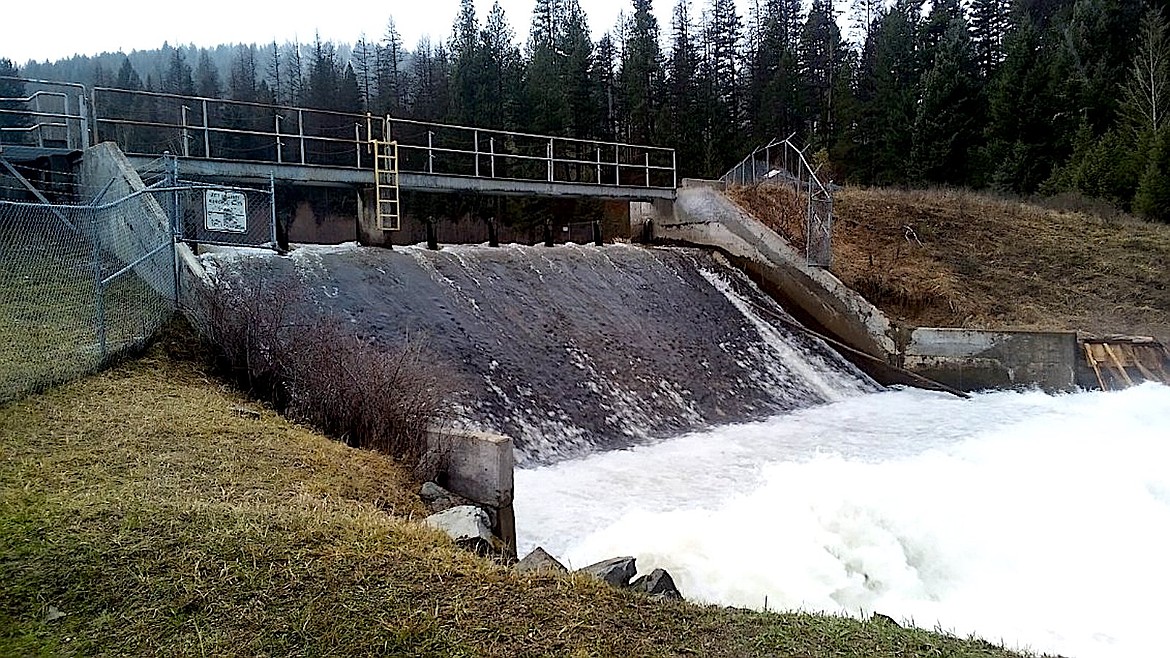
Water from Flower Creek flows over the lower diversion dam on the morning of Wednesday, Dec. 17, 2025. Officials said the facility is stabilized, but an area that washed out on lower right side is cause for further concern. (Scott Shindledecker/The Western News)
The City of Libby took a step forward in its effort to lift a boil water order issued last month following damaging flooding Dec. 11-12.
City administrator Sam Sikes provided an update on the municipality’s water system in a Jan. 14 email to city and county officials.
Sikes reported water samples were hand delivered to ME Labs in Kalispell Monday, Jan. 12, to test for total coliforms and chlorine residuals.
In terms of the boil order, Sikes urged patience as Montana Department of Environmental Quality officials analyze the information in the report.
“You will see that Libby’s water is absent coliforms and has adequate chlorine residuals,” Sikes said. “The city is still in a holding pattern while the DEQ considers all the information in order to make a well-informed decision on lifting the boil order while ensuring the quality of water to our customers. “We just ask for a little more patience while the analysis is completed, After all, the quality of our water affects those who are immune compromised and can’t afford the risk the most. Many thanks to everyone involved in this effort!” Sikes said.
Sikes said the city has taken every precaution, and added some additional, and completed coliform testing that has been required after past boil orders.
"The test results have all came back showing that the city is well within acceptable limits. However, we are not done yet," Sikes said. "The DEQ is requiring that we engage engineers to look at our recent water model and design a new directional flushing model and complete, or agree to complete, additional rounds of flushing prior, or immediately after lifting the boil order. We have our city engineer, Andy Evanson, and Kevin Grabinski, the dam certified engineer, on the project now. We ask for continued patience on the boil order while we walk through building the directional flushing model. The reason for the additional flushing is ensure that cryptosporidium will not be contained in our water mains for health concerns. This process may be able to happen after the boil is lifted and while we are on a health advisory. The DEQ is currently completing risk assessments and will have more information soon."
According to the Centers for Disease Control, cryptosporidium is a parasite that can live in water, food, soil, or on surfaces that have been contaminated with infected feces. Cryptosporidiosis is a disease that causes watery diarrhea.
DEQ Public Information Officer Maddison McGeffers said in an email the agency cannot commit to a timeline for lifting a boil water advisory. She did share DEQ's process as it analyzes the most recent test results.
"The boil water advisory can be downgraded to a health advisory once DEQ can be confident water being served in Libby meets state laws and regulations and requirements of the federal Safe Drinking Water Act," McGeffers said in the email. "For this situation, data must demonstrate that the source water is stabilized to be confident that the treatment plant can reliably and consistently produce water that meets state and federal regulations. Once tests confirm requirements have been met, the distribution system will need to be adequately flushed and tested."
Sikes also outlined the steps city workers have taken in efforts to lift the boil order.
“The city stabilized the bypass pipe in order to operate the sedimentation basin as designed to stabilize the raw water entering the treatment plant,” he said. “The city then flushed our water mains and tested the outflow to ensure that any remaining turbidity that was in the mains was removed.”
In another email on Jan. 15, Sikes reported that an additional dewatering pump was brought in and a pond liner was added to the temp coffer dam to help control seepage.
"We hope that with the additions, dredging will hopefully begin in a couple days," Sikes said.
During the flooding, the lower Flower Creek Reservoir was breached. A temporary coffer dam was put in Dec. 30-31, 2025, to hold water back and bypass the lower reservoir where any sediment can go into a basin before it enters the water treatment plant.
The goal is to reduce sediment levels so the boil order can be lifted by Montana Department of Environmental Quality officials. Sikes explained that the order can’t be lifted by the city.
Sikes said DEQ’s Surface Water Treatment Manager Joshua Seekins sought and received clarification on the actions and data from the plant for the last month. Seekins was provided with the latest test results from ME Labs.
In a phone conversation Wednesday afternoon with The Western News, Seekings said his department is currently evaluating the situation. He referred other inquiries to the department’s media relations.
McGeffers further explained the difficulties of the situation and that the agency has prioritized water testing results from Libby.
"Construction to stabilize the dam, along with the utilization of an alternate water intake at the reservoir, has the possibility of re-suspending settled contaminants making water treatment more difficult," McGeffers said. "DEQ is working with Libby to analyze source water data and test results from the water treatment plant and distribution system. DEQ recognizes the impact of this process to the community and has prioritized these results for analysis. Water operators in Libby have been working diligently with DEQ to protect public health. DEQ will continue to support the City’s work to address water quality concerns."
According to reporting by the Montana Free Press, the state of Montana has been covering the cost of bottled water distributed at the VFW in downtown Libby, said Boyd White, head of the Lincoln County Emergency Management Agency. That water is available daily from 9 a.m. to noon.
Boyd has been coordinating much of the recovery effort and is particularly focused on figuring out how the local community can secure state and federal funding. Shortly after the flood, the federal government released $5 million for the recovery, but that money did not go directly to the local community. Instead, those funds were allocated to the federal agencies responding to the incident, like the Federal Emergency Management Agency. Last week, staff members from FEMA visited Libby to assess the damage.
Boyd said if the damage and clean-up effort exceeds $2 million — and it likely will — the county would be able to apply for additional funding. Boyd said he’s also in the early stages of working with the state to identify funding to help individuals and businesses, possibly through low-interest loans, to help with the costs incurred from the incident, like having to buy pallets of bottled water.
Officials also recommended calling or texting the Disaster Distress Helpline (1-800-985-5990) because it provides free, confidential, emotional support for anyone affected by natural or human-caused disasters.
ARTICLES BY SCOTT SHINDLEDECKER

Officers involved in shooting near Libby while serving warrant
Lincoln County law enforcement officers were involved in a shooting Wednesday afternoon at a location on Libby Creek Road, authorities said.
Local officers involved in shooting near Libby
During the course of serving the warrant...
Four dead in head-on crash in Lincoln County
Four people died in a two-vehicle, head-on crash late Tuesday morning on U.S. 2 in Lincoln County.