
THE DIRT: Historic pollution study of the Coeur d’Alene Basin Pt. 3
Shoshone News-Press | UPDATED 1 month, 1 week AGO
Courtesy photo
During the summer of 1933, Dr. Ellis and a team of scientists from the U.S. Bureau of Fisheries launched one of the first systematic investigations into the effects of mine waste on the Coeur d’Alene River system. Their work sought to understand how decades of mining activity had altered the watershed’s chemistry and biology.
The study began with a review of historic and contemporary mining and milling practices, followed by an inventory of aquatic species and a chemical analysis of mine wastewaters. From there, the team conducted laboratory and field experiments to determine how native aquatic organisms responded to contaminated water.
To assess real-world conditions, live dace minnows and long-nosed dace were placed in large wooden live-boxes. One box was stationed offshore of Harrison Beach in Lake Coeur d’Alene, where relatively clean lake water mixed with river water. A second was placed a quarter mile upstream in the Coeur d’Alene River, fully saturated with mine waste. After three days, the results were stark: fish in the lake remained alive and healthy, while all fish in the river box had died, their bodies coated in heavy mucous slime.
The researchers next examined plankton, microscopic crustaceans that form the base of aquatic food webs. Water samples were collected from four locations: the river mouth at Harrison, a quarter mile upstream from Harrison, the river at Dudley, and clean water from Canyon Creek above the mining district. Each sample was settled and maintained at the same temperature in the laboratory, with tap water used as a control.
Plankton exposed to water from a quarter mile upstream died within 18 hours; those in Dudley water survived no more than 36 hours. Approximately 80 percent of plankton in mixed water from the river mouth died within 48 to 72 hours. No deaths occurred in the clean Canyon Creek or tap water samples during the 14-day experiment.
These findings confirmed what fishermen and riverside communities had long suspected: polluted reaches of the Coeur d’Alene River were acutely toxic, capable of wiping out both fish and the microscopic life that sustained the entire aquatic food web.
To pinpoint the cause, Ellis and his team isolated individual components of the waste stream and tested their effects on frogs, turtles, catfish, bass, goldfish, and plankton. Materials examined included milling chemicals, isolated lead and zinc ores, and hard mineral build up that formed on mine tailings exposed along riverbanks and floodplains.
Milling chemicals showed variable toxicity, with the strongest effects occurring near mill discharge points. As these chemicals traveled downstream, dilution from cleaner tributaries reduced their potency. While dangerous near their source, the scientists concluded that milling chemicals alone could not explain the widespread biological collapse observed miles downstream.
Testing of isolated ores revealed clearer patterns. Plankton exposed to lead ore died within 48 hours, while fish survived longer but secreted heavy mucous until lead particles settled out of suspension. Zinc ore, by contrast, produced no deaths and no visible distress.
Yet these results only deepened the mystery. If milling chemicals weakened with distance and raw ores failed to explain the river-wide devastation, what was causing such severe and persistent toxicity throughout the watershed?
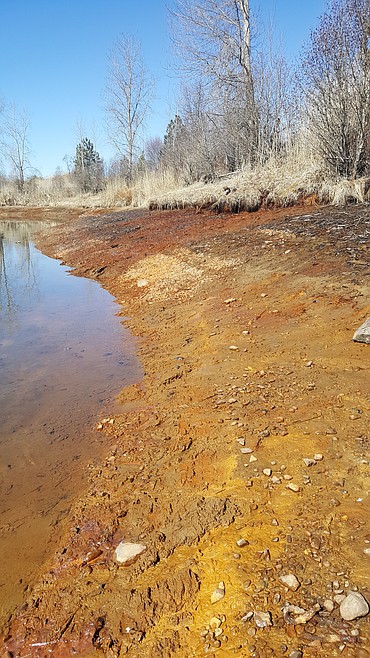
That question led Ellis and his team to focus on a far more dangerous culprit—one formed not in mills or tunnels, but along the riverbanks themselves. Stay tuned for the final installment of the Ellis Report findings.
The Dirt is a series of informative articles focused on all aspects of cleanup efforts associated with the Bunker Hill Superfund Site. Our goal is to promote community awareness of contamination issues, to provide tools for protecting public health, and to keep the community informed of current and future cleanup projects. The Dirt is a group of committed and local experts from multiple agencies, including the Basin Environmental Improvement Project Commission, Panhandle Health District, Shoshone County, Silver Valley Economic Development Corporation, and the Idaho Department of Environmental Quality.