
St. Joseph hosts mock emergency training
EMILY MESSER | Hagadone News Network | UPDATED 1 month, 2 weeks AGO
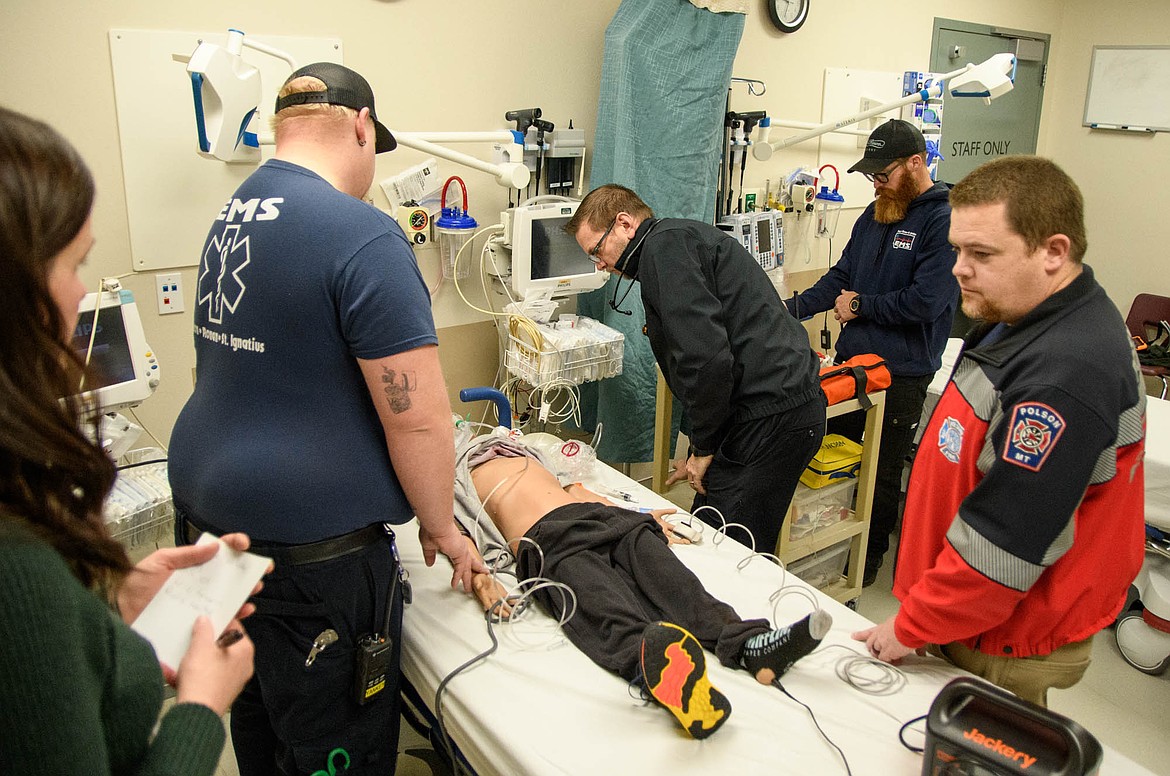
The Advanced Life Support team from Lake County EMS and Polson City Fire arrives on scene and records the patient’s vitals during the Sim Montana training on Jan. Tuesday, Jan. 6. (Emily Messer/Leader)
Emily Messer joined the Lake County Leader in July of 2025 after earning a B.A. degree in Journalism from the University of Montana. Emily grew up on a farm in the rolling hills of southeast Missouri and enjoys covering agriculture and conservation. She's lived in Montana since 2022 and honed her reporter craft with the UM J-School newspaper and internships with the RMEF Bugle Magazine and the Missoulian. At the Leader she covers the St. Ignatius Town Council, Polson City Commission and a variety of business, lifestyle and school news. Contact Emily Messer at [email protected] or 406.883.4343 | January 21, 2026 11:00 PM
Simulation in Motion Montana hosted a realistic training at St. Joseph Medical Center on Tuesday, Jan. 6. Multiple agencies were on hand to build connections, relationships and preparedness.
SIM-MT is a non-profit organization that offers educational simulations in rural areas to improve outcomes and build communication and connections to save lives. The organization is known for its high-fidelity manikins, which have interactive faces and voices, provide vitals and many other realistic aspects of a human patient.
SIM operation manager Maile Allzer and her colleague, simulation specialist Charity Stephens, brought their “Lamborghini manikin” to simulate a pediatric overdose. The manikin is an anatomically correct model of a 6- or 8-year-old male that can turn its head to follow voices, cry real tears, and have reactive eyes, among other features.
SIM Montana is primarily grant-funded, but it also receives donations for specific training. In some cases, medical facilities receive training funds and use it to bring in the organization. Montana Opioid Abatement Trust — which manages funds from settlements from pharmaceutical companies to support opioid remediation and education programs — funded this training due to Montana’s opioid crisis.
Allzer and Stephens set up a mock medical scenario in the emergency room with multiple agencies attending. The scene began when Ronan School District Resource Officer Brandon Gale found the “student” passed out in the restroom. Gale administered Narcan and CPR and then called it into dispatch.
Next, Lake County EMS was dispatched to the scene to provide Basic Life Support (BLS). They administered more Narcan, while Officer Gale showed them the pills he may have overdosed on. As the patient cried and came in and out of consciousness, they called for Advanced Life Support (ALS). In the background, Allzer controlled the manikin’s vitals, movements and reactions by computer as the medical teams worked.
The ALS team from Lake County EMS and Polson City Fire Department personnel recorded vitals and started “transport.” The team moved the patient out into the ER hallway, which was their “roadway” to the hospital.
The ER staff met them at the door, and quickly after, the patient was intubated. Hospital staff attended to the patient as the “mom” of the child arrived at the hospital. Stephen, playing the mother, threw herself into the scenario to recreate a confused and concerned parent.
As the “student” had a rapid heart rate and shallow breathing at the hospital, the staff consulted with the ER doctor who attended the simulation, and the patient was stabilized. After the simulation, Allzer and Stephens did a debrief with the team to identify what they did well and how they could improve.
“One of the things that we are most proud of is our ability to debrief groups. We find that is where all of the magic happens,” Allzer said in a later interview.
Allzer described it as a low-stress, non-judgmental environment where learning takes place. During this training, she broke down each step of the simulation and discussed what each group did to save the patient, along with how they worked together. Each person at the training was able to discuss what they did well and how they can improve in the future.
Allzer also noted that another benefit of this training is fostering connections between agencies. In the second training, she explained that the local school administration was able to connect with law enforcement and learn a new way to support each other.
“If we're able to help foster and create that space for them to make that connection, then we've accomplished our goal,” Allzer said.
Amber Dumont from Lake County EMS explained that this was a good opportunity to work with different departments and people she may not always see on scene. Dumont said it helps her remember what different structures or preferences a person has while on the job.
Officer Gale, who has administered Narcan many times in his career, said this training helps everyone be on the same page and ensures the student receives the best outcome.
ARTICLES BY EMILY MESSER

Polson commissioners hear plan for reducing E. coli in Flathead Lake
Representatives from the Flathead Lakers and the Polson Bay Golf Course presented a plan to the Polson City Commission last Wednesday to reduce stormwater runoff, which had caused increased levels of E. coli in Flathead Lake near Boettcher Park.
City Commission finalizes Salt Cafe grant, hears from market vendors
The Polson City Commission council chambers were full of support Monday night for Andrew Perkins, owner of Salt Cafe, who has been awaiting funding from the Tax Increment Finance District grant he received nearly three years ago.
Foundation established for Polson Police
A non-profit called the Polson Police Foundation was launched at the end of 2025 to support the department by contributing to training, officer wellness, critical equipment and community initiatives.