
Legislature seeks solutions on rising property insurance rates
JORDAN HANSEN Daily Montanan | Daily Inter-Lake | UPDATED 2 months, 1 week AGO
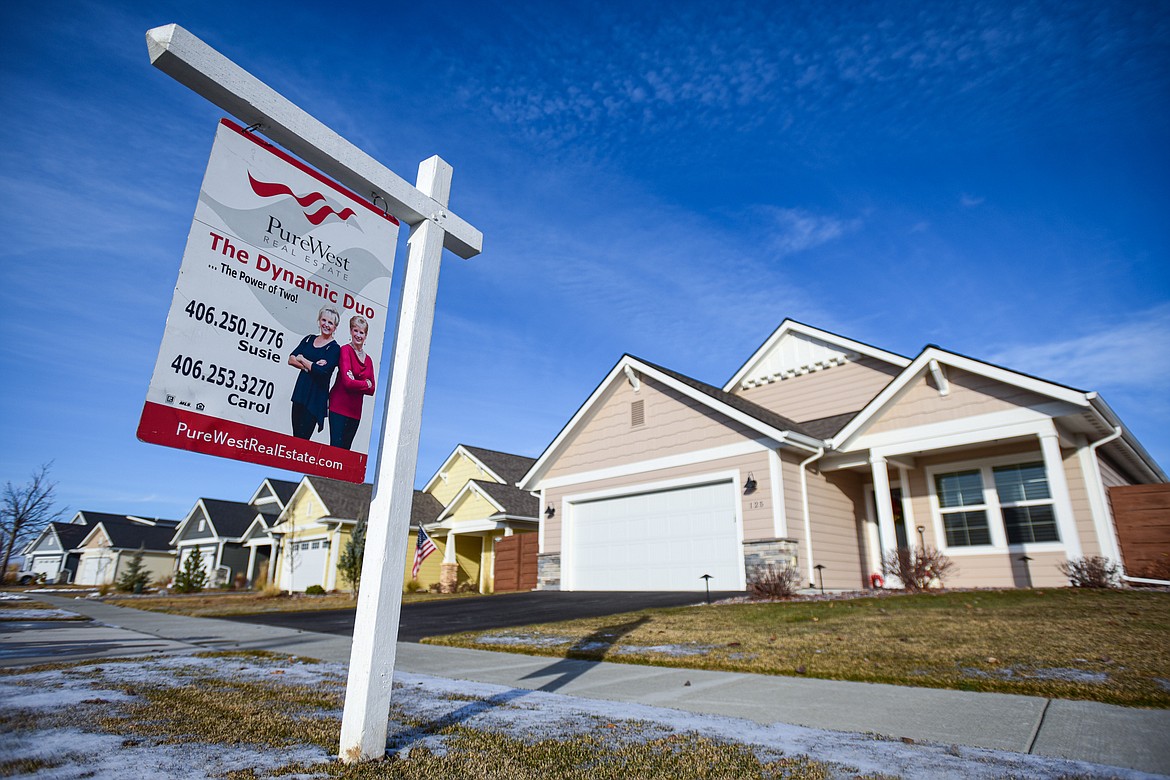
A home for sale in the Silverbrook Estates development in Kalispell on Friday, Dec. 15. (Casey Kreider/Daily Inter Lake)
Casey Kreider
Property insurance rates in Montana are increasing, advocates and insurance companies say, and the Legislature has been tasked to figure out why.
Passed during the 2025 legislative session, House Joint Resolution 61 requires a study of property insurance during the interim, and it was the highest ranked — or most important — study bill passed last session.
The Legislature’s Economic Affairs Interim committee, helmed by House Speaker Rep. Brandon Ler, has picked up the study. And on Tuesday, they heard from a panel that included insurance lobbyists, consumer advocates and research organizations including Headwaters Economics.
Insurance lobbyists said extreme weather, “legal system abuse,” a rise in building costs and regulatory overreach are all problems.
Insurance companies said they’re also paying out more than what they bring in and there’s concern about driving away providers.
Ler brought up cost shifting, a term also brought up repeatedly in the property tax discussions that dominated the final weeks of the last legislative session.
“If it gets cheaper for one party, it’s probably going to get more expensive for another and so, you know, the full solution is not just to pick a select group of insured and do something to make their policies cheaper,” Ler told the committee. “We’ve got a much bigger problem than that, and absolutely agree with that. Another thing, it’s already been stated that there is, you know, fewer and fewer insurance companies actually coming into the marketplace. We do not want to drive any of these last remaining insurance companies out.”
Consumer advocates, meanwhile, have expressed concern with the lack of data around rises in rates, nonrenewals of insurance policies and higher costs associated with lower credit scores.
“We need more data, and we need more accurate data, and it’s not just an issue in Montana, but across the country,” said Michael DeLong, who represented the Consumer Federation on the panel. “We’ve heard, there are a lot of anecdotes and stories, you’ve probably heard from people about rising insurance premiums, companies refusing to renew their policies, people cutting back and trying to hollow out policies, stronger, more frequent natural disasters, but there’s a lack of like, concrete information on what, exactly how bad the problem is, how much prices are going up.”
According to the Consumer Federation of America, average insurance premiums for a typical homeowner in Montana increased by about 10% from 2021 to 2024. Nationwide, the typical homeowner saw their property insurance premium increase by nearly $650 in that time period.
There has been one recent, major federal study into the issue, consolidated into a report that looked at rises in insurance rates between 2018-2022, using data obtained from the states. Some states, including Montana, did not submit data to this report.
DeLong went on to say there was a brief skirmish between the Treasury Department and the National Association of Insurance Commissioners, though the NAIC — which is made up of the elected and appointed insurance commissioners across the country — eventually came on board.
The state is also planning to participate in the next NAIC data call, but data from that likely won’t be usable until June, said Trevor Graff, the director of government relations with the Securities and Insurance office.
“I’m hoping we can focus on the fact that we are participating in the data call, and we will mitigate the prior administration’s non-participation in that action,” Graff said.
Wildfires are also a continual concern and according to the National Association of Mutual Insurance Companies, the number of billion-dollar disasters is expected to increase by about 50% by the end of the decade. Montana has been impacted by at least one billion-dollar disaster annually.
“By the end of this decade, it is likely Montana will have experienced 16 or more billion-dollar disasters in just 10 years,” a presentation during Tuesday’s committee meeting stated.
Fires and what to do about them have been a long-running discussion and late last year one of the panelists, Kimi Barrett, a lead wildfire research and policy analyst at Headwaters Economics, helped author a report on the issue.
“If the homes are part of this problem, they must fundamentally be part of the solution, and in the most simplest form, by reducing risk proactively, before the wildfire becomes the disaster is our best chance at long term insurance retainment,” Barrett said Tuesday.
Ler, who spent time working fires with the Department of Natural Resources and Conservation and then more than a decade as a volunteer firefighter, said it’s a concern – and will take federal fire mitigation action. Exactly what type of (and how much) mitigation is needed is a point of contention among some environmentalists, with some researchers saying the forests are not as overgrown as many think.
Even so, there has been a push to do more mitigation work, which can be expensive.
“For us to see real reduction and real risk reduction in the state of Montana, we have to charge the federal government with actually taking care of the lands that they, in a sense, own or have control over, because without that, we’re never going to see a real reduction,” Ler said. “We can have all the mitigation plans in place on your private property, but when you have a fire coming down at you at 60 mph, there’s absolutely nothing you can do, and the houses are going to burn just the same.”