
Record-breaking precipitation kicks off "deceptively positive" water year
USDA Natural Resources Conservation Service | Lake County Leader | UPDATED 1 day, 6 hours AGO
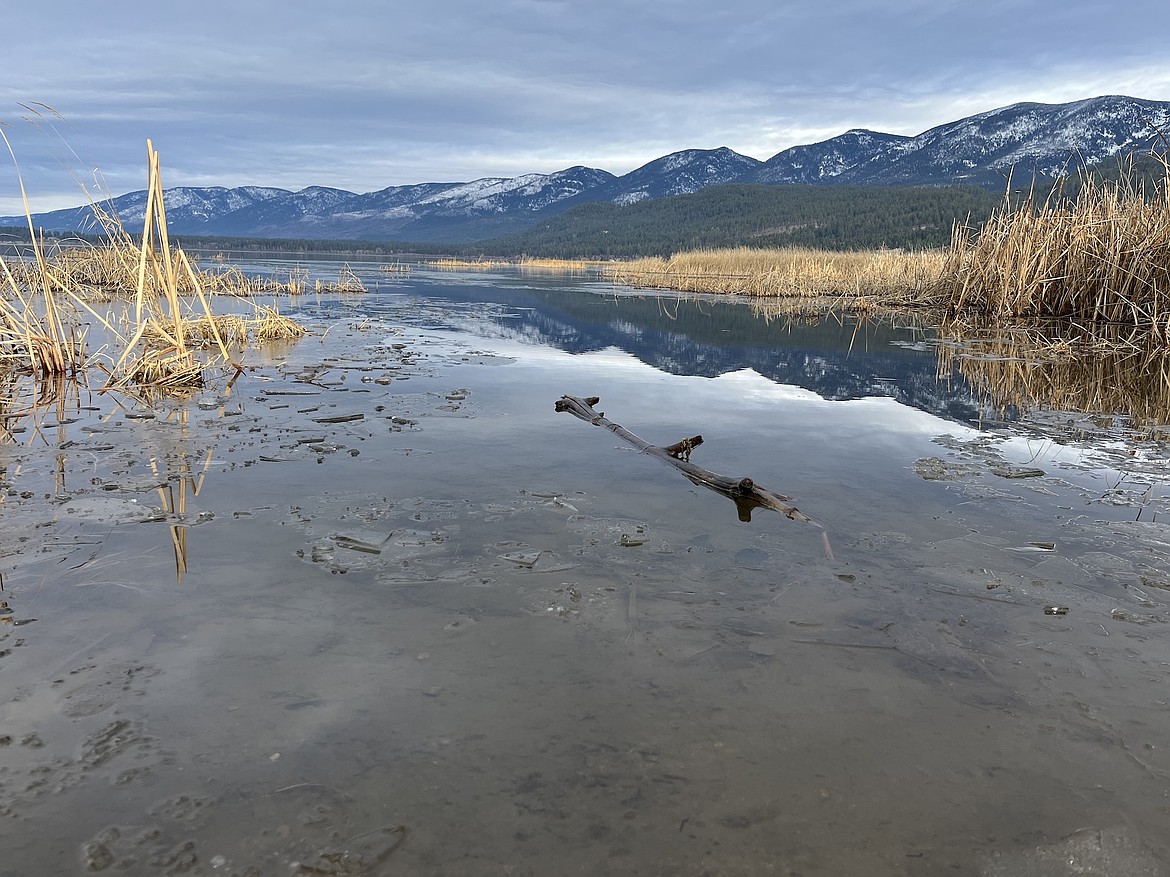
Although December brought record-breaking precipitation to Montana, January has been less generous so far, as shown by the sparsely covered Missions, north of Polson. (Kristi Niemeyer/Leader)
Montana’s snowpack accumulation season began with a stark elevational contrast. At lower elevations, winter started slowly, with warm temperatures and most precipitation falling as rain. At higher elevations, abundant precipitation accumulated as snow despite above average temperatures.
“Statewide, snow water equivalent (SWE) is looking deceptively positive,” said Florence Miller, USDA Natural Resources Conservation Service (NRCS) hydrologist.
Snowpack is near to above normal across most of the state. Most major basins have 90-100% of median SWE, with some higher elevation drainages in the northwest, Yellowstone and Bighorn basins reaching 110-120% of median.
The Powder, Tongue, and Lower Clark Fork basins have lagged behind on snowpack accumulation and are reporting 70-90% of median SWE. Lower elevation snow monitoring stations are generally reporting less than 80% of median SWE, around a one- to three-inch deficit.
Upper elevation stations are faring better, reporting 100-150% of median SWE, a three- to seven-inch surplus for Jan. 1.
“Lower elevation deficits could catch up in a few storms, similarly the higher elevation surplus could dwindle with a dry January. Mid-to-high elevation snowpack is the main contributor to summer streamflow,” explains Miller.
She noted that it’s still early in the season for snowpack accumulation and that conditions can change significantly.
“Summer streamflow will depend on how the rest of the winter and spring unfold,” she added. “For now, the snowpack in the mountains is on track, despite the unseasonable absence of snow in the valleys.”
According to Miller, December delivered record-breaking precipitation. Of the 96 SNOTEL stations within the state of Montana, 70 recorded their highest or second highest December precipitation on record.
Poorman Creek SNOTEL in the Cabinet Mountains, recorded its highest precipitation on record (28 years), totaling 46.3 inches since October, over half of the median annual precipitation of 75.5 inches. In December alone, the site recorded 22.8 inches of precipitation.
Statewide, December precipitation ranged from 170-300% of median. The atmospheric river that flowed across the state brought rain to many lower and mid-elevation SNOTEL sites, spurring unseasonable snowmelt and elevating river levels, contributing to the historic flooding near Libby.
Warm temperatures and heavy precipitation consolidated the snowpack in a manner normally reserved for spring snowmelt. Snowpack density is high across the state, resulting in lower snow depths than usual for the current SWE.
Water-year-to-date precipitation is above normal statewide, around 115-150% of median. The abundant precipitation has helped soil moisture and drought conditions statewide. Soil moisture across much of the state exceeds the 70th-90th percentile, though some pockets of below-normal soil moisture remain in central and southwest Montana.
Drought conditions have improved, with around 51% of the state experiencing abnormally dry to extreme drought conditions. This is a significant decrease from the start of the water year, where 78% of the state was experiencing drought conditions, and one year ago where 93% of the state was experiencing drought conditions.
Despite these improvements, mountain snowpack and water-year precipitation remain the primary drivers of runoff and summer streamflow.
A full report of conditions can be found in the monthly Water Supply Outlook Report available on the Montana Snow Survey website. In addition, real-time snow survey data can be found at nrcs.usda.gov/montana/snow-survey.