
Spring water forecast uneven, drought continues
CHERYL SCHWEIZER | Hagadone News Network | UPDATED 7 months, 1 week AGO
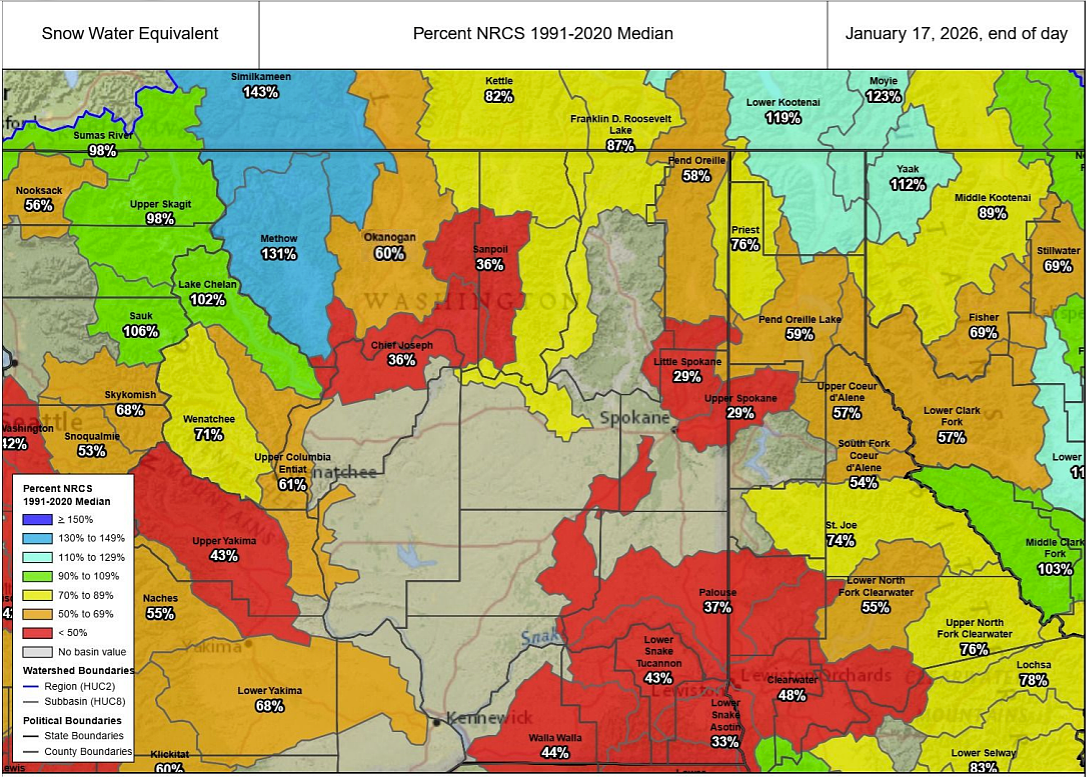
A lot of moisture in late 2025 hasn’t translated into an adequate snowpack for spring 2026, at least not as of mid-January.
SOURCE: NATIONAL WEATHER SERVICE
Senior Reporter Cheryl Schweizer is a journalist with more than 30 years of experience serving small communities in the Pacific Northwest. She began her post-high-school education at Treasure Valley Community College and enerned her journalism degree at Oregon State University. After working for multiple publications, she has settled down at the Columbia Basin Herald and has been a staple of the newsroom for more than a decade. Schweizer’s dedication to her communities and profession has earned her the nickname “The Baroness of Bylines.” She covers a variety of beats including health, business and various municipalities. | January 26, 2026 3:19 AM
SPOKANE — Warmer than normal temperatures in December and January may have consequences next spring with lower than normal runoff.
Joey Clevenger, meteorologist with the National Weather Service office in Spokane, said there’s been plenty of precipitation in the Pacific Northwest, but it’s not been falling as snow. Water levels in the snowpack are measured as a “snow water equivalent,” and in a lot of Central and Eastern Washington, that’s low.
“Outside of the mountains, we’re struggling to reach 50% for most of the area,” Clevenger said.
How much snow is in the mountains is less important than the amount of water it will produce when it melts, which is the snow water equivalent. The Upper Methow Valley is a 131% of normal snowpack, measured over the period from 1991 to 2020. The Lake Chelan drainage is at 102% of normal as of Jan. 17.
But at lower elevations in Okanogan County, running from Pateros north to Omak, the snow water equivalent is at 36% of normal. The area that feeds Lake Roosevelt is at 87% of normal, according to the NWS, but the Yakima River basin ranges from 68% to 43% of normal.
Clevenger said precipitation wasn’t the problem through the end of 2025.
“We were running about normal until the first of January, but we’ve been running dry since then,” he said.
The problem was warmer air coming into the region from the south.
“For pretty much most of the season, we’ve been under a tropical flow,” he said. “It just hasn’t been cold enough.”
Colder air has flowed into the region in January, but it brought drier air with it, he said.
“We haven’t gotten the cold air and moisture at the same time,” Clevenger said.
The mismatch between temperature and moisture extends through the entire region, Clevenger said, with snow water equivalent levels lower than normal in Oregon and Western Montana as well.
“The outlook is pretty bleak across the whole board,” he said.
Low temperatures dipped into the low 20s and high teens over the weekend as cold air came into the region — but while it was cold, it was dry.
“We’re right on the edge of that big storm that’s affecting the East Coast,” Clevenger said, but the snow and freezing rain associated with that storm all fell to the east.
The weather outlook remains cold and dry through the next couple of weeks, he said, but the extended forecast for February includes a chance of lower temperatures and normal to above normal precipitation.
ARTICLES BY CHERYL SCHWEIZER
Road projects on hold for Labor Day weekend
MOSES LAKE — With Labor Day weekend dead ahead, drivers will be able to move freely about the state. Most road projects are on hold for the holiday weekend. Nobody will be working on the Hansen Road overpass on Interstate 90, but the lane restrictions that are in effect will continue through the end of the project.
Cost estimates for water source alternatives given to Moses Lake City Council
Protected under the U.S. Endangered Species Act, efforts are ongoing to keep it self-sufficient
MOSES LAKE — It’s going to cost a lot of money to provide alternative water sources for the city of Moses Lake, but some of the possible alternatives will cost more than others. City officials provided the Moses Lake City Council with costs for various alternatives Tuesday.

Dryer vent cleaning is important -- but often overlooked
MOSES LAKE — Not all the maintenance a house needs is visible. Sometimes a potential problem just goes unnoticed until it causes trouble, sometimes serious trouble. But a lot of potential problems give off warning signs. Clothes dryers often do when they need a good cleaning.