
FEB NIBJ: Laurin Scarcello, a farmer concerned about the future
NOAH HARRIS | Hagadone News Network | UPDATED 2 months AGO
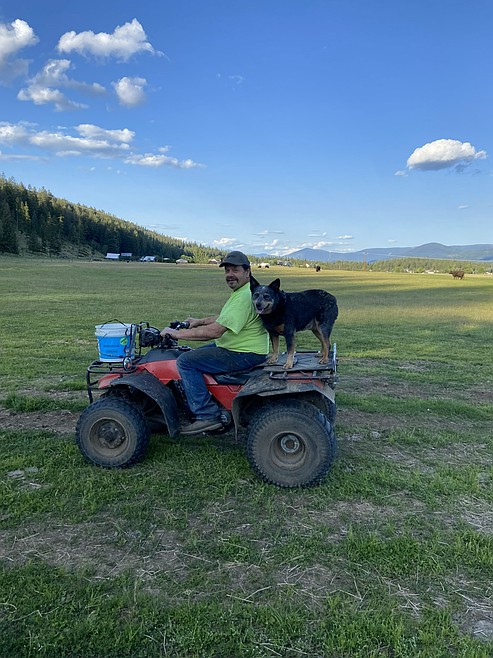
Laurin Scarcello on a tractor with his dog Scooter.
(Courtesy Photo)
Farming is in Laurin Scarcello’s blood. He lives and works on a ranch in Kootenai County that has been in his family since 1910. He has four sons and a daughter, who help him on the farm when they can.
“We have a family ranch in the Twin Lakes area,” Scarcello said. “That puts us at about 150 acres of madness, so to speak. It's enough to keep a fellow busy.”
Scarcello is very involved in the farming community in North Idaho. He serves on several boards for farming in the region, including the Boundary County–Shoshone Farm Bureau Board. He is also the current chair of the Kootenai–Shoshone Soil and Water Conservation District.
He said farming is much more difficult now than in previous generations.
“Our grandfathers and fathers could basically expand their holdings, buy that parcel next to them,” Scarcello said. “Now with the development and growth, expansion is not an option. Things are expensive.”
According to an article from the University of Illinois, the price of new agricultural equipment increased by more than 20% between 2021 and 2023.
Scarcello proposed an option that would allow both farmers and nature to benefit.
“We should be able to sign up land on the basis of short-term easements and pay landowners an ecological lease for the services they provide — airshed, viewshed and watershed — to preserve open space,” he said. “At the end of that 10-year lease, if the landowner and the community agree, there should be an incentive to renew. At the same time, if a city is expanding or a highway needs to be built, the land would not be permanently locked up and could be available for a school, fire station or highway if needed.”
Farmland has become increasingly expensive. In 2022, the average value of cropland was $5,050 per acre, a 14.3% increase compared to 2021, according to a USDA land survey. In 2025, the value rose to $5,830 per acre.
Scarcello said buying or leasing land is necessary for farmers to survive as costs continue to rise.
"To operate at a degree of scale that requires expensive machinery and more labor costs money, which makes it a kind of catch-22,” Scarcello said.
“I’m 67 years old. There was a 200-acre parcel that we leased for pasture that bordered our eastern border and, in a perfect world, I should have bought that to expand our operation. But when that land sells for millions of dollars — and I am talking millions — there is no way to pay for that with cattle.”
Scarcello expressed concern about the future of America’s farmers, whose average age is 58.
“We have the oldest workforce of any industry in the nation and because of that, two-thirds of America’s farmland will transition in the next 15 years,” he said. “But if you can’t realistically make a living wage, where’s the incentive for the next generation? It is the best lifestyle, bar none. It’s the hardest way to make a living that I have ever encountered.”
Currently, farmers can be paid through the Conservation Reserve Program, which encourages farmers to convert highly erodible and other environmentally sensitive acreage to vegetative cover, such as native grasses, trees and riparian buffers. However, the program does not include payments for land that is being farmed.
“I'll work until I die because I enjoy it,” Scarcello said. “At least I tell myself I do. But if I had a son walk up to me and he said, ‘Dad, I want to do this when you’re done,’ I don't see how he's going to do that without another revenue stream.”
“North Idaho is a great place to live,” Scarcello said. “It is a hard place to make a living and that never changes.”
ARTICLES BY NOAH HARRIS

Bill amended to let Canadian flag to fly

PREP BASEBALL: Bonners Ferry battles in 10-0 losses to Lakeside