
Echoes of the 1926 wildfire season, a century later
HAILEY SMALLEY | Hagadone News Network | UPDATED 3 months, 2 weeks AGO
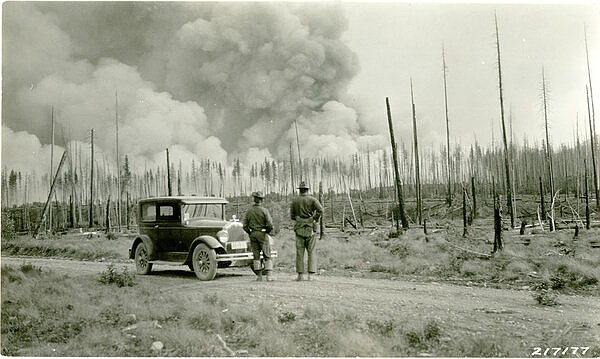
The Hay Creek Fire of 1926 burns in the Moose Creek drainage of the Flathead National Forest in Montana. (Archives & Special Collections, Mansfield Library, University of Montana)
An uneasy quiet settled over Superior, Montana on the night of July 17, 1926. Wind that had gusted throughout the afternoon suddenly calmed, leaving only the crackling of embers to fill the silence.
Several locals stood guard over the flames, which had burst to life just that afternoon from an errant campfire. A ragtag force of 250 men and women managed to stall the blaze on a hillside about a hundred feet southwest of town.
In the deepening twilight, the flaming hillock lay “like a wounded beast — apparently ready without warning to attack again,” wrote a reporter for the Daily Missoulian.
It was a hard-won battle in what would soon prove to be one of the worst wildfire seasons ever recorded in the inland Pacific Northwest.
More than 1,311 fires sparked in July and August of 1926, scorching about 325,000 acres across 13 national forests — the Bitterroot, Blackfeet, Cabinet, Clearwater, Coeur d’Alene, Flathead, Kaniksu, Kootenai, Lolo, Missoula, Nez Perce, Pend Oreille and St. Joe. Another 70,000 acres of private and state forestlands burned, and fires spread across about 50,000 acres in Glacier National Park.
A fire near McDonald Lodge in Glacier National Park temporarily shuttered the park’s western entrance for a few days. Another blaze razed the logging town of Stryker, leaving only the train depot and the telegraph operator’s office standing.
“It is a game of tag with the fires having the better of the argument,” read an Aug. 6, 1926, article in the Whitefish Pilot. “Everything that can be done is being done, but forestry officials fear that unless the break comes just right, the condition will grow worse until rain comes.”
By the time the rain finally fell in early September, the regional Forest Service had spent about $1.25 million on fire suppression — the equivalent of more than $23 million today.
It was the worst fire season the region had seen since the devastating “Big Blowup” in 1910, wrote Glacier National Park Superintendent Charles Kraebel in his annual report. He attributed the destruction to weather that was “not only unusual but phenomenally so.”
Spring-like temperatures during the winter of 1925 and 1926 left the valley bottoms bereft of snow by late March. The warm weather continued into summer, often accompanied by what Kraebel characterized as “unprecedented winds.”
That depiction may sound familiar to present-day residents. A similar bout of warm winter weather passed through western Montana and northern Idaho this winter, resulting in little snowpack accumulation at lower elevations and bleak hydrological forecasts for many basins. The dry conditions led the National Interagency Coordination Center to predict an above average risk of extreme wildfire in eastern Washington, northern Idaho and parts of western Montana for July and August of 2026.
“It really comes down to depleted snowpack,” said Alex Lukinbeal, a meteorologist for the National Weather Service in Missoula, of the current forecast. “The snowpack has really melted out earlier than normal for a lot of areas, especially in the West, and that’s just due to the really warm winter that we had.”
Warm winters with low snowpack are typical of El Nino years like 1926 and 2026. High temperatures often continue into the summer months, and the extra heat in the atmosphere may also lead to more extreme storms. That means both more potential for rainfall during the wildfire season and an increased risk of lightning strikes that can spark forest fires.
Even with the best forecasting technology available, the onset of a particularly bad fire season is, more often than not, a product of chance.
As towns and cities expand across the West, more people are living in wildfire-prone areas than ever before. There are far more homes, roads and lives at risk than there were in 1926, but agencies like the Forest Service are also far better equipped to protect nearby infrastructure than they were in the past.
One of the greatest challenges the Forest Service faced in combatting the 1926 fires was manpower. About 2,000 wildland firefighters had been hired onto national forests in western Montana and northern Idaho by July 10, 1926, according to the Daily Missoulian. By August, the paper reported that “the state literally is being scoured for men to fight fires.”
The situation became so dire, soldiers were called up to the fire lines from Fort Missoula and the Forest Service increased starting pay from 25 to 40 cents an hour, in an effort to entice more men to join crews in the northwestern forests.
At the height of the 1926 fire season, about 4,000 men were actively employed digging fire lines, evacuating homesteads and dosing flames in the northern forests at any given time, according to an October 1926 bulletin from the Forest Service.
As of June 2026, the Forest Service has hired 1,438 firefighting personnel for the Northern Rockies Region, which includes Montana, North Dakota and northern Idaho. Fewer staff isn’t necessarily a harbinger of doom; better technology and equipment means smaller crews are able to more effectively combat wildfire. Staff and resources are readily shared across regions and jurisdictions, making up for gaps in particularly hard-hit areas.
In total, 11,553 firefighting personnel are on the Forest Service’s payroll for June 2026 — a 6.4% increase from this time last year and a 13.5% increase from June 2022.
Firefighting equipment has also evolved over the past century, allowing smaller crews to combat wildfires more efficiently. A few flyovers were conducted during the 1926 fire season, but the Forest Service lacked its own aviation division until 1928. Aerial fire retardants were not commonly deployed until the 1950s. Other equipment, from vehicles to hoses to protective gear, have similarly evolved along with land managers’ understanding of fire science.
ARTICLES BY HAILEY SMALLEY

Trump stumps for Flint in Kalispell as Election Day nears
President Donald Trump, wearing a dark suit, red tie and red USA cap, ambled into the Majestic Valley Arena to the raucous roar of a crowd.
Flathead National Forest greenlights Swan Valley timber project
A 2,307-acre timber project is now under way in the Swan Valley.
Flathead National Forest greenlights Swan Valley timber project
A 2,307-acre timber project is now under way in the Swan Valley.