
Drought prospects looking dire this year, experts say
JOEL MARTIN | Hagadone News Network | UPDATED 3 months, 1 week AGO
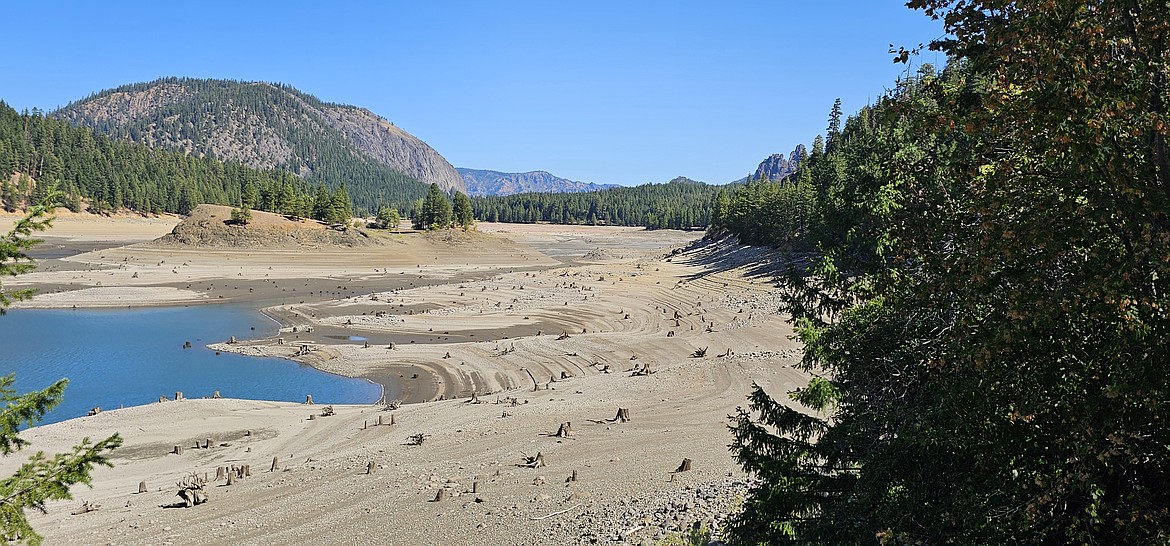
Drought conditions leave Rimrock Lake, a Cascades reservoir, nearly dry in 2025. Warm temperatures over the winter led to a scant snowpack in the Cascades and Rockies, which in turn will lead to an even more severe drought this summer, according to the experts. (Washington State Department of Ecology photo)
Joel Martin has been with the Columbia Basin Herald for more than 25 years in a variety of roles and is the most-tenured employee in the building. Martin is a married father of eight and enjoys spending time with his children and his wife, Christina. He is passionate about the paper’s mission of informing the people of the Columbia Basin because he knows it is important to record the history of the communities the publication serves. | July 10, 2026 12:00 AM
The question isn’t whether we’ll have a drought in the Inland Northwest this summer, according to regional experts. It’s just a question of how bad it will get.
“For the last, about two years, we've had extremely high temperatures compared to a normal two-year period,” said Idaho State Climatologist Russell Qualls.
Those temperatures have been above the 98th percentile, Qualls explained, meaning that temperatures in the last two years have been hotter than 98% of previous two-year periods.
“That can lead to a multi-year drought situation,” Qualls said.
The same thing applies to Washington, said Washington State Climatologist Karin Bumbaco.
“This year was unusual in that … our temperatures were so warm, it was the third-warmest December on record averaged over Washington state,” Bumbaco said.
The snowpack in the Rockies and the Cascades has been unusually scant, both Qualls and Bumbaco said. The problem isn’t so much that there was a lack of precipitation; Washington, Idaho and Montana were all drenched in rain in December 2025. The problem is that precipitation wasn’t staying in the mountains as snow, instead rolling down and flooding the lower elevations.
“The highest elevations did OK,” Qualls said.” They were cool enough that a fair amount of snow accumulated, but those locations were elevations above about 7,500 feet.”
A few parts of the North Cascades also retained a good bit of snow, Bumbaco said.
Some of Montana fared better than the rest of the Northwest in terms of snowpack, said LeeAnn Allegretto, a hydrologist with the National Weather Service stationed in Missoula.
“In western Montana, we’ve had the most snow this winter compared to Washington, Oregon and Idaho,” Allegretto said. “Our deficit was not as great as the other (states), and we did OK with soil moisture. So, we’re sitting pretty good west of the (Continental) Divide. But then you get down into the Beaverhead (in southwestern Montana) and into north central Montana, and it’s pretty bad.”
Those areas missed out on the atmospheric river that brought heavy rainfall farther west, Allegretto said, so the soil moisture is poor as well. In addition, western Montana has had a wetter spring than some other areas because of cool air coming down out of Canada.
“Unfortunately, eastern Montana did not,” Allegretto said.” Portions of Idaho and Washington also did not, and those are the areas that have the worst drought conditions currently.”
The snowpack in British Columbia was still healthy, Bumbaco said. For that reason, the Columbia River is likely to have a normal water supply, and that means irrigators in the Columbia Basin Project won’t have to worry about running dry come summer. The Yakima Valley and other regions that rely on water from the Cascades won’t be so fortunate, especially those growers who hold junior, or lower-precedence, water rights.
“This is the fourth consecutive year that they’ve had drought issues, and their junior water users are expected to only receive about half of their normal water allotments,” Bumbaco said. “I would expect to see more drought impacts there.”
A drought isn’t just a one-time thing, Qualls and Allegretto said. When one dry year is followed by another and then another, the effects multiply.
“In Montana and portions of Idaho, we have seen a three-year compounded drought problem,” Allegretto said. “It doesn't help that we had a winter that had such below-normal values for snow. Some places just didn't make up any ground over this winter, so it's just compounded even further on the preexisting drought conditions that were there”
Those effects ripple out into many areas of the environment and the economy,” Qualls said.
“When you have drought years stacked one after another, each successive drought summer things are worse than if we just had that one drought year isolated by itself,” he said. “Each year the starting point for soil moisture and stream flow is a little bit lower for farming. The soil doesn't get replenished as much, so you begin each year with a little bit more of a deficit. (That creates) other ecological impacts: when you have less snowpack, you get stream temperatures warming, which affects fish species that rely on very cold stream temperatures.
“It affects rafting; the big flows come out in March or a little bit later (when) not many people are rafting, so if you're at historic lows by May or a little bit later, that's really going to impact the recreation industry.”
Don’t expect the situation to improve in the coming years, the experts said.
“What we've seen over the last roughly 20 years is a gradual trend of warming,” Qualls said. “That doesn't mean that every single year is warmer than the previous year, because there are fluctuations, but the general trend (is that) the temperatures have been warming.”
“It's certainly expected with our climate change projections that the way that drought develops this year, where we had normal winter precipitation but below normal snowpack, that is really the key of what we expect to see more of in the future,” Bambuco said. “Our Cascade Mountains aren't going to get any taller, temperatures (will be) warm (and) we're going to see more rain. (That means) more flooding in the winter, and then less snow, so then less water when we need it in the spring and summer.”
ARTICLES BY JOEL MARTIN
Endless battle
Noxious Weed Control Board works to keep invasive plants under control
MOSES LAKE — Some of the nastiest plants in Grant County were the topic of a class led by Jay Johnson, a consultant with the Grant County Noxious Weed Control Board, Tuesday. The Noxious Weed Control Board, as its name would suggest, is tasked with keeping weeds under control in Grant County. That’s not a small job; the board’s website lists 129 species of noxious weeds that are found around Grant County. A noxious weed is defined as an invasive, non-native plant that threatens agricultural crops, local ecosystems or fish and wildlife habitat, according to the Noxious Weed Control Board. Washington state law requires that these weeds be identified and their spread kept to a minimum, if not completely eradicated. “We’re one of those agencies a lot of people don’t really understand,” Johnson said. “We’re a county office and … our funding is tax-based assessment. When you get your tax bill and you look down at all the expenses that you pay for, there we are.”

BASIN EVENTS: Oct. 16-24
COLUMBIA BASIN — Whether you feel like shopping, crafting, learning or seeing a show, there’s something happening for you this week in the Basin. Oct. 16 ‘My Family (Mi Familia)’ screening Spanning three generations, “My Family (Mi Familia)” is a heartfelt drama that follows the Sánchez family as they build their lives in East Los Angeles. Through love, hardship, triumph, and sacrifice, the film explores the immigrant experience, the strength of family bonds, and the traditions that connect one generation to the next. Lowrider show and taco truck before the screening. Sponsored by Columbia Basin Allied Arts, EDUBS C/S and the Moses Lake Creative District. $12 per person. Doors open at 6 p.m., film begins at 7 p.m. at the Moses Lake Civic Center Auditorium, 401 S. Balsam St. Tickets and info: www.cba-arts.org.
Moses Lake author encourages women to look beyond church culture norms
MOSES LAKE — A Moses Lake author’s book, “A Christian Woman Striving to Live Her Faith in a Man-Controlled World,” takes aim at the role to which many churches relegate the female half of their congregations. “It’s to encourage women in the faith,” Linda Curran said. “A lot of churches say, ‘Teach Sunday school, do this, do that, but don’t (evangelize.)’" In her book, Curran recounts a time when she moved to a new community and joined a church there. She was surprised to learn that, as a new female member, she had been automatically assigned church cleaning duties. When she questioned it, she wrote, she was met with condescension and her objections were brushed aside. In other churches, she said, women who were capable of teaching were relegated to “women’s ministry.”