
Gone in a blink: On moose watch in Glacier Park
CHRIS PETERSON | Hagadone News Network | UPDATED 3 months, 3 weeks AGO
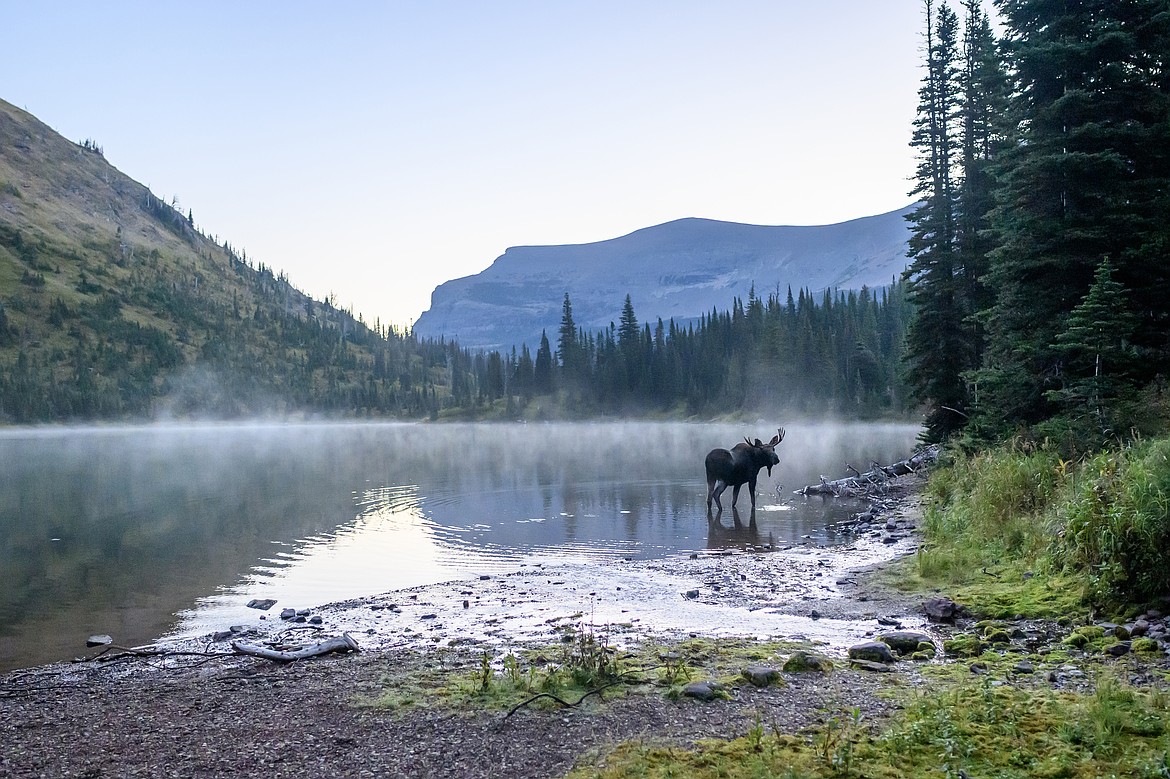
A moose in a high country lake at dawn.
Chris Peterson is the editor of the Hungry Horse News. He covers Columbia Falls, the Canyon, Glacier National Park and the Bob Marshall Wilderness. All told, about 4 million acres of the best parts of the planet. He can be reached at [email protected] or 406-892-2151. | July 16, 2026 12:00 AM
The big black back moved through the brilliant fall brush and I thought to myself, “My God, that’s the biggest grizzly bear I have ever seen.”
I started to quickly back up.
Then the antlers and a wary eye poked over the brush. He took a few more steps and was gone.
It was a bull moose. They also deserve plenty of space. Bull moose have been known to stomp people and pets to death, but at least they don’t have teeth and claws, at least not the sort of teeth designed to sink into flesh.
I watched the moose munch of the brush from a safe distance and then he took a few more steps and was gone.
Moose have a coat of hair that’s dark brown to black; large overhanging snout; pendant "bell" under throat and bulls have antlers that are massive and flat. They have short tails and according to the Montana Natural History Field Guide, Montana bulls (largest antlered animals in the world) weigh 800 to 1,200 pounds; while cows 600 to 800 pounds.
They’re usually solitary but may congregate during rut or on excellent winter range. The moose is made for water and snow, with long legs. In the open water season, they feed on bottom vegetation and may submerge for 3 to 4 minutes, or swim for miles.
Cows are very protective of calves and will charge with little warning, particularly if a person is walking a dog.
Western Montana’s moose are of the Shiras variety, and their antlers, while still large, don’t get as big as their Alaska cousins.
The moose was first described by Carl Linnaeus in 1758, from a specimen obtained in Sweden. (Moose are circumpolar ranging across the northern reaches of Europe to China and Russia).
Moose overheat easily, which has probably limited their southern range. In the winter months they eat shrubs like willow and red osier dogwood as well as trees like subalpine fir.
They mate in the fall and cows have their calf or calves (twins are not uncommon) in the spring. According to “Mammals of Montana” a calf moose can gain 2.2 pounds per day.
Moose are more common on the east side of Glacier National Park, or at least easier to view. They particularly like feeding in the park’s east side lakes in the summer months. They are also known to frequent the North Fork and the McDonald Valley, but are seen less often, as the region is deeply wooded, with plenty of places for even an animal as a big as a moose to hide.
Like the bull moose on that autumn day, they seem to disappear into the ether in just a few steps.
ARTICLES BY CHRIS PETERSON

For Nelson, computers and music merge
Adam Nelson has been playing music and tinkering with computers since he was a kid growing up in Columbia Falls.
Community could see reparations from CFAC pollution impacts
Reparations from the Columbia Falls Aluminum Co. plant’s past pollution could help Columbia Falls with projects like upgrading water lines, but it will likely be years before the city, or any other stakeholder, sees any money.

Columbia Falls High offering online alternative
Kayden Gonzales can solve a Rubik’s cube in about 30 seconds. But sitting in a classroom really isn’t for the Columbia Falls senior. He already works four days a week and only needs a couple of classes to graduate.