
Teamwork helps state continue to thwart aquatic invaders
KRISTI NIEMEYER | Hagadone News Network | UPDATED 3 months, 1 week AGO
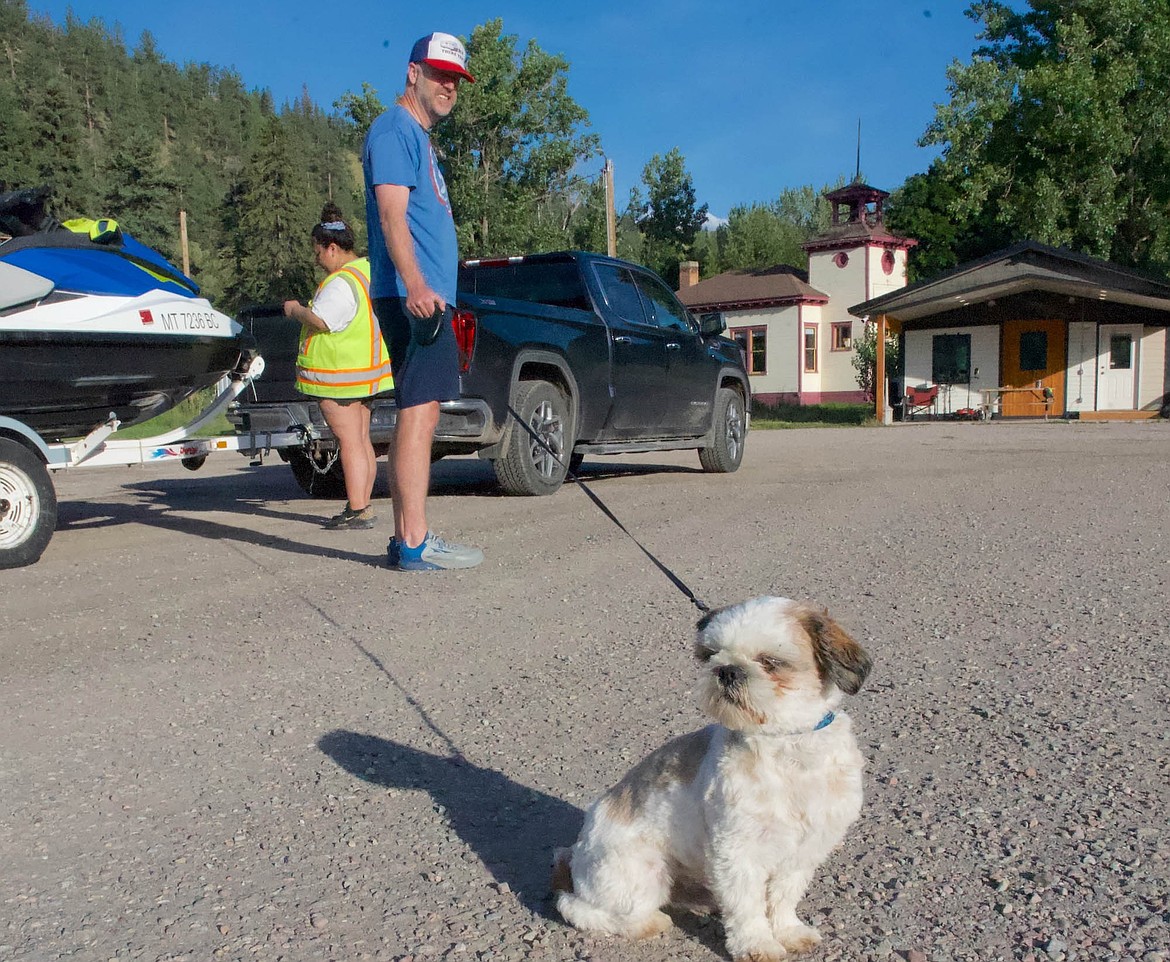
Helena resident Quinn Erwin and his sidekick, Vigo, stopped at the aquatic invasive species check station in Ravalli July 2, and received an "all clear" on two jet skis from Rozaline Alexander. The Confederated Salish and Kootenai Tribes employee said more than 300 watercraft owners stopped by on the Thursday prior to Independence Day. (Kristi Niemeyer/Leader)
Kristi Niemeyer learned her newspaper licks at weekly newspapers, beginning at the Mission Valley News in 1981, then at the helm of the Ronan Pioneer and, eventually, as co-editor of the Lake County Leader until 1993. She launched and co-published Lively Times, a statewide arts and entertainment monthly, before returning to the Leader in 2022, and serving as its editor until July 2026. Reach her at [email protected] | July 16, 2026 12:00 AM
“We gotta keep it protected,” said Quinn Erwin of Helena as he waited in line at the Aquatic Invasive Species (AIS) check station in Ravalli on July 2. He was on his way to Flathead Lake with two jet skis in tow.
“I've lived in Montana my whole life, and we spend a lot of time at Flathead,” he said, adding that he doesn’t mind stopping at AIS stations to have his watercraft checked for invaders such as mussels or Eurasian watermilfoil, especially if it helps protect the pristine waters of the big lake.
“This is not a big deal to me,” he said of the inspections. “Once you’ve been in that clean of water, you want to keep it that way.”
Rozaline Alexander, the Confederated Salish and Kootenai Tribes employee who checked his jet skis, said 309 boats had come through the station just that day, and two more pulled up as Erwin pulled out. That’s just a handful of the 5,671 inspections conducted by the Ravalli checkpoint as of Monday, July 13, according to the Montana Fish, Wildlife and Parks tracker.
As of Monday, 41,352 watercrafts had been inspected across Montana this season, with 6,700 conducted during the Fourth of July weekend – a jump of more than 1,000 over the same weekend in 2025.
In a recent social media post, the Flathead Lakers – a nonprofit organization dedicated to protecting the water quality of the lake and the basin that feeds it – noted that a Kalispell boat dealer alerted Fish, Wildlife and Parks after a wake boat with thousands of dead mussels arrived in his shop on June 30. The boat had been purchased in Minnesota and arrived in Montana in November, when check stations were closed.
At the Anaconda station on July 1, inspectors intercepted another wake boat from Minnesota, headed to Georgetown Lake. This one had hundreds of mussels attached to the trailer that were considered still viable, plus Eurasian watermilfoil.
The Ravalli station is among the busiest in Montana, second only to the station at Clearwater Junction, east of Missoula on Hwy. 200 – the gateway to a chain of lakes in the Swan Valley, as well as the popular Blackfoot River recreation corridor. Ravalli is also the only station open around the clock, seven days a week, from March 7 to Oct. 25.
So far this season, check stations have intercepted 18 mussel-fouled boats, eight of those in just the last two weeks. Of the 41,352 inspections tallied, nearly 8,700 were conducted on “high-risk boats,” or those coming from states with known AIS infestations, such as the Great Lakes and Colorado River Basin.
But the infestations keep spreading, with new mussel incursions reported in Saskatchewan, Oregon, North Dakota, South Dakota, North Texas and California.
Zebra and quagga mussels pose significant ecological and economic threats to Montana’s waterways by fouling boats and beaches, colonizing and restricting flows on water supply pipes and even altering the aquatic food chain.
Montana launched its AIS Early Detection and Monitoring Program in 2004, including its mandatory statewide watercraft inspection program. So far this season, more than 450 water samples have been processed, with no microscopic evidence of invasive mussels found in Montana’s waterways.
To keep the state’s waterways clean, the mantra is “clean, drain and dry” boats after leaving the water, and stop at check stations whenever bringing a watercraft across the border or over the Continental Divide, or putting a boat anywhere in Flathead Basin waters after launching elsewhere. Kayaks, canoes and paddleboards also need to be inspected.
The stakes are high. According to the Flathead Lakers, a mussel infestation in Flathead Lake would have cascading consequences: sharp shells blanketing beaches, foul odors from die-offs, clogged water infrastructure and declining fish populations. Overall, it would deal a serious blow to the tourism economy and lakeshore property values.
Once established, invasive mussels cannot be eradicated.
Flathead Lakers take targeted approach
The Flathead Lakers are doing their part too, by taking a new, targeted approach to AIS, supported with a grant from the Montana Department of Natural Resources and Conservation.
According to a recent press release, the Flathead Lakers are using state visitor data to identify recreational boaters and watercraft users who are most likely to accidentally introduce invasive species like zebra mussels, quagga mussels, and Eurasian watermilfoil into Montana's waterways and then reaching out to them directly before they arrive.
Under the grant, the Lakers are analyzing data collected by Montana Fish, Wildlife and Parks when visitors purchase AIS Prevention Passes and make campsite reservations at state parks. The Flathead Lakers are working to analyze that data using
By using geographic information systems (GIS) to map where repeat visitors live and comparing those locations to regions with known AIS infestations across the country, they identify "high-risk" watercraft users – people coming from areas where invasive species are already established in local waterways.
The Lakers staff then reaches out to those individuals with targeted messaging across multiple channels like social media, email, direct mail, radio and print to reinforce Montana's statewide "Clean, Drain, Dry" message and encourage watercraft inspection compliance before visitors launch watercraft on Montana lakes and rivers.
Coby Gierke, executive director of the Flathead Lakers, said the outreach effort is national in scope. The project's target communities span 13 states, including Minnesota, Michigan, Wisconsin, Ohio, Indiana, Illinois, Iowa, Texas, California and others – all areas with documented AIS infestations and significant populations of boaters who recreate in Montana.
To incentivize compliance, the Flathead Lakers are offering merchandise giveaways and complimentary one-year memberships to anyone who submits proof of having their watercraft inspected before launching in Montana.
"This is about being proactive," said Gierke. "Rather than waiting for an infestation to happen, we're using data to find the people who are most at risk of accidentally transporting invasive species and making sure they know what's at stake and what to do about it."
The project is a collaboration between the Flathead Lakers, Montana FWP and the University of Montana, with support letters from the Confederated Salish and Kootenai Tribes and the Flathead Lake Biological Station.
Findings from the project will be shared with FWP's AIS Prevention and Detection program to help strengthen statewide prevention strategies going forward.
For more information about AIS, visit flatheadlakers.org, fwp.mt.gov/conservation/aquatic-invasive-species or cskt.org/natural-resources/aquatic-invasive-species-program/.
ARTICLES BY KRISTI NIEMEYER

Polson Farmers Market takes break after productive season
“My body’s ready for a break, but it’s been a good year,” said Eric Gedenk between sales at the Ploughshare Farm stand. The organic farm in Moiese is a regular vendor at the Polson Farmers Market, which wrapped up for the season last Friday morning.

The Ripple Effect: Poolside party raises more than $20,000 for aquatic center
The Ripple Effect, a fundraiser for Mission Valley Aquatics and Fitness in Polson, drew nearly 200 supporters to the poolside Saturday night for games, drinks, appetizers and auctions.

Incumbent Shelly Fyant faces Republican Charles Headley in HD 91 race
Incumbent Democrat Shelly Fyant is running for a second term in the House of Representatives against Charles Headley.