
Feds propose rule shifting management of grizzly bears to states
MICAH DREW Daily Montanan | The Western News | UPDATED 11 hours, 22 minutes AGO
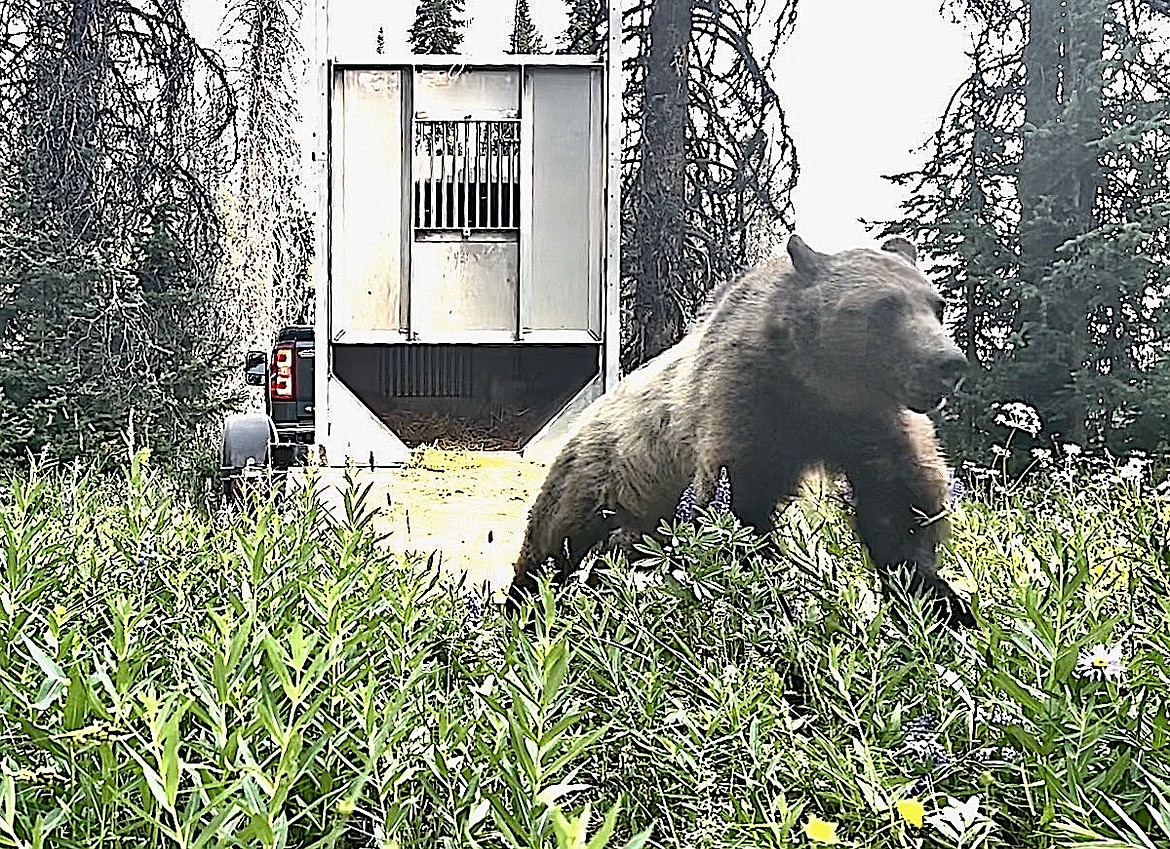
The female grizzly from Montana's Bob Marshall Wilderness was released in Wyoming during the summer of 2024. She emerged from her den recently with two cubs. (Montana Fish, Wildlife and Parks photo)
The federal government announced Tuesday that it is planning to shift management of grizzly bears in the contiguous U.S. to the states.
In a windy field south of Bozeman, Montana Gov. Greg Gianforte, flanked by Interior Secretary Doug Burgum, Idaho Gov. Brad Little and Wyoming Gov. Mark Gordon, praised the recovery of the species from a few hundred bears in 1975 to a population exceeding 2,000 along the Continental Divide. Gianforte said the species should be seen as a success, and that it calls for a new management framework.
“The goal of the Endangered Species Act is recovery. Today (Tuesday), that recovery is being recognized,” Gianforte, a Republican, said. “Recovery was never the end of the story, though, for this iconic species. The next chapter is about stewardship. State management does not mean the work is over. In many ways, it means the work becomes even more important.”
Many environmental groups criticized the rule as harmful to the species while the state’s all-Republican federal delegation gave unanimous support.
The proposed rule from the U.S. Fish and Wildlife Service does not remove the grizzly bear from the Endangered Species list (though it notes the agency is considering a separate determination related to the listing) or change geographic boundaries of the management plan.
Instead, it is the first step towards increasing state management of grizzly bears, Burgum said.
The change focuses on a set of protective regulations in the Endangered Species Act known as “4(d),” which allow the agency to create specific rules for a species with a “threatened” designation.
Under the current system, “taking” grizzlies — which includes harassing, harming or killing them — is illegal unless specifically permitted by federal authorities.
The proposed rule looks to create two tiers of additional exceptions to “taking,” which will broadly apply to state or tribal agencies, including Montana Fish, Wildlife and Parks, designated by the Fish and Wildlife Service.
That includes expanding the allowable killing of bears by designated state or tribal wildlife managers.
Gianforte specified that under the rule change, “we do not have the authority to have a hunting season.”
Many environmental groups decried the decision, arguing the action against an iconic species could lead down a slippery slope towards seeing increased mortality for bears and risking their recovery.
“This is a decision being made for political reasons, it is not based on science, in the best interest of the survival of the species, or in compliance with the requirements of the Endangered Species Act,” Greg LeDonne, Idaho director of Western Watersheds Project, said in a statement. “It’s clearly too soon to remove federal protections in light of the continued lack of connectivity, ongoing habitat destruction and modification due to climate change, and record numbers of grizzly bear mortalities in 2025 even under existing protections.”
The rule will be published in the Federal Register on July 17 for a 30-day public comment period. Previously submitted comments for the proposed 2025 rule will be considered.
Grizzly bears throughout the contiguous states were listed under the Endangered Species Act in 1975 when there were only an estimated 300 to 400 animals left in the wild. During the last decade, a saga of proposed delisting actions, lawsuits and petitions have raised questions about thefate of grizzly bears.
In January 2025, during the final days of the Biden administration, U.S. Fish and Wildlife Service rejected petitions from Montana and Wyoming that called for ending the “threatened” designation for the species in specific recovery zones, specifically the Greater Yellowstone Area and Northern Continental Divide Ecosystem.
Instead, wildlife managers proposed a draft rule retaining federal protections in the region and managing grizzlies as a single population across Wyoming, Montana, Idaho and Washington, rather than as geographically distinct populations. The proposal drew more than 200,000 public comments.
Earlier this year, the Trump administration pushed back a deadline to determine whether Yellowstone-area grizzlies should retain Endangered Species Act protections.
Delisting proposals have bubbled up in Congress over the years, often pushed by Montana’s delegation, including Rep. Ryan Zinke, a Republican former Interior Secretary, backed by state officials.
“Over the last several years, we’ve had a steady message for our federal partners: Montana is ready to have full authority to manage grizzly bears,” Gianforte said. “The state wildlife managers have experience, expertise, local knowledge, and community relationships to make them best suited to do the daily work required to manage this population using the best available scientific information.”
Earthjustice, an environmental law organization that is actively litigating several lawsuits over grizzly management, said in a press release that it has concerns about handing management over to states with “extreme anti-science and anti-grizzly attitudes” and is prepared to take the administration to court.
The proposal is light on details, Jenny Harbine, managing attorney for Earthjustice’s Northern Rockies Office, said, but it appears to “put grizzly bears at greater risk at a time of record mortality for the species.”
“The proposal defers details about how states would manage grizzly bears to as-yet undisclosed Memorandums of Understanding. The proposal does not identify parameters for management in areas essential for habitat connectivity. And it appears to afford states significant discretion to relocate or kill bears,” Harbine said. “All of these provisions worsen conditions for grizzly bears that need protections now, more than ever.”
Data from the U.S. Geological Survey from 2025 indicated a record number of grizzlies — 72 — died in the Greater Yellowstone Area last year, an increase from the 10-year average of 54 deaths.
Other environmental groups also said the proposal leaves more questions, pointing to the dearth of specifics in the rule around when additional management actions, such as removing bears, conflict with people or livestock, is warranted.
“The proposed 4(d) rule … punts on important details, such that the real-world impacts of the proposal are in large part determined by later agreements that will be developed outside the rulemaking process,” said Jake Li, with Defenders of Wildlife. “It also gives the Service room to let states maintain management control even if they are not meeting required conditions.”
But some organizations applauded the actions as empowering.
“Grizzly populations have grown steadily for decades, exceeding ESA recovery goals, yet state wildlife agencies and affected landowners have been handcuffed with very limited management options,” said Rocky Mountain Elk Foundation President and CEO Kyle Weaver. “We agree with biologists that grizzlies met and exceeded recovery goals years ago and should be delisted. This proposal allows state wildlife agencies and private landowners to effectively manage the impacts of grizzlies as populations continue to swell and expand.”
As grizzly populations have grown, there has been increased conflict with humans and livestock.
Gianforte, in his remarks, honed in on those as proof that bears are well-past recovery status.
“We’ve all heard of the stories of these encounters,” Gianforte said. “A mom in Choteau who is afraid to let her kids play at the local park, bears actually frequenting people’s backyards and requiring homeowners to put bars over their windows, or a rancher in Lewistown or Stanford who has lost livestock.”
Allowing state officials to take management actions will benefit Montanans who are on the forefront of these conflict zones, the governor said.
“The states are managing all manner of wildlife in their states, not just a single species, and they have an opportunity to look holistically across this and do what’s needed,” Burgum said. “So this is about common sense.”
All four members of Montana’s federal delegation released statements of support for the proposed rule.
“Montanans understand the importance of localized wildlife management for our landscapes and communities better than anyone,” said Rep. Troy Downing. “This proposed rule is a commonsense step that empowers states to manage their respective grizzly bears populations in an evidence-based manner while maintaining federal protections. Local experts need the ability to respond to conditions on the ground, especially when public safety and conservation are both at stake.”