
Guest opinion: Lakeside sewer upgrades independently reviewed
Rick Breckenridge | Daily Inter-Lake | UPDATED 3 months, 2 weeks AGO
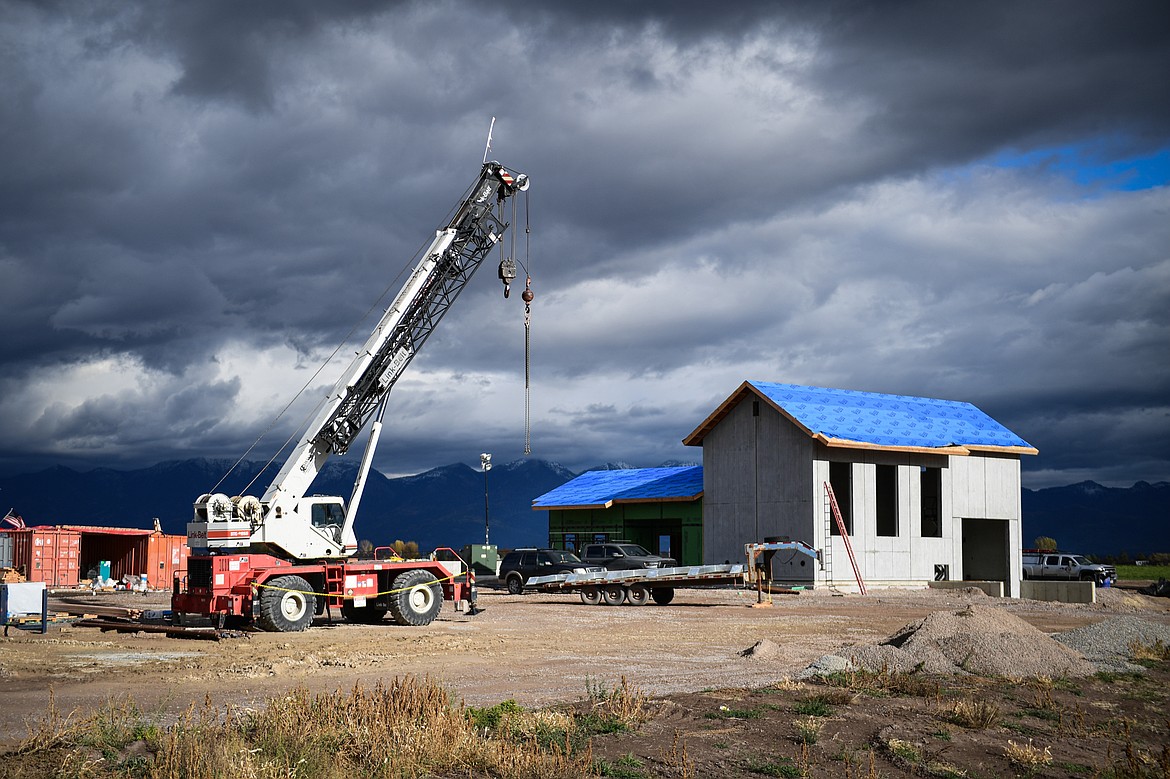
Construction of a new septage receiving facility for the Lakeside Water and Sewer District and Flathead County on Somers Stage Road on Wednesday, Oct. 29. (Casey Kreider/Daily Inter Lake)
Casey Kreider
A July 12 letter urged “environmental prudence” and asked the community to pause the Lakeside County Water and Sewer District project until more studies are done. The letter deserves a factual response, because every one of its central claims was formally submitted to the Montana Department of Environmental Quality during the public comment period — and answered, in writing, in DEQ’s April 28, 2025 Response to Public Comments on Permit MTX000307. That document is public. I would encourage everyone to read it before forming an opinion.
Start with the word “independent.”
The letter describes the Hauser Environmental and Hydro Solutions reports as work by “independent expert” scientists. They were commissioned by Citizens for a Better Flathead, an organization opposing the project. Their authors drilled no borings, installed no wells, ran no aquifer tests and built no competing model of this site. No professional engineer stamped their conclusions or assumed legal responsibility for them.
Expertise is not the issue — accountability is. The district’s engineering carries professional stamps, with real legal and licensing consequences for error. The critique reports carry none. They are opinion offered from outside the accountability system that governs everyone who actually builds things in Montana. Clearly, their “independence” is a conflict of interest for those who seek equity must do so with clean hands.
Next, “minimal baseline data.”
The record shows five monitoring wells installed at the site in 2023, monthly static water level measurements, quarterly water quality sampling and 15 slug tests — three in each well. The resulting aquifer properties fall squarely within the range published for the Delta aquifer in the scientific literature since 1986. Reasonable people can always want more data. “Minimal” is not an accurate description of what exists.
Third, the claim that regulators relied on “rosy assurances of industry engineers.”
Montana Department of Environmental Quality did the opposite. It re-ran the applicant’s calculations with harsher assumptions of its own: it credited zero natural attenuation of nitrate, used only a portion of the available mixing volume for dilution, assumed all effluent flows to the nearest surface water and doubled the discharge input in the phosphorus analysis — cutting the applicant’s breakthrough estimates roughly in half.
Where DEQ’s own conservative math showed two infiltration basins under the regulatory threshold, DEQ imposed effluent limits on them. That is not rubber-stamping. That is a regulator checking the work and tightening the result.
Fourth, the “high-speed pipelines” claim — that gravel channels could carry wastewater to local waterways in short order.
Montana Department of Environmental Quality answered this with measured site data: groundwater at this site moves 0.32 to 1.49 feet per day. At those velocities, water takes roughly 337 days to cross the 305-foot mixing zone and three and a half to nearly eight years to reach the nearest surface waters — during which nitrate decays to background levels within 640 to 1,200 feet of the basins, well short of any waterway. Anyone claiming a “direct breakthrough” owes the public measurements of their own. None have been produced.
Finally, the call to “pause” for multi-season studies.
That request was made during the comment period, which DEQ extended by seven weeks and supplemented with a public hearing in Lakeside. In the two years since the monitoring wells went in, the project’s critics could have funded a single boring, well, or test of their own to demonstrate the conditions they describe. They have not. Meanwhile, the permit they oppose requires exactly what they say they want: ongoing monitoring from six wells, public reporting of every result through EPA’s public databases, enforcement authority if limits are exceeded, and full re-evaluation — with public comment — every five years.
Prudence is a fine principle. It was exercised: in the field work, in DEQ’s independent recalculations, in the extended public process and in a permit built on monitoring and enforcement.
Repeating questions that have already been answered on the public record is not prudence. It is delay and obstruction
Rick Breckenridge is a Professional Land Surveyor from Proctor and a member of Montana Environmental Consultant Association.