
An interview with noted climber and author Terry Kennedy
Seth Anderson/Story and Photos | Hungry Horse News | UPDATED 3 months, 2 weeks AGO
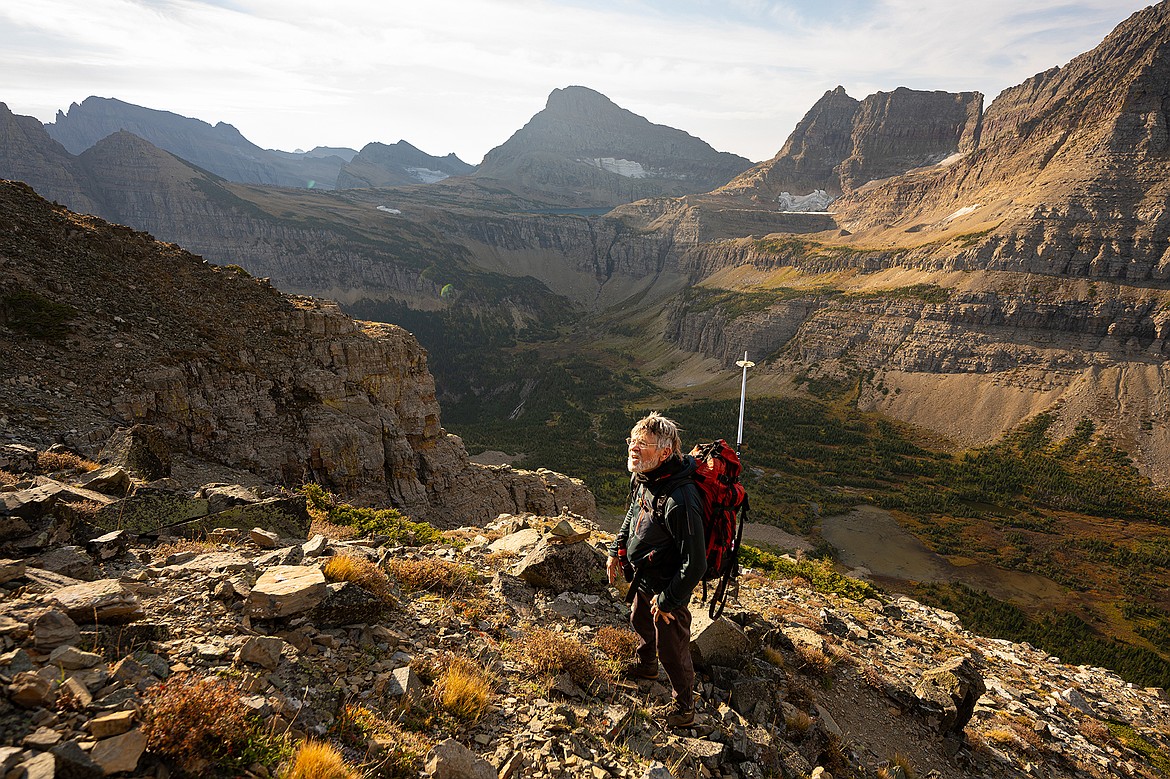
Terry Kennedy ascends Mount Cleveland via the Stoney Indian Traverse. Seth Anderson Photography
SETH ANDERSON PHOTOGRAPHY
Editor’s note: The following in a recent interview with Columbia Falls native and noted climber Terry G. Kennedy. Kennedy made first ascents on Mount Siyeh’s north face and Mount Cleveland’s north face in Glacier National Park. Kennedy is also the author of “In Search of the Mount Cleveland Five.”
What got you interested in climbing?
I was inspired before I was a “climber” as a kid in the Cub Scouts when Hal Kanzler gave a slideshow at a big scouting event. He and his sons, Jim and Jerry, and other contemporaries of Hal’s, climbed many of the peaks in Glacier during the early 1960s. As a second- or third-grader, I thought they were like moon explorers. I wanted to do that.
Tell us a little more about Hal Kanzler
Hal was a captain in the Marine Corps and fought in the Pacific theater during World War II, as my dad (R. Glenn) did. Hal had many outdoor pursuits that evolved into mountaineering. He climbed many mountains in Glacier during the later 1950s and 60s with partners around the Flathead Valley, many who worked at the aluminum plant, and quite a few were World War II veterans. Sometimes they did peaks with J. Gordon Edwards. Hal was very driven within his own sphere. He made the first ascent of Miche Wabum Peak in 1962 with two other men from Columbia Falls. He took his sons, Jim and Jerry, to the mountains. In 1963, the three Kanzlers climbed Mount St. Nicholas when Jim was 15 and Jerry was 12. Hal led on a 7/16” by 120’ Goldline rope.
Who inspired you as a young climber?
In the 1970-72 years, I was influenced by those great Yosemite climbers of the day: Royal Robbins, Warren Harding, and all those 1960s climbers. Charlie Porter’s and Gary Brocarde’s A5 first ascent of The Shield on El Capitan was unforgettable.
How about later, as you progressed
George Lowe’s and Chris Jones’s epic ascent of the North Face of North Twin Peak in Canada [1974] blew Jim Kanzler and me away. We kept referring back to that accomplishment as we pursued our own. It just so happened to be the same summer that Jim and Pat Callis made the high mark on the Emperor Face [north face] of Mount Robson at that time.
Of course, there was this obsession of mine about becoming a climbing partner of Jim’s, which took a few years. He sorta took me under his wing, and I guess he saw me as a genuine partner after 1975. I emulated the climbing form of Pat Callis’s, who was an important climbing partner of mine throughout the years.
What was it like climbing with Jim on Cleveland and Siyeh?
Oh, he was a take-charge guy! Like our friend and climbing partner Doug “Dougal” McCarty once said, “We’d follow him anywhere.” Jim was progressive, had great style, and his favorite words were “go up.”
What was it like being at the forefront of cutting-edge alpinism during the Siyeh years?
Honestly, I don’t think I was at the cutting edge in the broader scope. There was so much bigger stuff being done on bigger mountains in bigger ranges around the world. Jim Kanzler and I were just trying to get our own objectives done and move up from there.
How did the Mount Cleveland Five open your eyes to the possibilities of bigger climbs in Glacier and beyond?
It was like ... my turn to break trail.
Did the North Faces of Cleveland and Siyeh feel inviting, or rather unforgiving walls of lifeless rock?
You know, the north face of Cleveland haunted me for many years. I guess it still does. Siyeh? Well, it’s like Kanzler said, “let’s go slay the dragon.”
What did you feel when you reached these summits?
We were certainly joyous on top of Cleveland, and spent a good hour in perfect warm weather, yucking it up. But we became somber descending the west face through the path of the avalanche had taken. Once we got to the short waterfall near timberline, we stripped naked and took turns standing under the falls. It was not only to wash the sweat off, but also a ceremony to wash ourselves of Mount Cleveland.
On Siyeh’s summit, as the sun was setting, the mood went from elation to lamenting before it got dark, and we bivouacked again. Jim and I had other projects in mind for the following year, but for some reason, we never returned to Glacier to attempt them.
Are there other first ascents around Glacier that were memorable?
Well, a very proud achievement was the west face of Mount St. Nicholas (1974) with Steve Jackson. He and I were still trying to fledge, and we barely knew what we were doing, but we were starting to spread our wings after the bergschrund incident on Mount Andromeda in the Canadian Rockies a couple weeks before, [see chapter 9, One Hell of a Nice Jump in Kennedy’s book]. Others include the north face of the NE spur of Mount Cannon with Tom Cladouhos (1982) and the east face of Little Chief (October 1978, see chapter 17, The Consolation) with Jim Kanzler. I soloed the St. Nick standard route (1988).
What about important ascents outside of Glacier?
Of course, the Beartooth Mountains hold some nice prizes. Brian Leo and I did the second route on Silver Pillar (1975) [see chapter 10, Bombs Away, Sir], the 16-pitch Piro de la Calico with Doug McCarty (1979), and the 23-pitch Sundance Warriors with Ron Brunckhorst (2007), all part of the Silver Run Plateau. These are some of the favorite climbs I’ve done. I soloed the north face of Granite Peak (2004) and the north face route of Teewinot in the Tetons (1984).
Dexter Hale and I climbed Super Couloir (north face) on Delta Form Mountain in the Canadian Rockies (1982). That turned into a hairy epic because of rockfall, and poor conditions on verglas and multiple cornice collapses as we approached the top of the face [see The Grey Zone in the GMS Journal [1982 or 83...?]. Pat Callis and I did a FA on East Kahiltna Peak next to Denali (1993) (see 1994 American Alpine Journal). I spied this line as my brother, Dan, Tom Cladouhos, and Ed Sondeno passed below it when we climbed the South Buttress (1984).
Why did you pursue new routes instead of following where others had gone?
We would just do one climb or peak and see the next thing and say: Let’s go try that. Everything you touched was new. I must say that the North Ridge of the Grand Teton with Jim Emerson (1973) was a must-do classic. We sorta cut our teeth on it and I thought: there’s all kinds of stuff like this in the Beartooths and Absarokas.
Why climb in Glacier rather than on better rock elsewhere?
Yeah, great question. I’ve asked myself that many times. Glacier was in our backyard, and I was a homebody, I suppose.
What drove you throughout the Cleveland and Siyeh climbs?
The fear of failure.
Why, after so many years, do you think Glacier still gets little attention for technical routes?
It’s really bad rock, right? At least, that’s what we kept perpetuating.
Truth be told, the steeper the rock in Glacier, the better it tends to be. In my experience, bad rock in the Canadian Rockies or even the Tetons is more unpredictable and dangerous because it fractures haphazardly.
The characteristics of the horizontal strata of Glacier’s sedimentary rock is more predictable. Also, it tends to take gear well. Thin pitons in horizontal cracks in steep rock are typically bomber. Of course, that means carrying a hefty hammer. It’s a trade-off.
It’s a bit amusing to me that technical climbing in Glacier is fly-over country. I’m sure the rangers don’t mind that. It’s nice for the local climbers to pick the low-hanging fruit.
How does it feel to inspire generations of climbers that came after you?
I feel honored, to be sure. But I must say, I think that influence is rather limited outside of Glacier.
What impresses you with today’s state of climbing?
It’s mind-boggling: the training ethic; lighter, faster, harder, fearless.
What’s next for you? Any writing?
Actually, I’ve been writing some stories of the three to seven pages length this past winter. Some about climbing, some not, more developing, none published…yet.
Any new climbing plans?
I’ve had to put up with several chronic orthopedic issues; some improving, some not. I just try to enjoy climbing within my own capability, which is to say, I’m now well to the right on the ol’ bell curve. I’m more of a dabbler now. I like exploring game trails, finding little secrets of the woods and mountains. I like connecting with nature in ways that climbing cannot. I’m pursuing an old hobby of making primitive tools with only [modern] hand tools. But of course, climbing will always remain a passion of mine.
You’ve been to Cleveland six times. Why keep going back? Why try to bridge the gaps in the history of the Cleveland 5’s catastrophe: tragedy or catastrophe?
(Ed’s note: The Cleveland Five tragedy was when five climbers died trying a winter ascent of Glacier’s highest peak in 1969. It’s the subject of Kennedy’s book.)
Once I saw Jim Anderson’s [one of the Mount Cleveland Five] slides that were recovered from Cleveland after the tragedy, I knew that the accepted conclusion of the National Park Service was not accurate: that they were not caught at 8,300 feet on their way up, but on the way down. This discovery came as my book manuscript was about to be printed, and I wanted to include one of those Jim Anderson photos in the book. The Anderson family was very gracious to let me choose from the entire collection. There was no time to delve into this or include my subsequent findings into the book. But I started investigating this for my own peace of mind, even before my book came out. The “forensic evidence” clearly indicates to me that they summited and triggered the avalanche on the way down — in the dark. I’ve been on Cleveland’s west face four of those six ascents since 2016, matching photos with Anderson’s photo locations. There’s little room left for speculation at this point. And by the way, some of your [Seth B. Anderson’s] photos cemented my conclusion.
Guess it’s time to set the record straight.