
Connecting people and protecting a place: Flathead Bio Station’s annual research cruise sets sail
Vivianne Ostheimer | Lake County Leader | UPDATED 1 day, 4 hours AGO
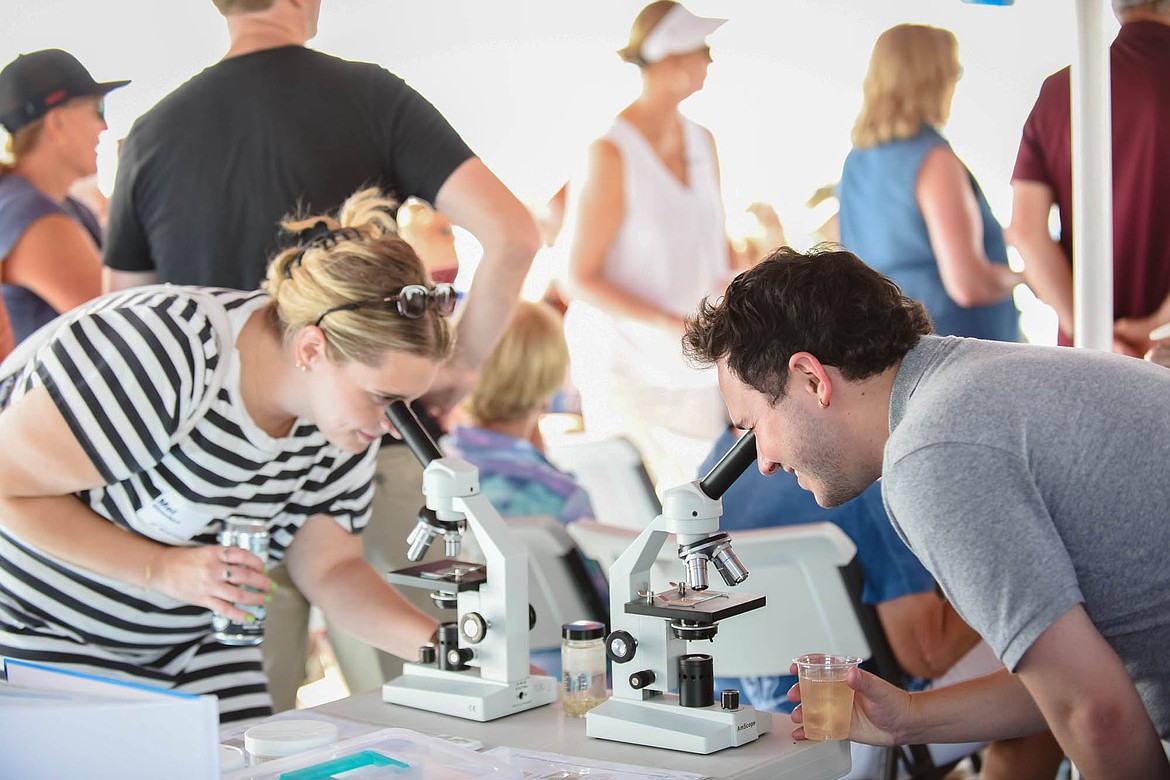
Cruise attendees view lake microorganisms through a microscope at the Flathead Lake Biological Station's annual research cruise. (UM Alumni Association photo)
“Welcome to the largest natural freshwater lake west of the Mississippi,” Jim Elser, director of the Flathead Lake Biological Station, told nearly 100 passengers aboard the Far West.
Before he could finish, audience members chimed in: “... west of the Mississippi.”
Elser laughed. “You know my schtick, don’t you? Founded in 1899, it’s the second-oldest biological field station in the Western Hemisphere … possibly in the universe,” he said.
This time, it was the audience’s turn to laugh.
Nearly 100 people joined the Flathead Lake Biological Station's annual research cruise on July 17 to learn about the station's research, education and long-term monitoring efforts.
As Elser spoke, the Jessie B — the station's research vessel, named for student and benefactor Jessie Bierman — pulled alongside the Far West. Researchers lowered a net into the shimmering water, demonstrating one component of the station's long-term monitoring program: sampling mysis shrimp, an introduced species that has helped fuel the growth of lake trout populations.
The station has monitored Flathead Lake since the 1970s, and associate director Tom Bansak said the annual cruise is designed to connect the people who live around the lake with the scientists working to protect it.
“It's just a great afternoon to get out there on the water and for attendees to learn about the place that they love and the bio station's work to understand, preserve and protect it,” he said.
This year, the bio station partnered with the University of Montana Alumni Association to bring more UM alumni aboard the annual cruise, which was conceptualized as a fundraising event when it started over a decade ago.
However, it doesn’t actually raise funds.
“We consider it a friend-raising event,” Bansak said. “It's a way to raise awareness. Our goal is to break even.”
Kylie Schumacher, the bio station’s director of development, said the cruise can often begin relationships with future donors.
“This is kind of where it starts. You have to know about something before you're going to give to it,” Schumacher said.
She considers herself a matchmaker between donor passions and bio station needs.
“ So if they said they used to be a teacher, well, I'm gonna think FLARE K-12,” she said, referencing the station’s Flathead Lake Aquatic Research and Education K-12 program. “I'm listening to key things to be able to match them to something that they're going to care about giving to.”
Philanthropy provides about 25–30% of the bio station's funding, and its impact reaches nearly every part of the station. Half of students taking college courses receive philanthropic scholarships, and 75% of summer interns hold philanthropically funded positions. Philanthropy also funds 100% of the station's K–12 education program and more than half of its lake monitoring program.
It even supports physical infrastructure, according to Bansak.
“ Our philanthropic support is helping us literally keep the lights on, repair broken things and buy new windows,” he said.
But the annual research cruise isn’t only about cultivating financial support. It also encourages attendees to become stewards of the lake. Participants learn how their seemingly small, everyday actions — such as spraying weeds with herbicides — can affect water quality. They also hear about citizen science research and how to get involved in programs like Monitoring Montana Waters and the Pesticide Stewardship Partnership Program.
Bansak said the event is especially valuable for newcomers to the Flathead Valley.
“A lot of effort and resources have gone into keeping the lake this way, and we want the newcomers to be aware of that and how they can contribute to being community stewards of this place that we all love and depend upon,” he said.
That stewardship is especially important as researchers continue to monitor threats to the watershed.
According to previous Leader reporting, the bio station recently found ‘forever chemicals’ in the lake. These substances, used in industrial processes and consumer products such as clothing, food packaging, pesticides and herbicides, were detected at low levels, and more research is needed to understand their ecological implications. Elser said all PFAS and PPCP sampling and analysis at the station is made possible by philanthropic support.
In addition to monitoring these ‘forever chemicals,’ bio station researchers are currently studying other threats to the lake — such as invasive species and human impacts — and how they’re changing as Montana’s environment and ecology shift over time.
But even so, Elser said Flathead Lake has remained remarkably stable over four decades of monitoring. Standing on a crowded double-decker boat peacefully floating across the lake, Elser joked that he consistently has to deliver a “boring” annual update.
“Right now, there’s not much going on,” he said. “It’s been a boring year on the lake, because not many things have changed over 40 years — in terms of pollution and food-web dynamics — which is pretty impressive.”