
Growing fast
JOEL MARTIN | Hagadone News Network | UPDATED 2 months, 3 weeks AGO
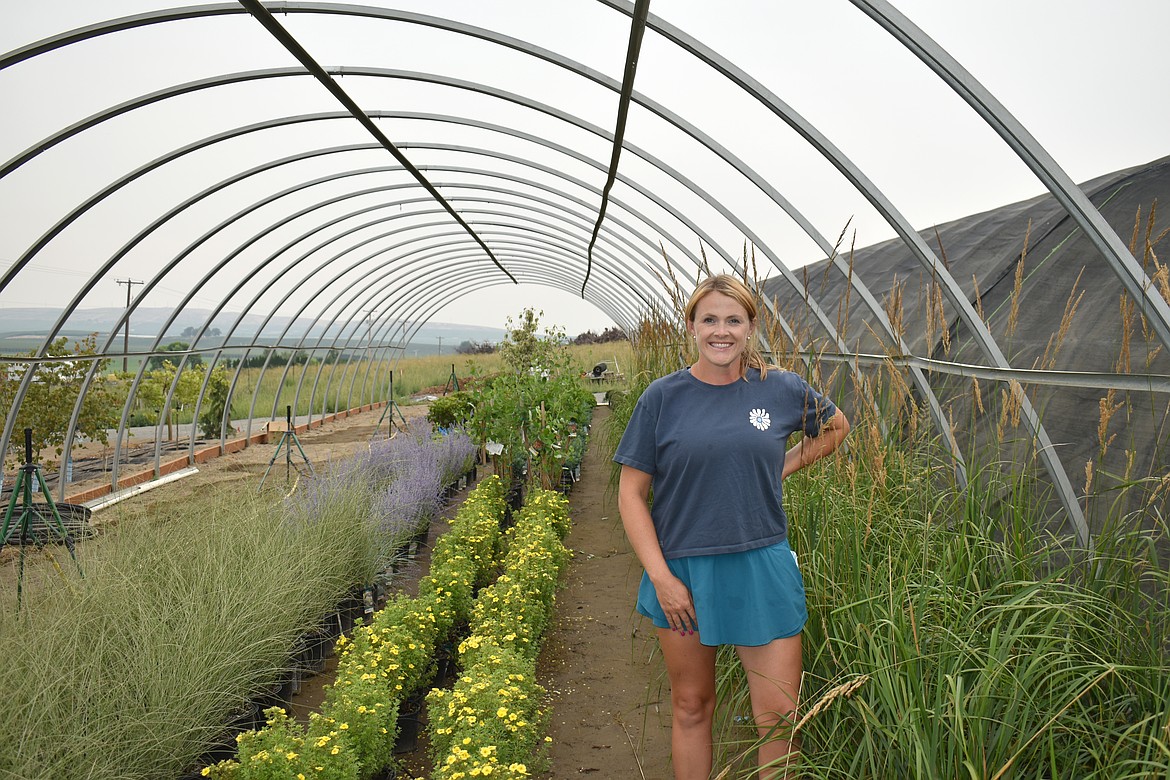
Kylie Gray-Eilers, owner of Gray Girl Farms, stands among the plants she’s staged at her new nursery near Royal City.
JOEL MARTIN/COLUMBIA BASIN HERALD
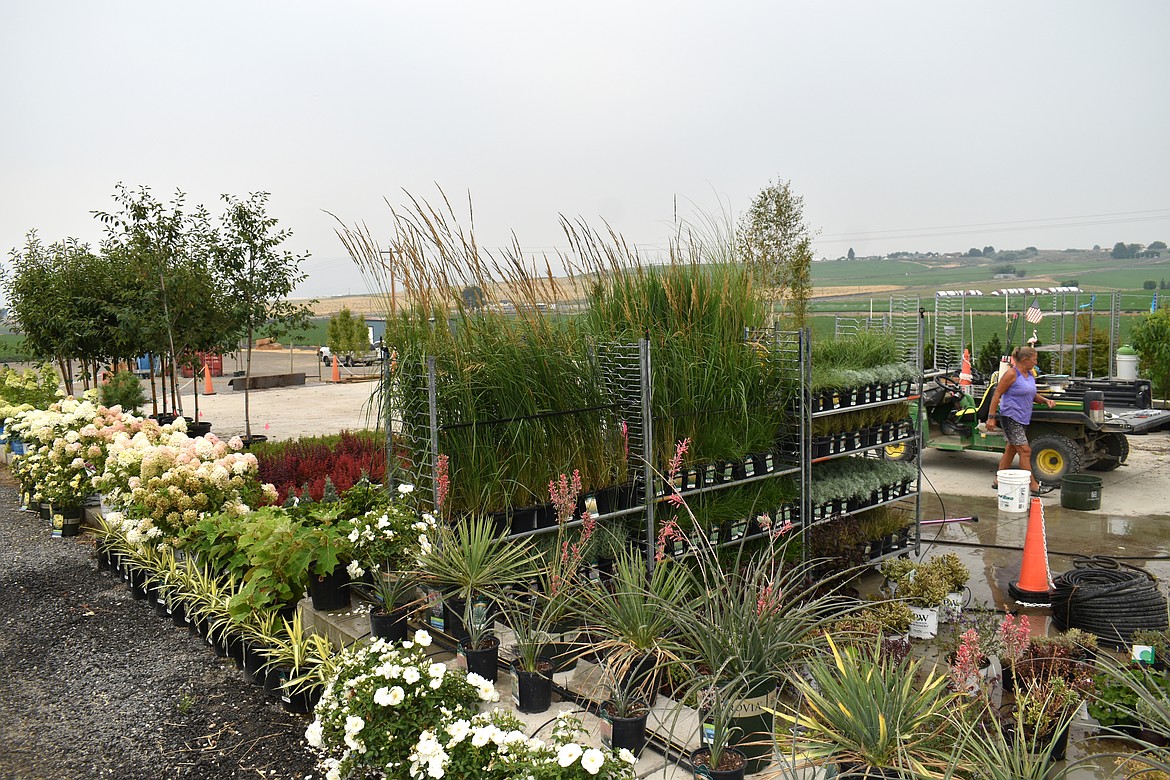
Some of the inventory at Gray Girl Farms nursery is staged around the loading dock. Gray Girls gets mostly bulk orders but also sells to the general public.
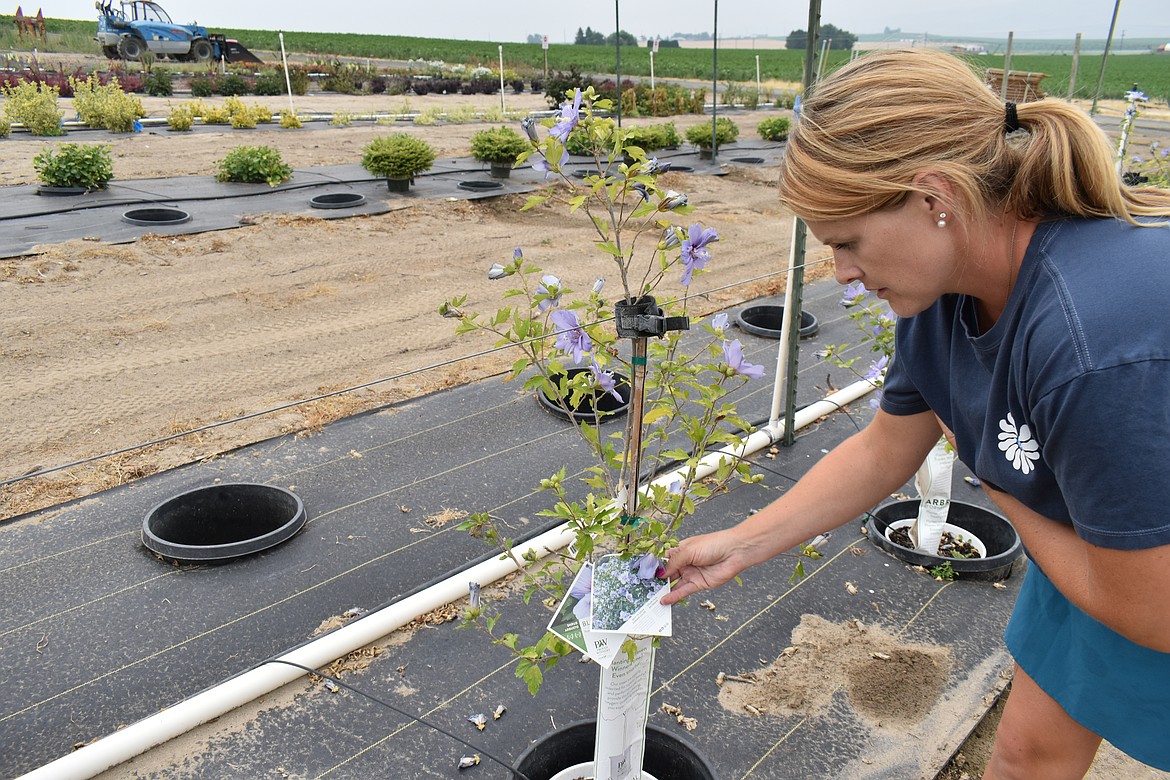
Kylie Gray-Eilers shows a Blue Chiffon Rose of Sharon at her nursery at Gray Girl Farms.
Joel Martin has been with the Columbia Basin Herald for more than 25 years in a variety of roles and is the most-tenured employee in the building. Martin is a married father of eight and enjoys spending time with his children and his wife, Christina. He is passionate about the paper’s mission of informing the people of the Columbia Basin because he knows it is important to record the history of the communities the publication serves. | July 24, 2026 3:00 AM
ROYAL CITY — It’s one thing to grow and sell flowers. Owning a complete nursery is something else altogether, especially when you have only months to build it.
“The learning curve has been really steep,” said Kylie Gray-Eilers. “I just always tell myself that every day is a new day.”
Gray-Eilers isn’t a stranger to raising plants; her Gray Girl Farms has sold dahlias for almost eight years, and she holds a Dahlia Days festival every year in October. The dahlia operation was beginning to reach the point where she needed either to scale it back or grow, she said. So when she learned that Robin Prchal, owner of Emerald Desert Nursery in Quincy, was fixing to retire, Gray-Eilers decided it was time to expand.
“I was a customer at Emerald Desert for years,” she said. “There was a huge need in the industry that Robin filled. It’s been great to kind of pick up where she left off and help the customers along the way.”
Before closing down, Prchal sold off all of her inventory, but Gray-Eilers and her husband brought the infrastructure – the greenhouses, irrigation, tree pots and so forth – back to their property and set it up more or less the same it had been at Emerald Desert, she said. Some of the employees from Emerald Desert also took jobs at Gray Girl.
“The employees who came to work for me are fabulous,” Gray-Eilers said. “Robin had top-notch employees, and now I have top-notch ones too.”
Gray-Eilers and her new team had their work cut out for them.
“Luckily, my husband loves semis and trucks,” she said. “They just kept loading it on flatbeds and hauling it over … We broke ground the last week in January and our first truckloads of product for here maybe March 10.”
Gray Girl mostly sells wholesale, she said, although a fair number of home gardeners make the drive out to Royal City to check out her inventory. The question isn’t what she has at the nursery, Gray-Eilers said, but what doesn’t she have.
“We have evergreens, maple trees, bushes, shrubs, perennials, annuals, grass, roses, everything you could think of and more,” she said.
Which of those things sells when can be impossible to predict, Gray-Eilers said. Last week, she was hit out of the blue by a run on hornbeam trees.
“I sold a bunch of them,” she said. “By the third or fourth phone call, I was like, are you guys bidding a job? And no, it wasn’t (a single job). I sold out of them, which was so random. It’s been like that; it ebbs and flows.”
Unlike the dahlia operation, Gray-Eilers doesn’t grow her own inventory; she has a number of distributors she buys from. But she’s picky about the quality, she said.
“It’s not something you’re getting at your average (chain store),” she said. “We’re bringing in really nice, large plants. I’m just proud of the whole thing.”
Gray Girl Farms & Nursery
11737 Road E SW
Royal City
Monday-Friday 10 a.m.-5 p.m.
Saturday 8 a.m.-1 p.m.
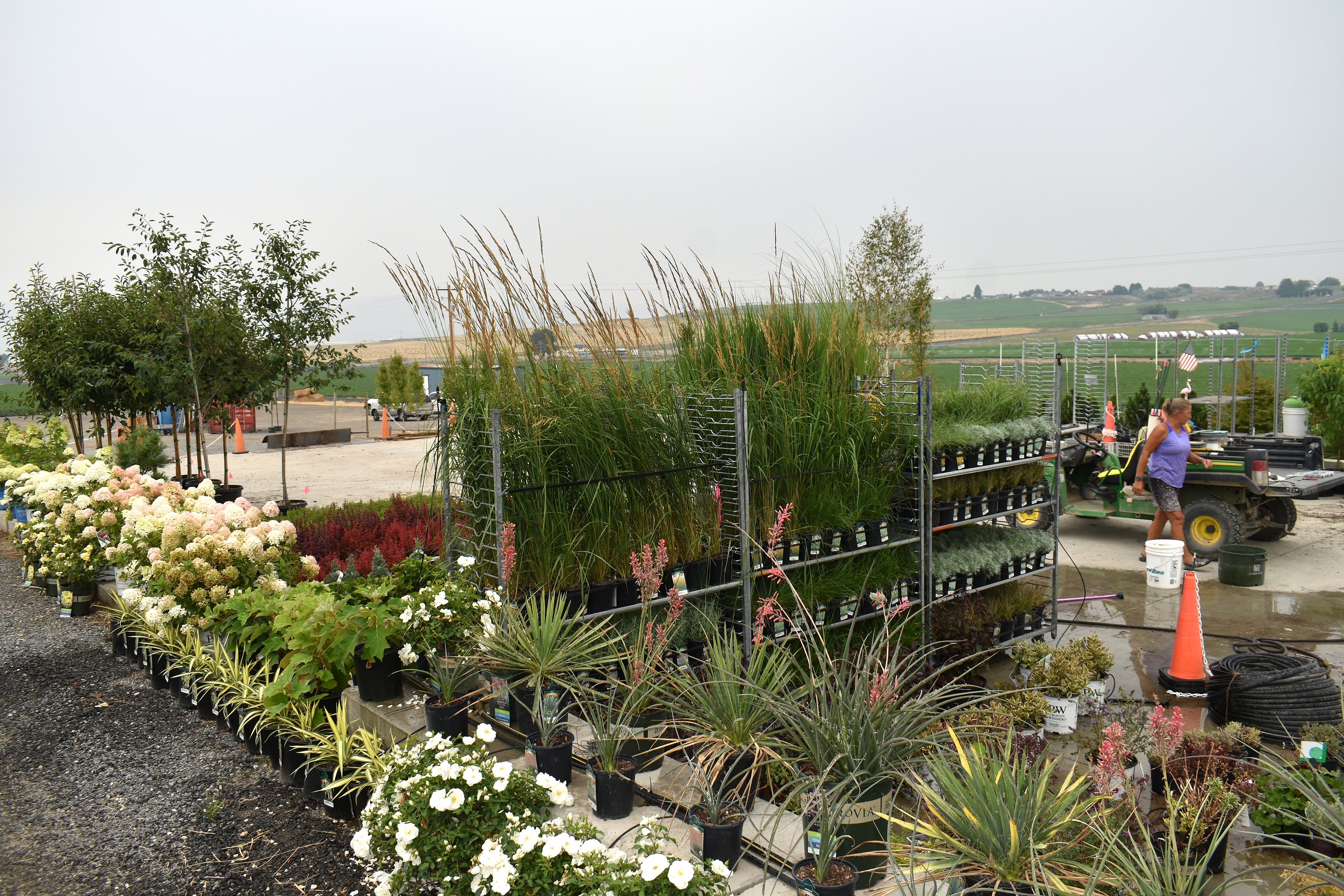 Some of the inventory at Gray Girl Farms nursery is staged around the loading dock. Gray Girl Farms gets mostly bulk orders but also sells to the general public.
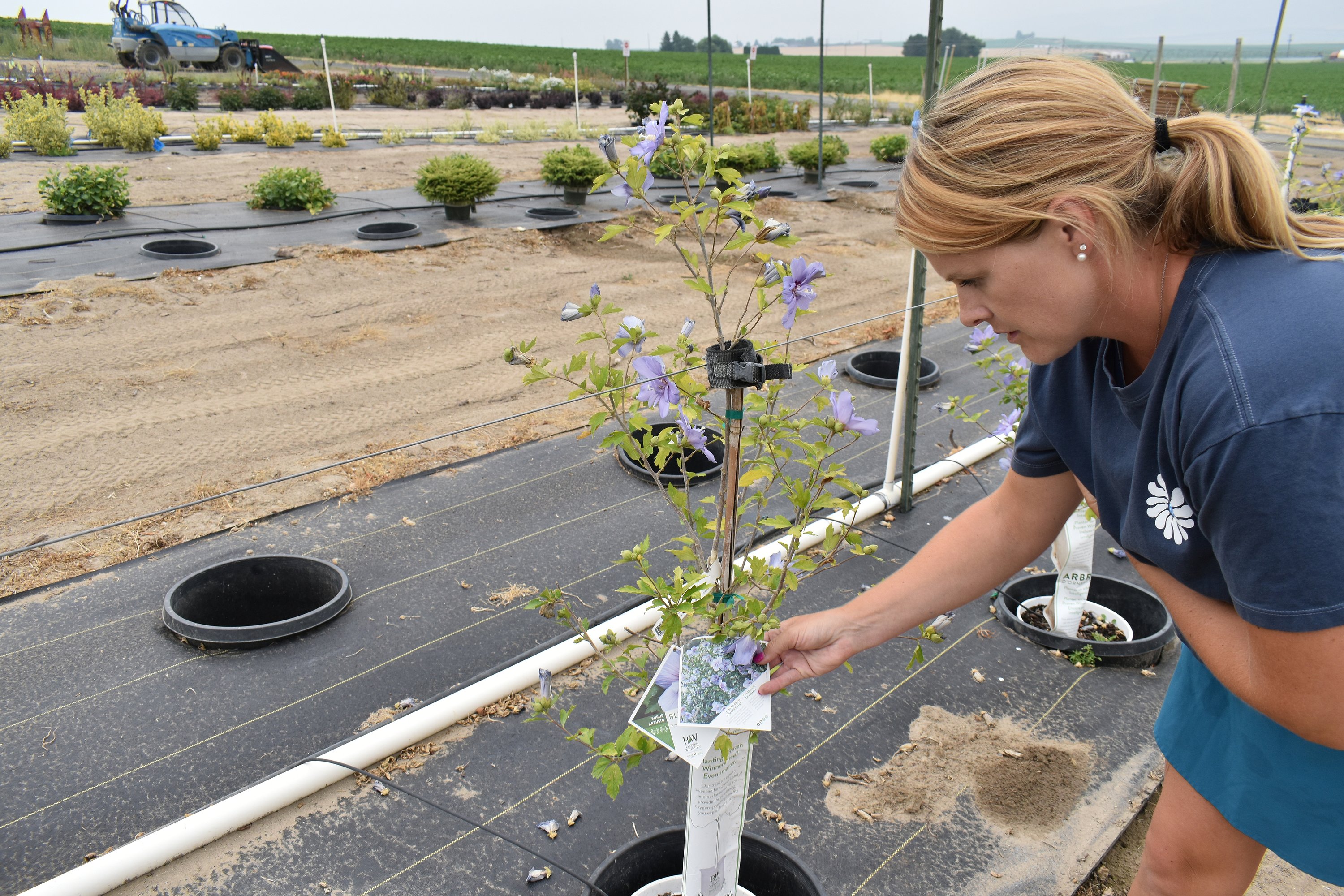 Kylie Gray-Eilers shows a Blue Chiffon Rose of Sharon at her nursery at Gray Girl Farms.
ARTICLES BY JOEL MARTIN

Endless battle
Noxious Weed Control Board works to keep invasive plants under control
MOSES LAKE — Some of the nastiest plants in Grant County were the topic of a class led by Jay Johnson, a consultant with the Grant County Noxious Weed Control Board, Tuesday. The Noxious Weed Control Board, as its name would suggest, is tasked with keeping weeds under control in Grant County. That’s not a small job; the board’s website lists 129 species of noxious weeds that are found around Grant County. A noxious weed is defined as an invasive, non-native plant that threatens agricultural crops, local ecosystems or fish and wildlife habitat, according to the Noxious Weed Control Board. Washington state law requires that these weeds be identified and their spread kept to a minimum, if not completely eradicated. “We’re one of those agencies a lot of people don’t really understand,” Johnson said. “We’re a county office and … our funding is tax-based assessment. When you get your tax bill and you look down at all the expenses that you pay for, there we are.”

BASIN EVENTS: Oct. 16-24
COLUMBIA BASIN — Whether you feel like shopping, crafting, learning or seeing a show, there’s something happening for you this week in the Basin. Oct. 16 ‘My Family (Mi Familia)’ screening Spanning three generations, “My Family (Mi Familia)” is a heartfelt drama that follows the Sánchez family as they build their lives in East Los Angeles. Through love, hardship, triumph, and sacrifice, the film explores the immigrant experience, the strength of family bonds, and the traditions that connect one generation to the next. Lowrider show and taco truck before the screening. Sponsored by Columbia Basin Allied Arts, EDUBS C/S and the Moses Lake Creative District. $12 per person. Doors open at 6 p.m., film begins at 7 p.m. at the Moses Lake Civic Center Auditorium, 401 S. Balsam St. Tickets and info: www.cba-arts.org.

Moses Lake author encourages women to look beyond church culture norms
MOSES LAKE — A Moses Lake author’s book, “A Christian Woman Striving to Live Her Faith in a Man-Controlled World,” takes aim at the role to which many churches relegate the female half of their congregations. “It’s to encourage women in the faith,” Linda Curran said. “A lot of churches say, ‘Teach Sunday school, do this, do that, but don’t (evangelize.)’" In her book, Curran recounts a time when she moved to a new community and joined a church there. She was surprised to learn that, as a new female member, she had been automatically assigned church cleaning duties. When she questioned it, she wrote, she was met with condescension and her objections were brushed aside. In other churches, she said, women who were capable of teaching were relegated to “women’s ministry.”