AUG NIBJ: Leadership doesn't have to be loud
JOSH McDONALD | Hagadone News Network | UPDATED 2 weeks, 5 days AGO
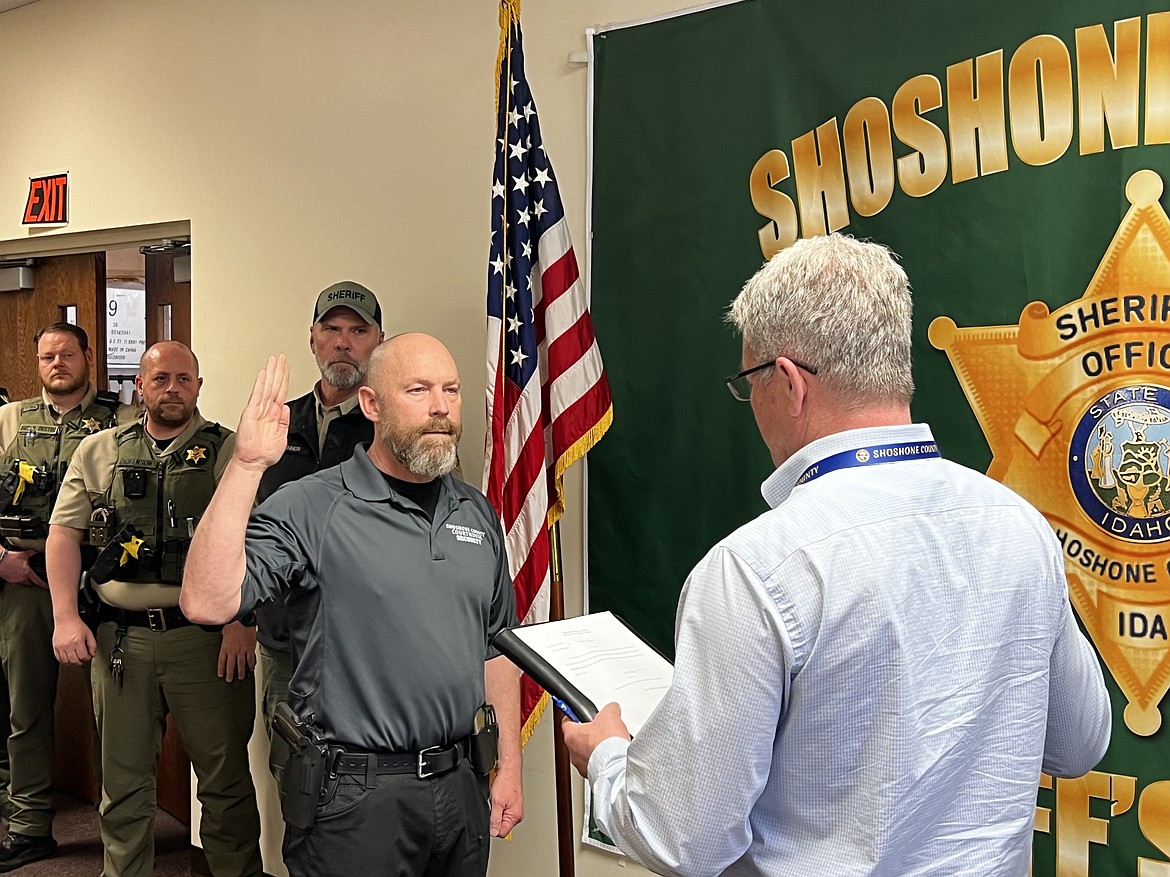
Shoshone County Sheriff Shawn Wehr is sworn into office by Commissioner Jeff Zimmerman in March of this year.
JOSH McDONALD
WALLACE — In a world where leadership often looks and sounds loud, some of the most effective leaders are neither the biggest personalities in the room nor the ones demanding the most attention. Instead, they're the people who quietly build trust, empower those around them and focus on results.
Shoshone County Sheriff Shawn Wehr appears to be one of those leaders.
When Wehr took over the Shoshone County Sheriff's Office earlier this year, he inherited an agency dealing with more than its share of challenges. Public controversy, budget concerns, staffing issues and ongoing litigation had created an environment where simply stabilizing the organization would have been considered a success.
Yet within months, much of the turmoil that had defined the office had begun to fade into the background.
Contrary to what some might assume, that wasn't accomplished through sweeping ultimatums or a heavy-handed management style.
"I've learned over the course of my military service and nearly three decades in law enforcement that leadership isn't about being the loudest person in the room," Wehr said. "It's about earning trust, making sound decisions under pressure, and treating people with respect."
That philosophy has become evident throughout the Sheriff's Office.
When Wehr interviewed for the position, county officials were immediately struck by the depth of his experience. His military background as an Army Ranger, combined with a lengthy career with the Los Angeles Police Department, provided a résumé unlike any recent sheriff candidate in Shoshone County.
But credentials alone don't create successful leaders.
For better of for worse, the position of sheriff is the highest-profile seat in Shoshone County. Every move that gets made from that position is analyzed tenfold.
The challenge facing Wehr was significant. Beyond public scrutiny, the sheriff's office was working through budgetary struggles, employee turnover and operational issues that had frustrated previous administrations. The county jail, in particular, had long presented challenges that proved difficult to overcome.
Rather than trying to solve every problem personally, Wehr has focused on building trust within the organization and empowering employees to take ownership of their responsibilities.
For Wehr, effective delegation begins with mutual respect and confidence between leaders and staff.
"Trust is the foundation of any successful organization," Wehr said. "When people know you're consistent, honest, and willing to support them, they're more willing to take ownership of their responsibilities."
He views delegation not as a way to pass responsibilities to others, but as a way to strengthen an organization from within.
"Delegation isn't about giving work away, it's about developing people, empowering them to make good decisions, and holding them accountable," he said. "My goal is to always build leaders, not followers in the sheriff's office."
That mindset appears to have resonated with employees. Staff members frequently speak positively about Wehr's leadership style and his willingness to listen before making decisions. In an industry where command presence is often associated with forceful personalities, Wehr's approach has proven that authority does not have to come at the expense of humility.
The sheriff credits much of his leadership philosophy to lessons learned throughout his military and law enforcement careers. Just as importantly, he says he learned valuable lessons from witnessing both good and bad leadership firsthand.
"Some of it is personality, but most of it was developed over decades of leading people in very difficult environments," Wehr said. "More importantly, I learned by watching both exceptional leaders and poor leaders because you learn something from both."
At the center of that philosophy is a single trait he considers non-negotiable.
"If I had to identify the single most important leadership trait, it would be integrity," Wehr said. "Your people have to know that your decisions are based on what's right, not what is easy, popular or personally beneficial."
As Wehr continues navigating the financial and operational challenges that come with running a modern sheriff's office in a rural, financially challenged area, his leadership philosophy remains remarkably straightforward.
"Leadership isn't about rank or authority, it's about service," he said.
In an era when leadership is often measured by volume and visibility, Wehr is quietly proving there is another way. Sometimes, the people making the biggest difference are not the loudest voices in the room. They're the steady hands earning trust, building teams and simply getting the job done.
ARTICLES BY JOSH MCDONALD

Mullan, Shoshone County near agreement for services renewal
Mullan, Shoshone County near agreement for services renewal