
The Best Night Sky Events for June
JOHN TAYLOR / Press Contributor | Coeur d'Alene Press | UPDATED 1 month, 1 week AGO
June has arrived! And way up here in North Idaho, just a stone’s throw from the Canadian border, we will now get to experience wonderfully long days and disappointingly short nights. Starting this month look for the Summer Milky Way rising in the East just after dark (11 p.m.), the Strawberry Moon, conjunctions and appulses, a planetary alignment, and the June Bootid meteor shower. So, enjoy the now warm evenings because this month is packed with plenty of events to keep you busy.
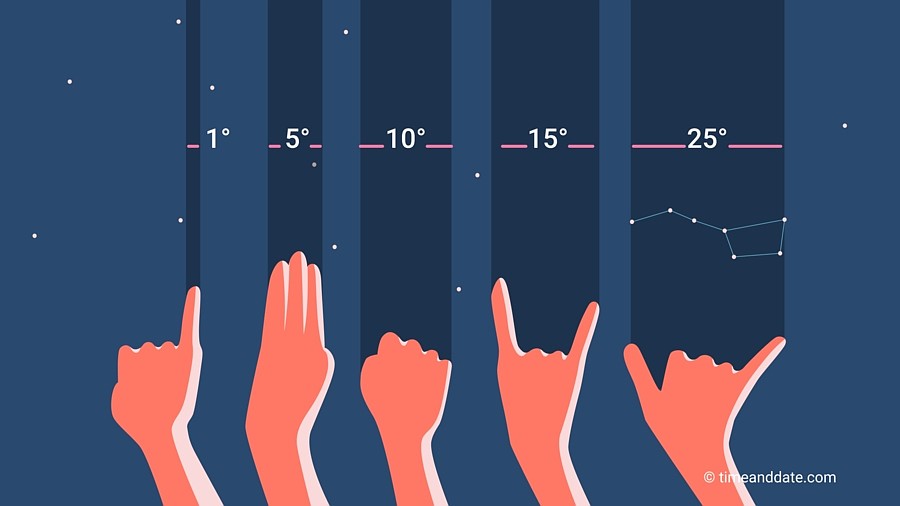
June 1 – How to Gauge Separation in the Night Sky
Here is a handy reference guide to use with this month’s numerous events. Use it to somewhat accurately gauge how many degrees one object is from another. Remember, holding up fingers should be done at arm’s length.
June 8 – Last Quarter Moon
The Last Quarter Moon is the third and final quarter phase of the Moon during its monthly cycle. At this point, the Moon appears half-illuminated, with the left half visible from the Northern Hemisphere. This Moon is visible after midnight and throughout the morning.
June 8 – Mercury at its highest altitude in evening sky
Mercury will reach its highest point in the sky in its May–June 2026 evening apparition. It will be shining brightly, a bit dimmer than Jupiter. This appearance of Mercury high enough above the horizon to be visible, but still moderately difficult to observe because of the twilight sky, A pair of binoculars will aid immensely in locating Mercury just 15° above the horizon in the Western sky around 9pm. While looking for Mercury, don’t forget to turn your gaze up and to the right to see Venus and Jupiter very close to one another.
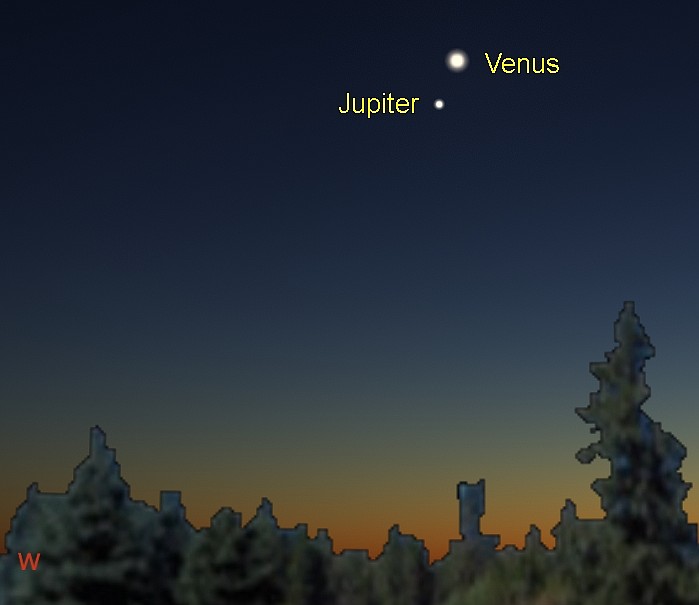
June 9 – An Appulse and Conjunction Between Venus and Jupiter
Venus and Jupiter will share the same right ascension in the sky (this would be a line of longitude if it were on the earth), making it a conjunction. At around the same time, the two objects will also make a close approach, 1½° apart. This near approach of two astronomical bodies is called an appulse.
They should be visible around 9:15 p.m., at 18° above the western horizon. They’re both very bright and should be very visible as dusk fades to darkness. The pair will be too widely separated to fit within the field of view of a telescope but will be visible to the naked eye or through a pair of binoculars.
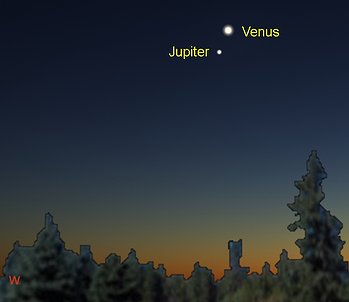 Image courtesy of John Taylor and Stellarium
June 14 – New Moon
The New Moon is the beginning of the lunar cycle when the Moon is not visible from Earth. It occurs when the Moon is positioned between the Earth and the Sun. Since the illuminated side of the Moon is facing away from us, the night sky will be especially dark, making it an excellent time for stargazing without moonlight interference.
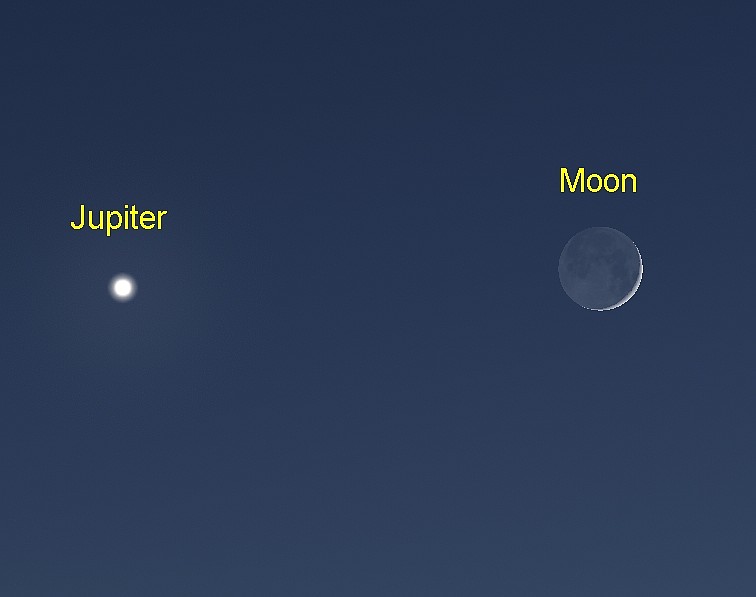
June 16 – Conjunction of the Moon and Jupiter
The Moon and Jupiter will share the same right ascension, with the Moon passing just 2½° to the north of Jupiter. The Moon will only be two days old. At roughly the same time, the Moon and Jupiter will be close enough to technically call this an appulse.
The pair should become visible just after 9pm, appearing 13° above the western horizon, as dusk fades to darkness. Be advised though, a two-day old moon is sometimes difficult to spot so from bright Jupiter look directly to the right to see the baby moon. The pair will be too widely separated to fit within the field of view of a telescope, but will be visible to the naked eye or through a pair of binoculars.
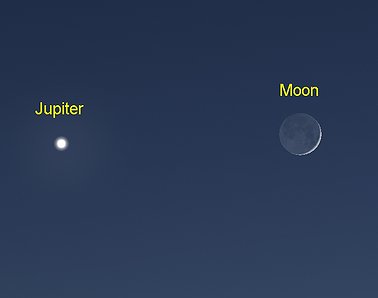 Image courtesy of John Taylor and Stellarium
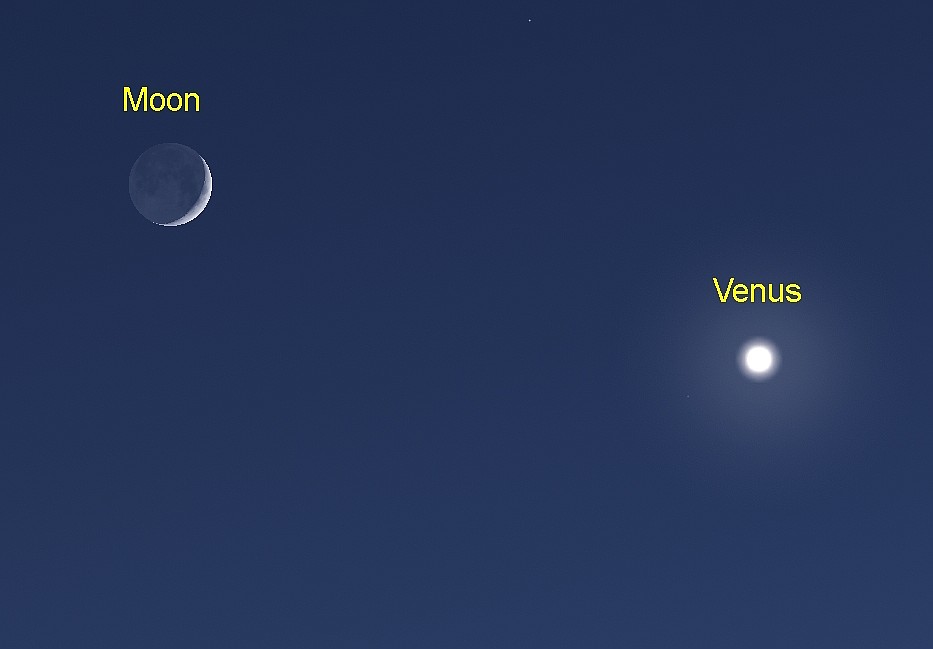
June 17 – Close approach of the Moon and Venus
The Moon and Venus will make a close approach, passing just under 4° from each other. The pair will become visible after 9pm. Look toward the western horizon, to see these our second and third brightest objects in the night sky.
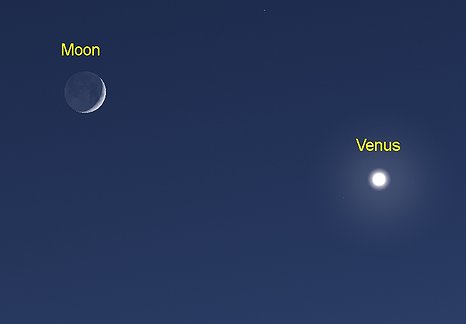 Image courtesy of John Taylor and Stellarium
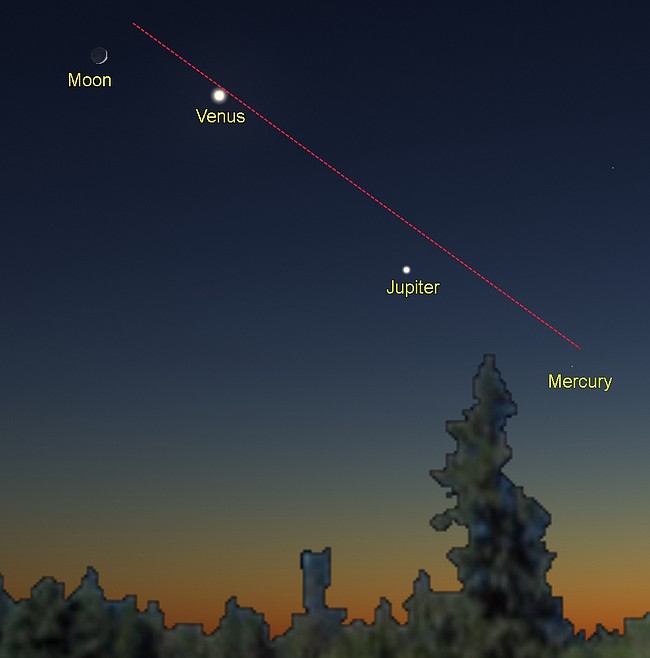
June 17 – A Planetary Alignment
A unique occurrence happens this night as the Moon, Venus, Jupiter, and Mercury are all lined up in the Western dusk sky. Look toward the Western horizon after 9:15 p.m. to see this amazing spectacle. A pair of binoculars will help find Mercury and show some nice details on the lunar surface.
Notice that you can almost draw a straight line from the Moon down to Mercury that also includes Venus and Jupiter. This line is called the Ecliptic and all the solar system bodies (save Pluto) fall onto this line.
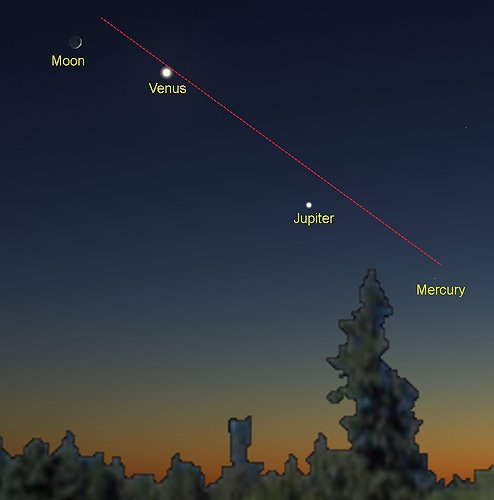 Image courtesy of John Taylor and Stellarium
June 21 – First Quarter Moon
The First Quarter Moon marks the halfway point between the New Moon and the Full Moon. It appears as a half-illuminated disk with the right half visible from the Northern Hemisphere and is visible in the afternoon and evening sky.
June 21 – Summer Solstice
This is the day when the Sun reaches its greatest distance north of the Earth’s equator in our annual journey around the Sun. This marks the official start of summer in the Northern Hemisphere and winter in the Southern Hemisphere. In the North it’s the longest day of the year (and shortest night of the year.) In astronomical terms, official nighttime starts when the Sun goes more than 18° below the horizon. On this date, the Sun is more than 18° below the horizon for a mere 1 hour and 33 minutes.
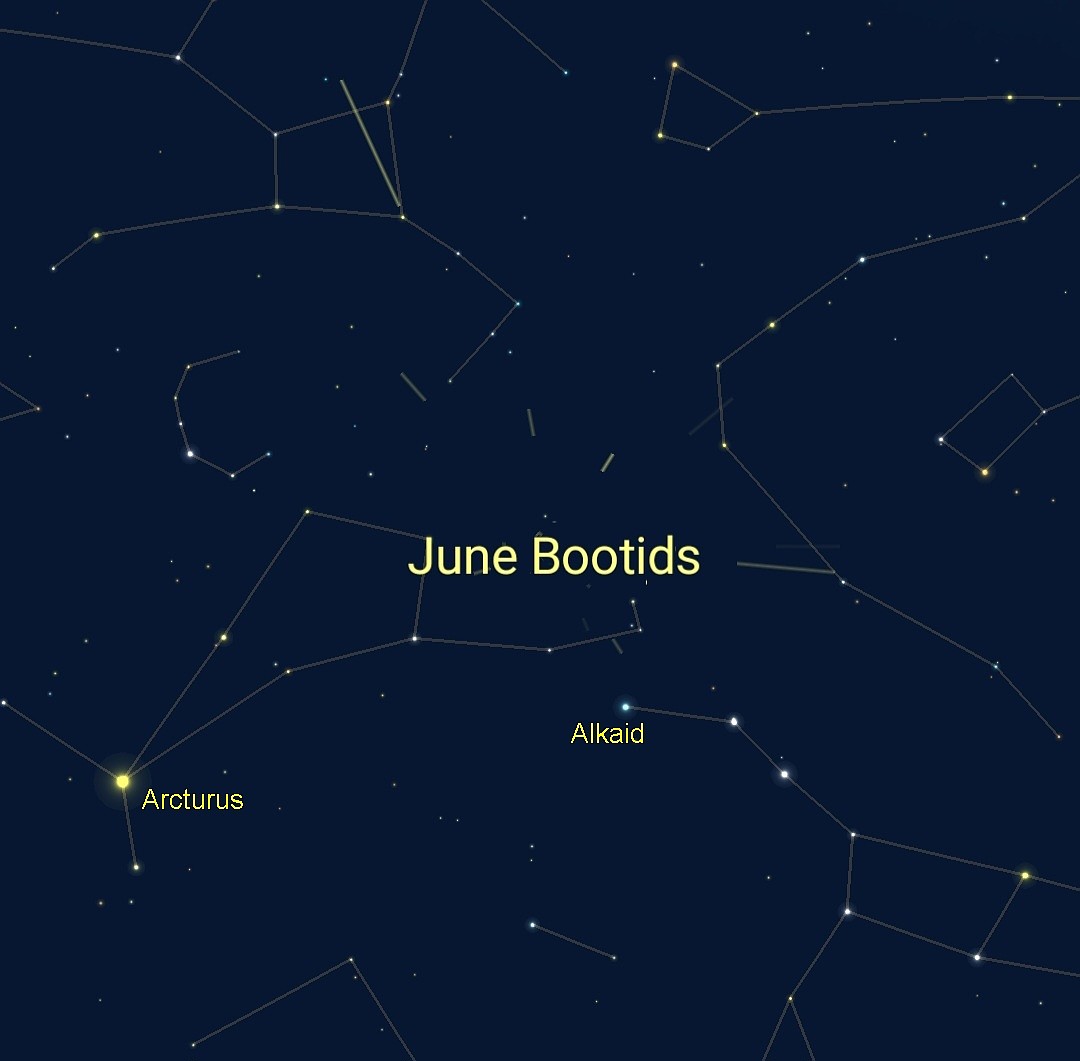
June 27 – June Bootid Meteor Shower
On the night of June 27, you may get a surprising show from the June Bootid meteor shower. Most of the time it is a rather quiescent meteor shower producing only 1 to 2 meteors per hours. On rare occasions though it can produce as many as 50 to 100 meteors per hour! Either way, it surprises with bright, slow-moving meteors lighting up the night. Look high in the Western sky, after dark, between the bright star Arcturus and the last star in the Big Dipper’s handle (Alkaid) This event is a great reason to spend some time outside after dark even though the Moon will be almost full. Remember that these meteors can appear anywhere in the sky!
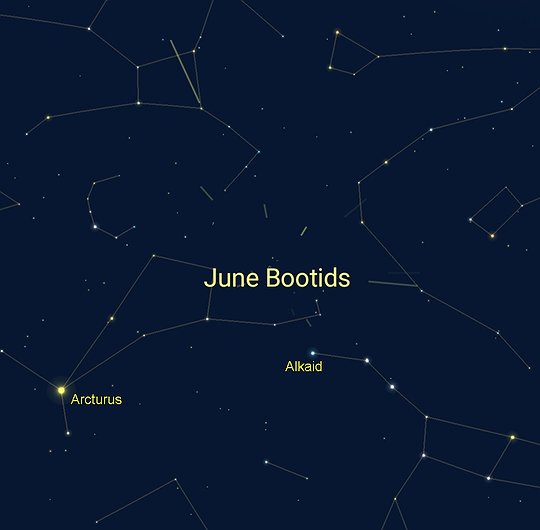 Image courtesy of John Taylor and Stellarium
June 29 – Full Moon, The Strawberry Moon
The Moon will be located on the opposite side of the Earth as the Sun and its face will be fully illuminated. This full Moon was known by some early Native American tribes as the Strawberry Moon because it signaled the time of year to gather the ripening fruit. This Moon has also been known as the Rose Moon and the Honey Moon.
Lastly, whether you’re choosing your first telescope, setting up gear, tracking down night sky objects, or diving into astrophotography, just ask at:
http://ncmrrimrockobservatory.space/contact/
• • •
John Taylor is an amateur astronomer who lives in Hayden.