
Grim outlook for fire season
CAROLYN BOSTICK | Hagadone News Network | UPDATED 1 month AGO
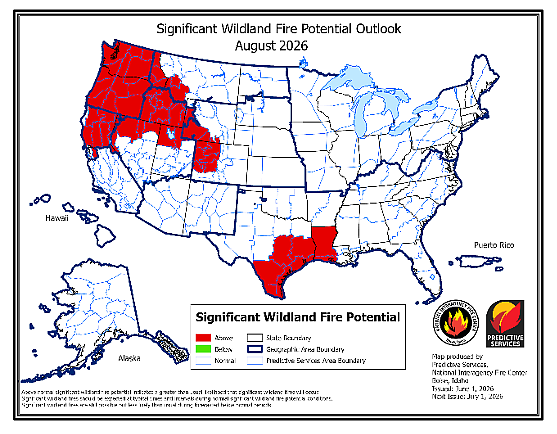
The Idaho Panhandle is expected to face significant wildland fire potential this summer according to forecasts drawn from represent the cumulative forecasts of the ten Geographic Area Predictive Services units and the National Predictive Services unit.
The wildfire potential in August is significantly above the norm for North Idaho.
Courtesy photo
Carolyn Bostick has worked for the Coeur d’Alene Press since June 2023. She covers Shoshone County and Coeur d'Alene. Carolyn previously worked in Utica, New York at the Observer-Dispatch for almost seven years before briefly working at The Inquirer and Mirror in Nantucket, Massachusetts. Since she moved to the Pacific Northwest from upstate New York in 2021, she's performed with the Spokane Shakespeare Society for three summers. | June 5, 2026 1:08 AM
Policy changes and cuts could affect wildfire preparedness, response and recovery across the country, including Idaho, officials said Tuesday.
During a webinar with the Center for Western Priorities, fire experts said there is an above-normal potential for summer wildfires.
“With historical lows in the snowpack in most of the United States under drought conditions, we’re also facing significant workforce reductions,” said Andrea Delgado, who has a background with the U.S. Forest Service.
Delgado clarified after the webinar that with few exceptions, nearly every state saw less wildfire risk reduction work completed in 2025. In the West, the exceptions were Wyoming, Utah, and New Mexico.
Hawk Eye Strategies LLC, founded by Delgado, analyzed staffing cuts across federal agencies impacting public lands and tallied more than 26,000 staff lost. About 35% of those cuts were in Western states.
She said the positions included scientists, engineers and dispatchers.
Every state saw less wildfire reduction work completed in 2025, Delgado said.
Thinning, prescribed burning and other wildfire mitigation in national grasslands fell by 35% in 2025 compared to 2024 because of federal cuts affecting staffing for programs that support preventative wildfire services.
“That translates to 1.4 million fewer acres treated compared to 4.1 million acres in 2024,” Delgado said.
That comes to about six times the size of Rocky Mountain National Park that didn’t get treated last year.
She sees those who deal with wildfire prevention to be on the edge of a figurative blade when it comes to wildfire potential.
“The question is whether the agencies and bureaus responsible for risk mitigation and wildfire response, whether they have the workforce in place to be doing the work,” Delgado said.
The wildfire mitigation work is crucial, Delgado argues to give firefighters “a fighting chance” to reduce harm to life, property and resources.
Hugh Safford currently works at the Department of Environmental Science and Policy University of California-Davis and is formerly a part of the U.S. Forest Service.
“I think the major problem in fire management is the sudden and what I think is shocking disavowal of everything we’ve learned over the last 60 years,” he said.
Grassroots Wildland Firefighters Vice President Bobbie Scopa said she is concerned about the numbers for the support staff at fire caches throughout the country.
In her work as a former operations section chief for the U.S. Forest Service, Scopa raised an alarm about the cuts impacting incident management teams called in when a fire exceeds an initial attack.
A large fire could have between 50 to 70 people manage the response to it.
“The person calling that in is not a firefighter, they’re impacted by all of these cuts going on,” Scopa said.
While expressing confidence in those involved directly in wildland firefighting efforts, she was concerned about people with less expertise responding in less optimal ways.
“There might be pressure to take actions that look like they’re more aggressive, but they don’t make sense and they’re not safe,” Scopa said.
North Idaho Wildfire Outlook:
According to the National Significant Wildland Fire Protective Outlook, above-normal significant fire potential is forecast across much of the West in June, including most of the Inland Northwest.
In July, above normal potential will spread into the Idaho Panhandle, southwest Montana, southwest Oregon and northwest Washington.
For August, potential will spread to all the Idaho Panhandle and much of southwest Montana.
For September, above normal potential will continue across most of the northwestern U.S., but return to normal in the Idaho Panhandle.
**** Editor's note: This story has been updated to include a clarification after publication from Delgado that nearly every state saw less wildfire risk reduction work completed in 2025. In the West, the exceptions were Wyoming, Utah, and New Mexico.
ARTICLES BY CAROLYN BOSTICK

Water skiing couple goes after world record on Hayden Lake
Water skiing couple goes after world record on Hayden Lake
It was an unlikely goal to pursue. Jonathan Dance had an idea to have his parents, Richard and Julienne Dance, break a Guinness Book of World Records challenge.
Smokey spreads fire safety awareness in Hayden Lake
New sign will offer the latest on conditions
The current fire danger level at Hayden Lake sits at moderate.

Rita Case opens curtain as families fill NIC theater for free show
Rita Case opens curtain as families fill NIC theater for free show
It was a night of princess dresses and magical memories on Monday at Boswell Hall at North Idaho College. There was more than just the magic of the theatre at play, however.