
Warm May temperatures accelerate snowmelt, reduce snowpack
Natural Resources Conservation Service | Lake County Leader | UPDATED 2 days, 3 hours AGO
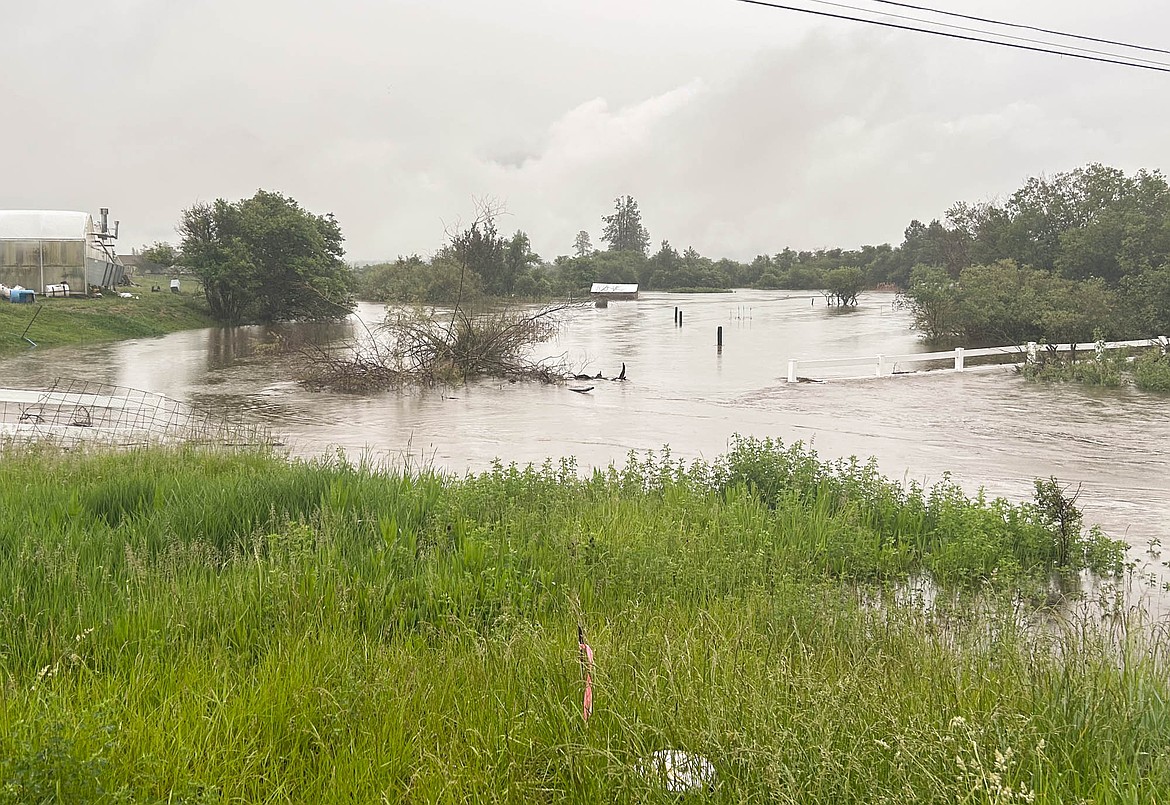
The field behind Bev’s Bloomers south of Ronan was filled with water from overflowing Crow Creek on June 1. (Emily Messer/Leader)
Montana’s snowpack rapidly melted with warm temperatures in May, and by June 1 was largely below 50% of median, a considerable degradation from May 1, where snowpack ranged from 55% to 90% of median.
Exceptions are the Flathead, Clark Fork and Upper Yellowstone basins which still held 50% to 70% of median snowpack. Spring storms helped maintain snowpack in the Flathead and Clark Fork basins, while high elevations supported the Upper Yellowstone basin.
“Late spring snowpack percentages rarely tell the whole story,” said Florence Miller, USDA Natural Resources Conservation Service hydrologist. “When evaluating a season’s snowpack, peak accumulation and snowmelt timing provide a more comprehensive picture.”
This year’s snowpack followed regional and elevational trends. Higher elevation SNOTEL snow monitoring sites in the Flathead, Clarks Fork, and Upper Yellowstone basins saw near to above normal snowpack accumulation. Higher elevation SNOTELs across the rest of the state received 65% to 90% of a typical season’s snowpack.
Warm temperatures depressed lower elevation snowpack statewide, with most lower elevation SNOTELs receiving less than 65% of a typical year's snow.
Most basins saw peak snowpack accumulation in mid-March, about a month earlier than normal. This continued into an early snowmelt season. While some higher elevation SNOTELs retained a respectable snowpack, warmer than normal temperatures in May has caused the majority of the state’s snowpack to melt into streamflow.
Of the 145 SNOTELs associated with Montana basins, 111 have melted out, and 66 of these had the earliest or second earliest melt out date on record.
May precipitation patterns further accentuated the snowpack’s spatial distribution. The northwest and Upper Clark Fork received near to above normal precipitation in May, largely due to end-of-the-month storms. Water-year-to-date precipitation remains above normal in these regions.
Southwest Montana received well below normal precipitation in May. Water-year-to-date precipitation is still buffered by the December atmospheric river but has settled to near or slightly below normal values.
West of the Continental Divide remains the only region of the state currently drought free. Drought conditions are widespread east of the Divide, and extreme drought conditions have intensified in southwest Montana and expanded into eastern Montana. However, the late May precipitation reduced the extent of extreme drought in the Golden Triangle region of north central Montana.
NRCS Water Supply Forecasts vary with snowpack and precipitation statewide. West of the Divide, more positive streamflows are expected. Regions that received significant rainfall from the late May storm, such as the Mission Mountains and Rocky Mountain Front, saw improvements to streamflow predictions.
East of the Divide – except for higher elevation watersheds in the Upper Yellowstone and Bighorn –water supply forecasts dropped from last month.
For the June-July forecast period, streamflows are largely expected be near normal in the Clark Fork and Kootenai basins, with some forecast points below normal. Streamflow from the Mission Mountains and Rocky Mountain Front is predicted to be near to above normal. The Flathead and St. Mary Basins are predicted to see 80% to 90% of normal streamflow. Rapid snowmelt decreased Bitterroot forecasts to around 60% of median streamflow.
The Jefferson, Madison, Gallatin, Smith, and Musselshell basins are forecast to have 70% or less of their normal streamflow. The Upper Yellowstone basin is forecasting 70% to 80% of normal streamflow, while the Bighorn and Lower Yellowstone are predicting 60% to 70% of normal streamflows.
Higher elevation watersheds draining the Absaroka-Beartooth and Wind River ranges are forecasting 75% to 100% of normal streamflow. The Powder and Tongue basins are predicting severely reduced streamflows of less than 60% of median.
“Continued June precipitation could help improve these forecasts, though in most regions east of the divide, full recovery to normal streamflows is unlikely,” said Miller. Additionally, with snowmelt occurring earlier than normal, runoff volumes are likely to be shifted earlier in the season.”
A full report of conditions on June 1 can be found in the monthly Water Supply Outlook Report available on the Montana Snow Survey website. In addition, real-time snow survey data can be found at nrcs.usda.gov/montana/snow-survey.