
Future of aviation discussed at Flightpath presentation
CHERYL SCHWEIZER | Hagadone News Network | UPDATED 2 months, 3 weeks AGO
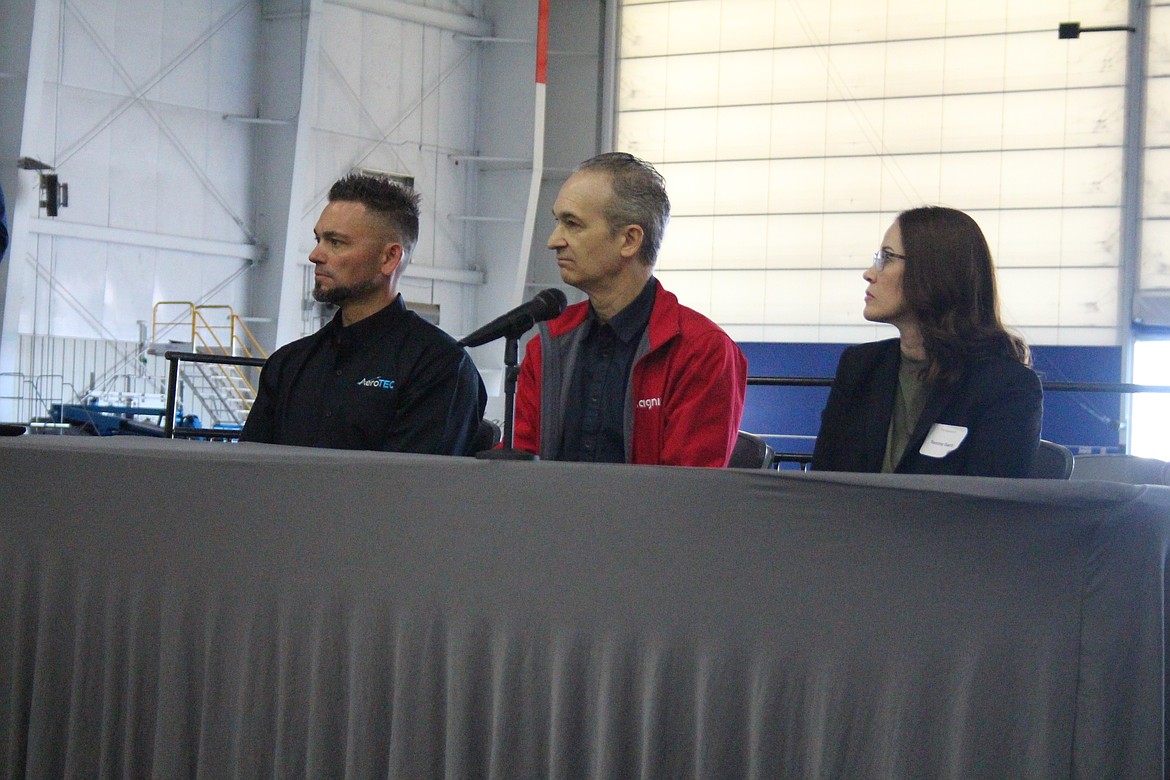
From left: Aerospace executives Justin Morigeau, Michael Toberman and Tommy Gantz discussed the present and future of aviation during a presentation Thursday in Moses Lake.
CHERYL SCHWEIZER/COLUMBIA BASIN HERALD
Senior Reporter Cheryl Schweizer is a journalist with more than 30 years of experience serving small communities in the Pacific Northwest. She began her post-high-school education at Treasure Valley Community College and enerned her journalism degree at Oregon State University. After working for multiple publications, she has settled down at the Columbia Basin Herald and has been a staple of the newsroom for more than a decade. Schweizer’s dedication to her communities and profession has earned her the nickname “The Baroness of Bylines.” She covers a variety of beats including health, business and various municipalities. | June 12, 2026 3:45 AM
MOSES LAKE — Central Washington has a lot to offer aviation and aerospace businesses, but workforce development and the state’s business climate are causing some challenges. The future of aviation in Washington and the Columbia Basin in particular was one of the topics of discussion at a daylong aviation presentation at the Port of Moses Lake.
The “Flightpath” program was sponsored by the Washington Department of Commerce and is one of three scheduled in airports around the state.
Aviation has a long history in Washington, as Cory Ertel, senior manager of government operations for the Boeing Corporation, pointed out.
“We’ve been around, as of next month, 110 years,” Ertel said.
As a result, said Justin Morigeau, president of AeroTEC, generations of Washington families have a connection to aviation.
“I was raised on Boeing paychecks,” he said. “My parents were raised on Boeing paychecks, and there’s deep, deep lineage there that’s very important to me and my family, and I’m passing that down to my kids.”
But, said Tommy Gantz, business development manager for TLG Aerospace, aviation requires a specialized workforce, and those employees are in high demand elsewhere.
“Typically, with the type of work we do, we need a very, very highly skilled workforce,” she said. “We're not in a position to take someone and train them from the grounds up on loads and flutter. It's very, very specialized. If you're not getting them coming out of college with that level of technical expertise, and then the area that they're residing in doesn't have a cost of living that's sustainable, that obviously complicates the workforce picture.”
Morigeau said the industry should work to heighten interest among young people.
“You’ve got to invest in the kids, you’ve got to make aerospace interesting,” he said. “Those sparks are what eventually gets people like you sitting in the seat right now. If that spark’s not there, guys, this room in 20 years might be empty.”
Morigeau said state officials need to look at regulations and its effect on business development.
“We need to make it less restrictive to operate in this state,” he said.
Gantz cited the case of an aviation customer who wanted to build in Washington.
“It was going to take them longer to get the permitting to begin developing the infrastructure for what they had than it would have taken them to develop the aircraft,” she said. “I've heard of a number of businesses (where) the permitting processes for commercial development and expansion have been so prohibitive, they haven't been able to achieve that here.”
Aviation has been important to Grant County since training bases were established in World War II, and Morigeau said the Port of Moses Lake has some advantages.
“Our goal is to help our clients get their product to market as fast as possible, so we act as an extension of their team,” Morigeau said. “They have an idea, they have a design, a concept, they bring that to us; we do the full design integration, and we go test that. What makes Moses Lake particularly great for that is the degrees of freedom that we have. You can take a 200-foot-long aircraft and whip it around the middle of the runway and take off again without any issue whatsoever.”
Port officials are willing to work with customers, he said, when they are testing equipment.
“That freedom is what enables our customers to test and try out their equipment very, very quickly, (and) it makes this area unique,” Morigeau said. “If we try to do that in Seattle, that’s going to be very difficult.”
Gantz and Michael Toberman, program manager for magniX, said the port’s flexibility makes it possible for their businesses and their customers to carry out research and experimentation.
“Many of the projects we were on from the design and analysis side end up having a lot of the flight test elements done here,” Gantz said.
Toberman said magniX is researching electric and hybrid aircraft engines and battery technology, since that’s the way the industry is trending.
ARTICLES BY CHERYL SCHWEIZER
Road projects on hold for Labor Day weekend
MOSES LAKE — With Labor Day weekend dead ahead, drivers will be able to move freely about the state. Most road projects are on hold for the holiday weekend. Nobody will be working on the Hansen Road overpass on Interstate 90, but the lane restrictions that are in effect will continue through the end of the project.
Cost estimates for water source alternatives given to Moses Lake City Council
Protected under the U.S. Endangered Species Act, efforts are ongoing to keep it self-sufficient
MOSES LAKE — It’s going to cost a lot of money to provide alternative water sources for the city of Moses Lake, but some of the possible alternatives will cost more than others. City officials provided the Moses Lake City Council with costs for various alternatives Tuesday.

Dryer vent cleaning is important -- but often overlooked
MOSES LAKE — Not all the maintenance a house needs is visible. Sometimes a potential problem just goes unnoticed until it causes trouble, sometimes serious trouble. But a lot of potential problems give off warning signs. Clothes dryers often do when they need a good cleaning.