
What’s inside? The story behind Coeur d’Alene’s historic time capsule
STEPHEN SHEPPERD/Moving History Forward | Coeur d'Alene Press | UPDATED 2 weeks, 6 days AGO
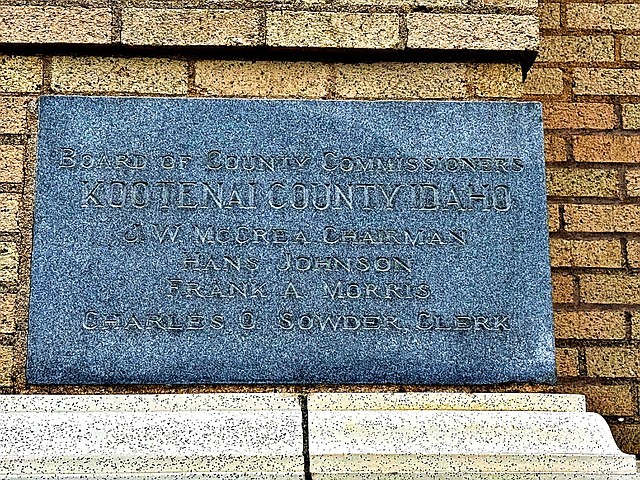
A shot of the Kootenai County Courthouse cornerstone's inscribed face.
Stephen Shepperd Photo
During my research on the story of the historic “time capsule” recently retrieved from behind the Kootenai County Courthouse cornerstone, I found it interesting that there was never a mention of a time capsule in the newspaper coverage of the laying of the cornerstone by the Masons in 1926. Repeated searches of contemporary newspapers of the time brought up nary a word about a “time capsule.”
The Coeur d’Alene Press made no mention of a time capsule in its coverage of the event, and the Spokesman-Review article reported only a “casket” being placed under the cornerstone by the officials of the Masonic Grand Lodge of Idaho that day. However, both newspapers provided a list of the items encased in (or under) the granite stone — lists that read very much what might be found stored with a cornerstone. But nowhere did they once call it the contents of a time capsule.
It was obvious that further research was needed. By definition, “time capsules” are curated collections of historical records and/or objects that have been placed in a container with the intention of communicating with future generations. In each case, a set date is attached to it that indicates when the container can be opened.
The term time capsule was coined in 1938 by a public relations consultant, George Pendray. He used it to describe the 90-inch long, 800-pound copper-alloy capsule that the company he was working for, Westinghouse, intended to have buried the following year on the site of the 1939 World’s Fair in Flushing Meadows, N.Y. You will have to wait a long time to see the Westinghouse capsule opened. The directions provided for its exhumation say that it cannot be opened for another 5,000 years or specifically the year 6939. The Westinghouse time capsule contained everyday items, a newsreel and a letter from Albert Einstein.
Placing a “casket” in a cornerstone has a much longer history than burying a time capsule. It is typically part of a formal cornerstone laying ceremony, which is one of the oldest and most formal ceremonies performed by the Freemasons of the Masonic Lodge. It is typically done when a public building, a school, a church or a Masonic Temple is being constructed and a cornerstone is laid.
It is perhaps called a casket because of its similarity in shape to the funerary box that is used for burying human remains. It is most often a rectangular metal box that is designed to be filled with contemporary historical records so if a building ever falls or is demolished, future generations have the opportunity to look back on how life was lived during the era the structure was built.
No set date is ever attached to it, telling when the box is to be extracted and opened. It is intended to only be opened when the life of the building has come to an end by accident (or on purpose).
The oldest known casket to have been placed with a cornerstone in the United States is within the walls of the Massachusetts State House. It was put there during a ceremony in 1795 by then-Governor Samuel Adams and Paul Revere, and it remains there to this day.
Common casket contents include newspapers, photos, coins, religious texts and rosters of public officials or students.
To see what was placed within the Kootenai County Courthouse casket and also the new Courthouse Time Capsule, you will need to attend the USA 250 Celebration scheduled for the Old Courthouse lawn at Garden Avenue and Government Way on July 3 at 1:30 p.m.