
Montana snowpack rapidly melted in May
MICAH DREW / Daily Montanan | Coeur d'Alene Press | UPDATED 2 weeks, 4 days AGO
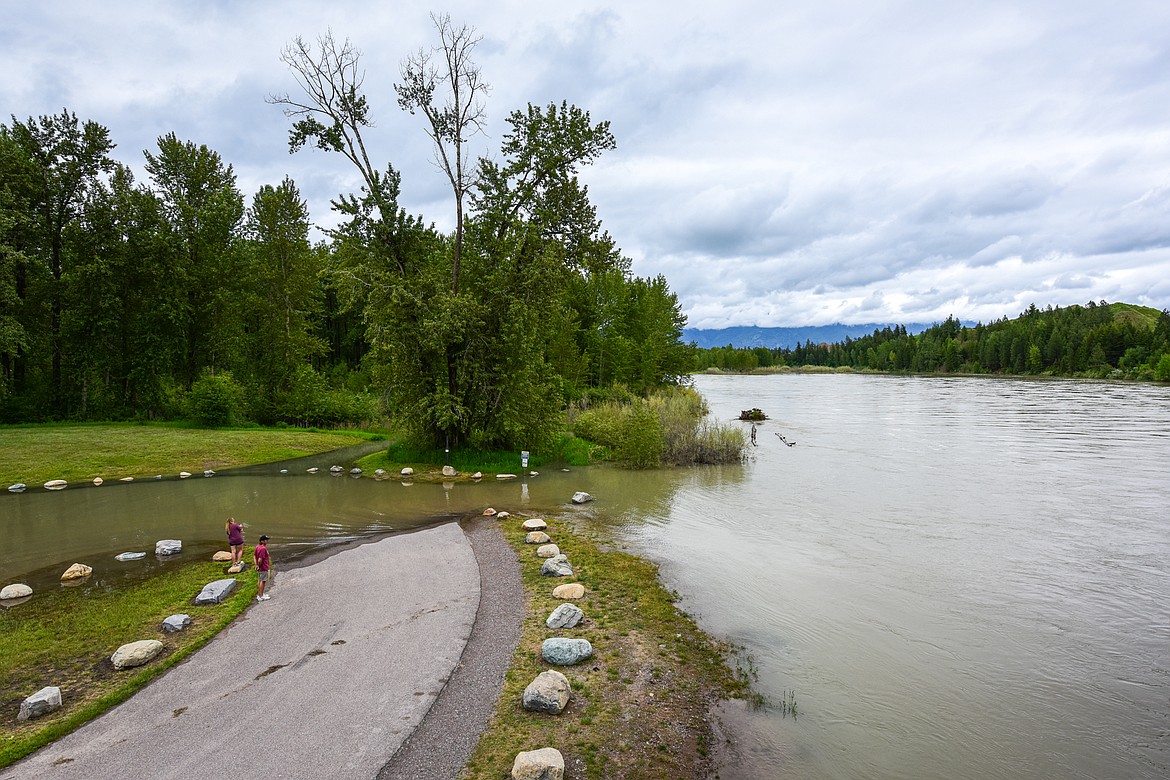
People stand along the banks of the swollen Flathead River at the Old Steel Bridge Fishing Access in Evergreen on Tuesday, June 2. (Casey Kreider/Daily Inter Lake)
Casey Kreider
Throughout May, warm temperatures across Montana led to a rapid melt of the state’s snowpack, which sits “largely below 50% of median,” as of June 1.
That’s according to the U.S. Department of Agriculture’s Natural Resources Conservation Service, which released its June Water Supply Outlook Report last week.
“Late spring snowpack percentages rarely tell the whole story,” said Florence Miller, USDA Natural Resources Conservation Service Hydrologist, in a press release. “When evaluating a season’s snowpack, peak snowpack accumulation and snowmelt timing provide a more comprehensive picture.”
Even though some higher elevation sites, including those that feed into the Flathead, Clark Fork and Bitterroot basins, saw near- or above-normal snowpack accumulation for the season, “snowpack accumulation peaked and transitioned to melt in mid-March, about a month earlier than usual.”
The NRCS report shows that snowpack is around 55% to 70% of the 30-year median in the northwest, but at or below 50% of the median in the rest of the state as of the start of June, following rapid melting in May.
Of the 145 SNOTEL sites that track data for Montana’s river basins, 111 have melted out, with 66 experiencing the earliest or second-earliest complete meltout on record. Snowmelt plays a key role in agriculture, hydropower production, water storage, aquatic ecosystem health, recreation such as boating and fishing, and flood and drought forecasting.
The St. Mary basin, which stretches into Alberta, shows the highest snowpack percent of normal — 72% — followed by the upper Clark Fork at 69%, the Flathead basin at 66% and the Lower Clark Fork at 56%.
Due to major storms last fall at the start of the water year and late-spring precipitation, the state is showing overall precipitation on par with normal values. Still, both early- and late-season storms occurred under warmer conditions, resulting in less snow to buffer summer streamflows.
In the final water supply outlook report for the season, forecasts indicate that streamflow across the state is unlikely to exceed the 30-year median on most rivers. However, a high-precipitation summer could bolster the water supply.
Starting in the state’s northwest corner, streamflow forecasts for the Clark Fork and Kootenai basins are near normal, while the Flathead and St. Mary basins are expected to be around 80%-90% of normal streamflow.