
El Niño has been declared
RANDY MANN / WEATHER OR NOT | Coeur d'Alene Press | UPDATED 2 weeks, 1 day AGO
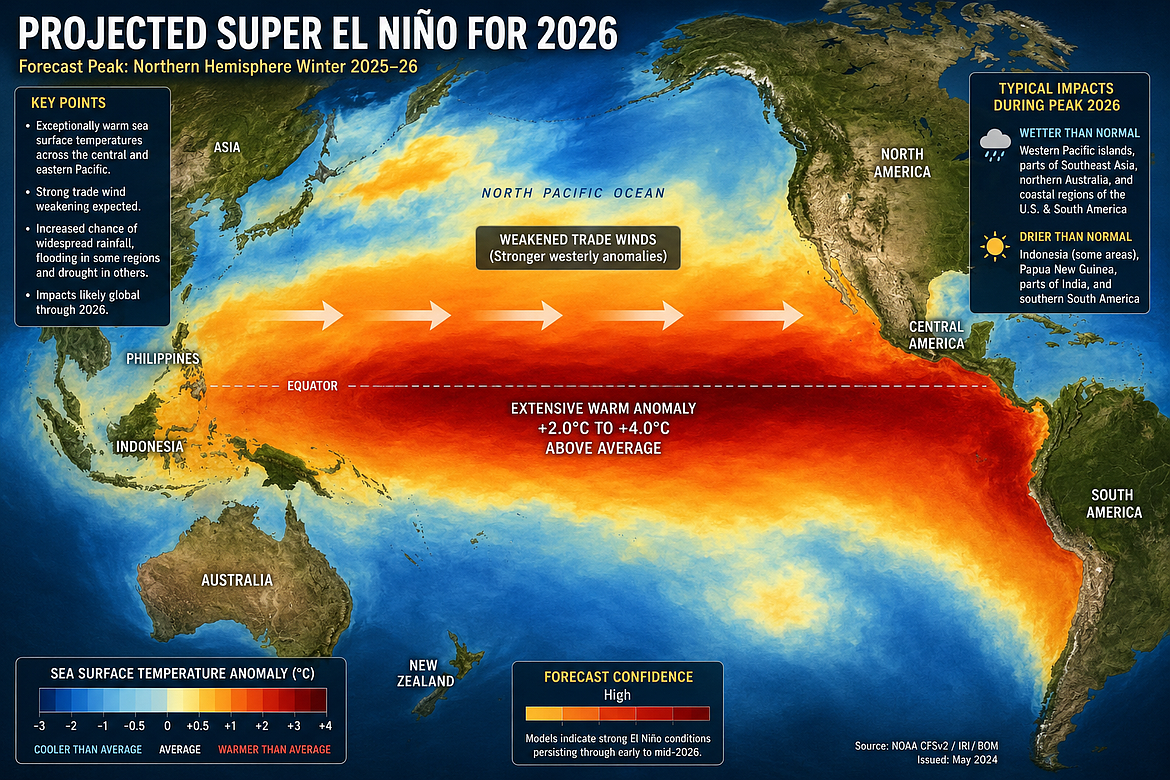
Since early this year, we’ve been talking about the potential of a strong El Niño forming in the waters of the south-central Pacific Ocean. Last week, the Australian Bureau of Meteorology and NOAA declared that El Niño conditions are present as sea-surface temperatures continue to warm. In fact, readings near the West Coast of South America are approximately 4 degrees higher than average. Many forecasters still claim that ocean waters will likely continue to climb in the coming months, leading to what could be one of the strongest El Niños in recorded history by the end of the year. Currently, NOAA has a 63% probability of a very strong event.
As mentioned in previous articles, an El Niño is a climate phenomenon, primarily along the Equatorial regions, that scientists measure using a combination of oceanic and atmospheric indicators. The most important method for measuring El Niño and La Niña events is monitoring sea surface temperatures (SSTs) in the central and eastern equatorial Pacific Ocean. Scientists compare current, weekly and monthly temperatures to long-term averages to calculate anomalies. When ocean temperatures in regions along the equator are at least a degree above average for at least several consecutive months, forecasters will determine that El Niño conditions are occurring. However, if these sea-surface temperature anomalies rise above about 2.7 degrees, the event is classified as strong. This temperature-based index, often referred to as the Oceanic Niño Index (ONI), is the primary standard used worldwide.
During an El Niño event, a region of the equatorial waters that stretches approximately 6,000 miles from the western coastline of South America to the International Dateline warms by as much as 4 degrees. The warming is enough to completely alter normal wind, rainfall and temperature patterns across the globe.
The primary cause of El Niño is a weakening of the trade winds, located in Earth's equatorial and tropical regions, normally blow from east to west across the tropical Pacific Ocean. Under normal conditions, these winds push warm surface waters toward Indonesia and Australia, where sea levels are slightly higher and ocean temperatures are warmer. As warm water is pushed westward, cold, nutrient-rich water rises to the surface along the west coast of South America through a process called upwelling. This pattern helps maintain the normal distribution of ocean temperatures across the Pacific. However, when the trade winds weaken or, in some cases, temporarily reverse direction, the warm water that has accumulated in the western Pacific starts moving eastward toward the central and eastern Pacific Ocean. As sea-surface temperatures rise over a vast area the warmer ocean surface release more heat and moisture into the atmosphere, which often alters weather patterns around the world.
Over 90% of the world’s oceans remain unexplored, and there have been theories that underwater volcanic activity has provided some influence of the warming. It’s well-known that thousands of volcanoes exist beneath the Pacific Ocean. These volcanoes release heat, gases and minerals into the surrounding water. In some locations, such as hydrothermal vents, the water can become extremely hot. However, it is believed this heating is very localized and affects only a tiny fraction of the Pacific Ocean.
One important measurement for the determination of an El Niño or La Niña involves atmospheric pressure, known as the Southern Oscillation Index. This is measurement compares air pressure differences between Tahiti and Darwin, Australia. During El Niño, barometric air pressure tends to be lower in the eastern Pacific and higher in the western Pacific, resulting in a negative SOI value. By contrast, there is a positive value during a La Niña event. With a negative value, the trade winds will usually weaken.
During an El Niño, the pressure difference across the Pacific weakens or even reverses. Air pressure becomes higher than normal over Australia and Indonesia and lower than normal over the central and eastern Pacific. As a result, the trade winds weaken and warm water that had accumulated in the western Pacific often spreads eastward across the equatorial Pacific. According to NOAA, a sustained pressure difference of -7 indicates an El Niño. The latest figure is -21, which may be pointing to a very strong El Niño later this year.
Although scientists understand the general processes that cause El Niño, predicting exactly when an event will occur remains challenging. The Earth’s climate system is highly complex, and small variations in ocean temperatures, wind patterns and atmospheric conditions can influence the timing and strength of an El Niño.
In terms of our local weather, despite some recent showers and a few thunderstorms, may locations across the Inland Northwest continue to be drier than normal. The long-range computer models indicate that June may be another drier-than-normal month. Looking farther down the meteorological roadway, our upcoming summer season is still expected to start out drier and warmer than normal, but as sea-surface temperatures warm, we could start seeing moisture from the south later in the summer and fall from a stronger sub-tropical jet stream. Stay tuned.
• • •
Contact Randy Mann at [email protected].