
Retiring bio station director’s love for lakes leaves lasting impact
HAILEY SMALLEY | Hagadone News Network | UPDATED 4 months, 1 week AGO
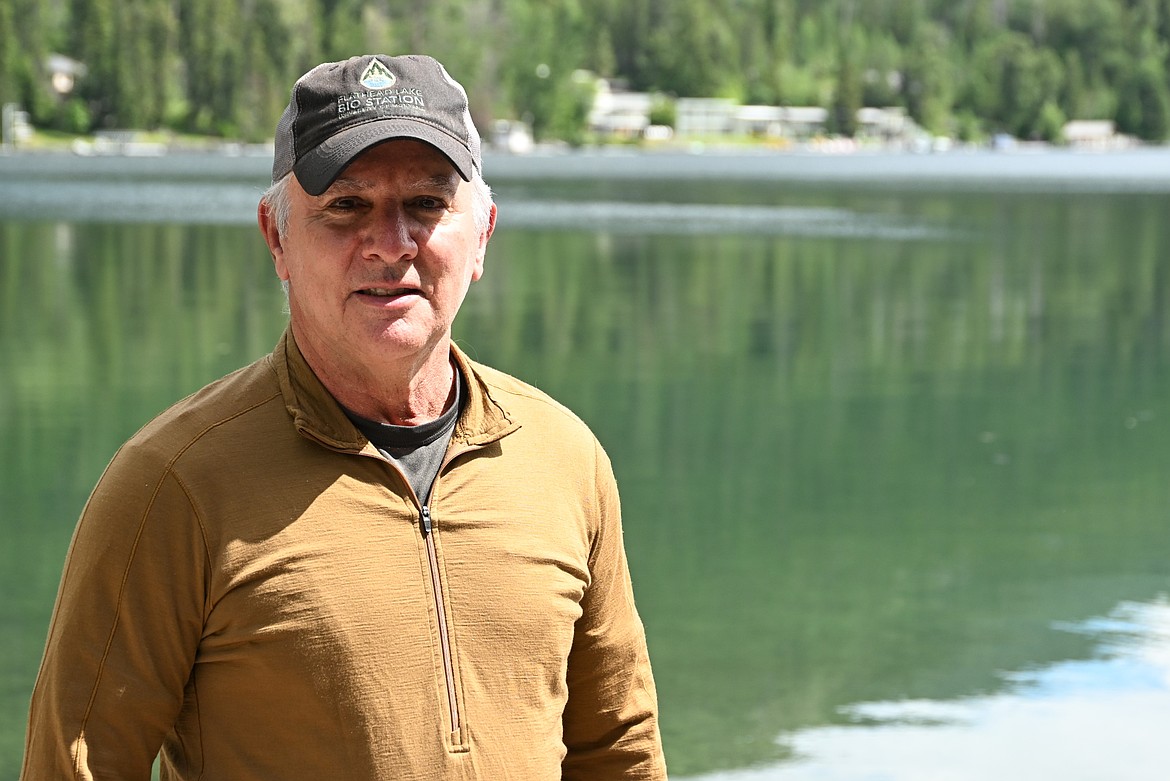
Jim Elser will retire this year, after serving as the director of Flathead Lake Biological Station for 10 years. (Hailey Smalley/Daily Inter Lake)
Jim Elser met two of his greatest loves at once.
The sophomore biology student was taking summer classes at the University of Notre Dame’s field station in Wisconsin when he came face-to-face with the woman he would marry and the subject he would spend the next 40 years researching.
“It’s kind of a romantic story,” said Elser. “I fell in love with my wife, and I fell in love with lakes, and the rest is history.”
This autumn, Elser will officially close the book on part of that history when he retires from his role as director of Flathead Lake Biological Station.
Growing up, Elser didn’t think a career in biology was possible.
The only scientist he knew was his father, who worked as a physician, and the sight of blood made Elser’s stomach churn. He much preferred to examine the living worlds that swam through the streams outside the industrial Connecticut town he called home.
“I guess I was a tree hugger, but I didn’t have a very realistic view of science or what a scientist does,” said Elser.
It was only after meeting his mentor, Steve Carpenter, at the field station that Elser realized he could get paid to pursue his childhood hobbies. By the end of the summer, he was head over heels for limnology, the study of lakes and other inland waters.
Many of his early dates with Monica, the woman he met at the field station, involved driving to a nearby lake in the beat-up car Elser inherited from his grandfather, a small plastic boat haphazardly strapped to the top. The duo paddled out to the center of the lake and dipped vials beneath the water, collecting samples that Elser would then spend hours poring over.
After graduating from the University of Notre Dame, the pair enrolled in a master’s degree program in ecology at the University of Tennessee. They briefly returned to the University of Notre Dame to work in Elser’s mentor’s lab, and Elser completed a doctorate degree at the University of California Davis before the couple decided to shift their lives, once again, to Arizona State University.
The desert was, admittedly, a strange place for a limnologist to build his career, but Elser said the new environment also gave him a chance to stand fully on his own, apart from the guidance of more well-established hydrologists.
“Being the only lake guy for 100, 200 miles ended up being good for me because I had to justify my existence,” he said.
Over the next 25 years, Elser published hundreds of scientific studies on lakes across the world. He spent his summer breaks and sabbaticals studying tarns in remote Alaskan wildernesses, alpine lakes in China and springs in the Mexican desert. Closer to home, Elser helped develop and led the Sustainable Phosphorus Alliance, a nonprofit that aims to facilitate more sustainable management practices for phosphorus.
Despite his mounting success at Arizona State University, Elser admitted he had his eye on another university position, some 1,200 miles north of the southwestern desert.
Every few months, Elser pulled up the webpage for Flathead Lake Biological Station to see whether longtime director Jack Stanford had announced his retirement. Founded in 1899, the University of Montana’s field post on Flathead Lake had what Elser described as a “tremendous reputation” in the field of limnology.
Plus, “a chance to live and work on the shore of this lake is hard to pass off,” he said.
Elser’s opportunity finally came in 2016. The position hardly slowed the pace of Elser’s research. He continued to publish new research, primarily focused on ecological stoichiometry, the study of the balance of energy and chemical elements in lakes and other ecological systems.
The groundbreaking work earned Elser a spot in the National Academy of Sciences in 2019 — an honor secondary only to the Nobel Prize in the world of science.
“And they don’t give out Nobel Prizes for limnology,” said Elser.
But he said his most treasured achievements as the director of the biological station came from growing the site’s educational programs. Elser introduced two new faculty positions at the station, leading to new curriculum and research opportunities for university students.
Monica Elser, Jim’s wife, took the lead on creating the biological station’s K-12 educational program. In Arizona, Monica had built her own storied career leading the university’s sustainability education program, and she promptly set to work organizing field trips and public events that directly engaged students in the science that happened at the biological station every day.
Monica taught visiting students how to take and analyze water samples and showed off up-close images of plankton caught in the lake.
“When you put things up on the microscope, it’s squeals and laughter and screams of horror,” she said. “Even after doing it for 10 years, I still get excited.”
She estimated that, to date, the program has touched around 20,000 students from schools across Montana. Like Jim, Monica is retiring this year, leaving the K-12 program fully in the hands of Education Coordinator Kelly Minear.
Jim Elser expects he will be able to announce his own replacement this summer. The new director will likely take over operations at the beginning of 2027.
Elser said the incoming director will face a wealth of challenges. Climate change is reformulating the hydrological patterns in Northwest Montana, making the water level of Flathead Lake less predictable. Lakeside communities continue to grow and place new pressures on local water quality, and many longtime funding streams for science and environmental research have dried up under the Trump administration.
Despite the hurdles, Elser has faith in the biological station and its perpetual mission to advance the scientific understanding of water and the life that depends on it.
“It’s been here for 125 years. It’s not going anywhere,” he said. “Its mission will never be fulfilled because there’s always something else to analyze or understand.”
Reporter Hailey Smalley can be reached at 406-758-4433 or [email protected]. If you value local journalism, pledge your support at dailyinterlake.com/support.
ARTICLES BY HAILEY SMALLEY

Trump stumps for Flint in Kalispell as Election Day nears
President Donald Trump, wearing a dark suit, red tie and red USA cap, ambled into the Majestic Valley Arena to the raucous roar of a crowd.

Flathead National Forest greenlights Swan Valley timber project
A 2,307-acre timber project is now under way in the Swan Valley.
Flathead National Forest greenlights Swan Valley timber project
A 2,307-acre timber project is now under way in the Swan Valley.