
Heat waves, thunderstorms drive up late-summer wildfire risk
HAILEY SMALLEY | Hagadone News Network | UPDATED 4 months, 1 week AGO
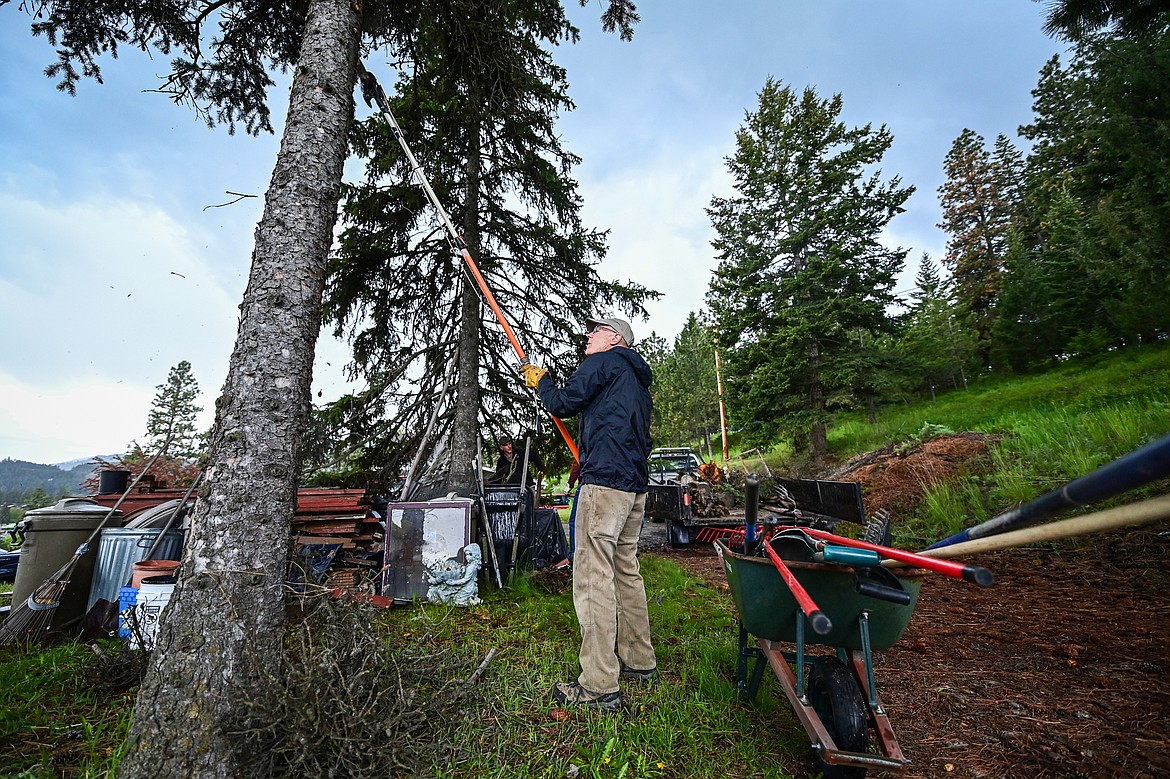
A volunteer with Fire Safe Flathead trims a tree at property in Lakeside to reduce wildfire risk on Wednesday, May 20. (Casey Kreider/Daily Inter Lake)
Casey Kreider
A wave of hot weather and late-summer thunderstorms will tee Northwest Montana and the Idaho Panhandle up for increased wildfire risk in August and September, according to forecasts from the National Weather Service’s Climate Prediction Center.
Those weather patterns are typical of an El Niño event, in which trade winds that normally push warm water away from the Pacific Coast weaken.
“Imagine you just have a bathtub of really warm water in the eastern Pacific,” said Alex Lukinbeal, a meteorologist with the National Weather Service in Missoula, at a June 9 wildfire and smoke outlook forum moderated by Climate Smart Glacier. “With all that warm water, it’s ripe for tropical activity, so that typically lends itself to more hurricanes and tropical storms in the eastern Pacific, off the western coast of Mexico.”
The warm stormfronts often push north, raising summertime temperatures across the western United States and elevating the risk of lightning strikes that can set off wildfires.
While the number of acres burned in the Northern Rockies was below average in three of four El Niño events during the past decade, Lukinbeal said minimal snowpack at lower elevations complicates predictions for the upcoming wildfire season. The little snow that had accumulated at low- and mid-elevations melted early, leaving many areas parched leading into summer. Heat waves will likely dry forests further before thunderstorms bring both an increased chance of precipitation and lightning strikes in August.
“Those are the watch out days,” said Lukinbeal.
Similarly hot and dry summer weather is upping the wildfire risk across much of the western United States and British Columbia, so Lukinbeal said some smoky days are likely this summer, even if local wildfire activity remains minimal.
El Niño events are temporary, lasting anywhere from nine months to a few years, but this year could provide hints at future norms, said Kyle Bocinsky, director of climate extension for the Montana Climate Office.
The agency predicts that average annual temperatures across the state of Montana will increase anywhere from four to five degrees Fahrenheit by 2050, with especially large spikes in average temperatures during the summer and winter months.
Precipitation is expected to increase in the spring — when Montana typically sees peak snowpack accumulation — and decrease in the summer. Coupled with warming temperatures, the seasonal shift in moisture could spell trouble for future wildfire seasons, Bocinksy said.
“It’s really going to depend on how that [springtime] water comes,” he said. “Are we going to have a winter like we had in this one, where we had low snowpack across lower elevations, or is it going to come as snow? That’s a big question.”
With so much unpredictability in the weather forces that drive wildfire risk, preparation is more important than ever, said Mike West, a fire prevention and mitigation specialist for Flathead National Forest and the coordinator of Fire Safe Flathead. There is no foolproof way to stop all wildfires from sparking, but simple acts like trimming trees, cleaning out gutters and picking up yard debris can help mitigate the spread of sparks and reduce the ignition risk for individual homes.
“And then, when we have the inevitable wildfire, whether it’s lightning-caused or human-caused, we’ll have less smoke and we’ll have less impact on the community,” said West.
Reporter Hailey Smalley can be reached at 406-758-4433 or [email protected]. If you value local journalism, pledge your support at dailyinterlake.com/support.
ARTICLES BY HAILEY SMALLEY

Trump stumps for Flint in Kalispell as Election Day nears
President Donald Trump, wearing a dark suit, red tie and red USA cap, ambled into the Majestic Valley Arena to the raucous roar of a crowd.
Flathead National Forest greenlights Swan Valley timber project
A 2,307-acre timber project is now under way in the Swan Valley.
Flathead National Forest greenlights Swan Valley timber project
A 2,307-acre timber project is now under way in the Swan Valley.