
Kalispell 'Rosie' receives American Spirit Award from National World War II Museum
ELSA ERICKSEN | Hagadone News Network | UPDATED 3 months, 3 weeks AGO
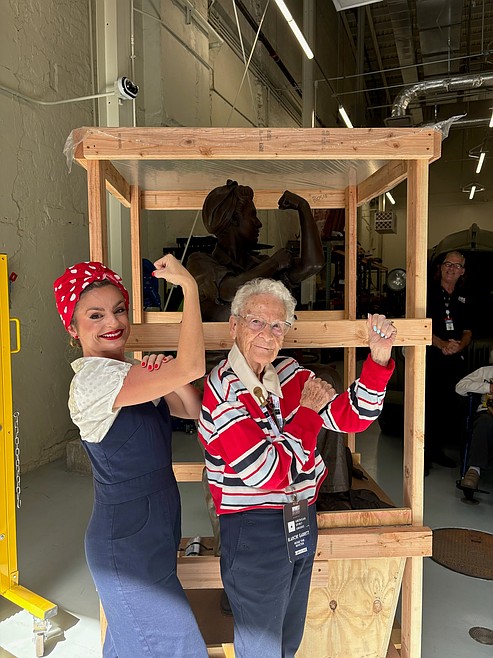
Blanche Garrett flexes with the model for the Rosie the Riveter statue at the American Spirit Awards in New Orleans from June 4 to 6. (Courtesy Blanche Garrett)
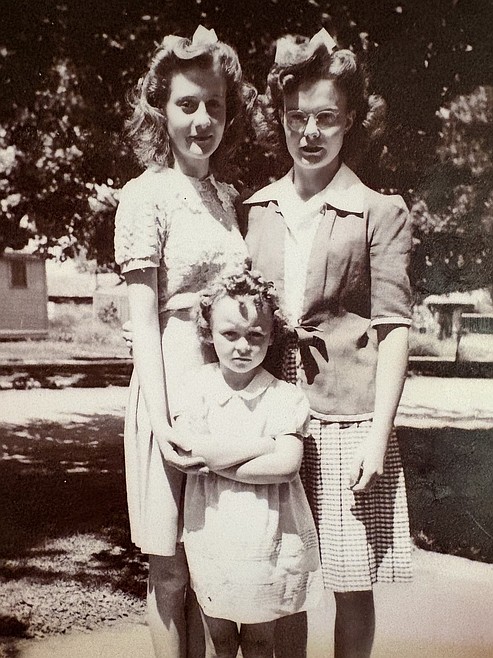
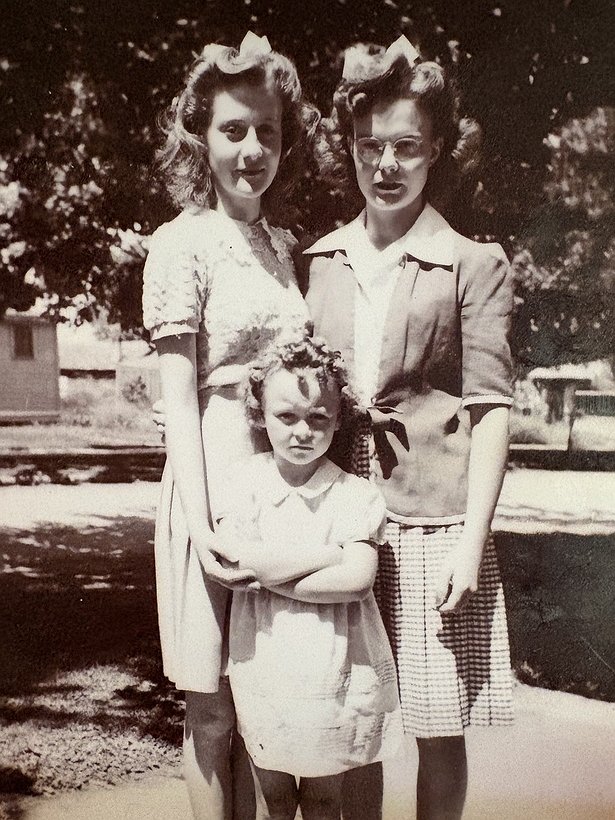
Blanche Garrett with her childhood friend Ritalee Graham. The two women worked as welders in the Oregon Shipyards during World War II. (Courtesy Blanche Garrett)
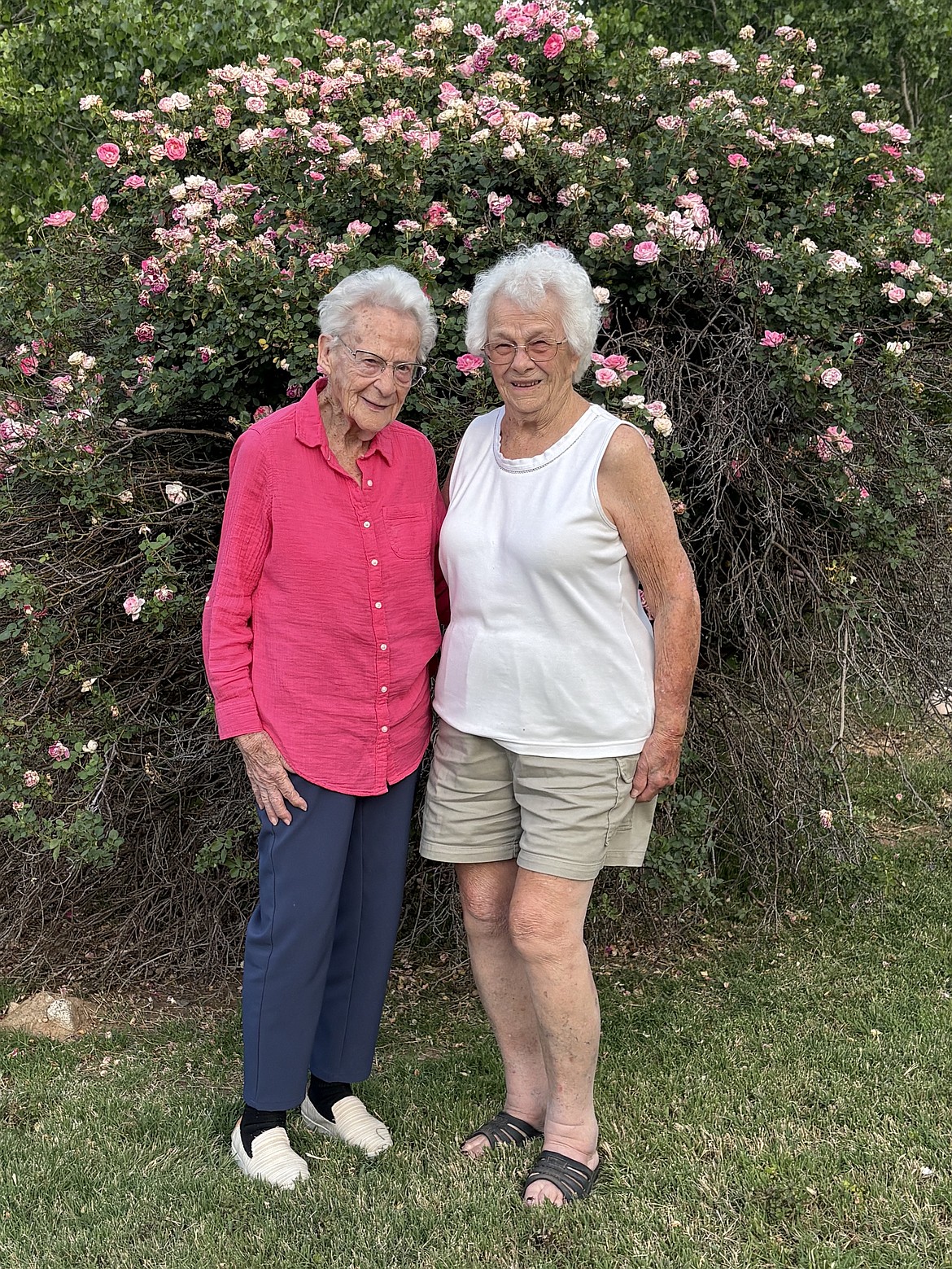
Blanche Garrett with her childhood friend Ritalee Graham. (Courtesy Blanche Garrett)
Blanche Garrett with her childhood friend Ritalee Graham. (Courtesy Blanche Garrett)
Blanche Garrett with her childhood friend Ritalee Graham. (Courtesy Blanche Garrett)
Blanche Garrett was just 15 years old when she arrived at a shipyard near Portland, Oregon, lied about her age and found a job as a welder constructing the behemoth Victory and Liberty ships that shuttled troops and cargo across the oceans to the frontlines of World War II.
“I never even considered my age,” Garrett said. She also never considered the fact that she had never used a welding rod before, but no matter. “I just figured it was something to do.”
Garrett, a Flathead Valley native, was one of the thousands of women who entered the workforce during the war. These women would come to be known as “Rosies,” a nod to the 1943 song “Rosie the Riveter” by Four Vagabonds and memorialized by the iconic J. Howard Miller “We Can Do It!” poster that became synonymous with the feminist movement in the 1980s.
Garrett was honored alongside 30 other living Rosies at the National World War II Museum’s annual American Spirit Awards, which took place earlier this month in New Orleans. The awards ceremony recognizes individuals and organizations whose work reflect the spirit of the men and women who served their country during World War II.
As women workers, the Rosies mastered technical skills and produced supplies critical to supporting the United States military and its allies abroad. Their determination and patriotism reshaped the role of women in American society.
Garrett, who will turn 100 in October, was among the youngest Rosies represented. Three of the Rosies, she said, have celebrated their 104th birthdays.
Perhaps most special was that in New Orleans, Garrett reunited with her lifelong friend Ritalee Graham, a woman she grew up with in Montana and worked alongside in the shipyard. They later raised families together.
“It is overwhelming, and I’m very proud to think that they are recognizing us,” Garrett said of the award, which is the highest honor bestowed by the museum. “I didn’t expect it, and I think it’s one of the nicest things that could ever happen to us. I didn’t do it for praise.”
No, as a teenager, Garrett struck out for the west coast and joined the war effort in search of a job, not recognition or glory. The Great Depression had not been kind to Montana, and work opportunities were sparse.
Garrett’s family relocated to Kila just a few years earlier, where her father operated a railroad tie mill and did business with the company laying down tracks between Kalispell and Spokane. The enterprise was fickle, though, and the tie mill went under when the railroad route changed.
With seven brothers, Garrett and her siblings had to work to support themselves. At 13, Garrett left home in search of employment in Kalispell.
For a couple years, Garrett juggled odd jobs with local families, until Graham suggested she try her luck in the Pacific Northwest. A few months earlier, in the wake of Pearl Harbor and the United States’ entry into the war, Graham and her father had moved to Portland to pick up work in the burgeoning shipyards.
“This was a chance for me to make some money to continue school, and that was the main reason, because there was no work here,” Garrett said.
IT WAS also her chance to do something for “the boys” overseas. One of Garrett’s brothers was in the Air Force and part of the Burma Campaign in Southeast Asia. She wanted to do her part to support him and the other troops fighting abroad.
When she arrived in Portland, Garrett was dazzled by a city that felt a world away from the life she left behind in rural Montana.
“It was amazing, just amazing, seeing those big buildings, and all the beautiful shops,” Garrett said. “To me, it was just like a dream world coming from Kila, Montana.”
On the banks of the Willamette River, though, the edges of the dream started to fray. Tens of thousands of people from around the country flocked to the shipyards of the Oregon Shipbuilding Company. Henry Kaiser, the industrial titan who revolutionized shipbuilding in the early days of the war, constructed a temporary city to house the influx of workers.
Life there was rustic. Garrett lived in a two-room cabin with Graham and Graham’s father, and they shared an outdoor shower and toilet with neighbors. Garrett trekked a mile to work each day, rain or shine, weighed down by the heavy leather welding clothes.
“I didn’t realize how humble our living conditions were at the time, but it was a great experience,” she said.
The war set a frantic pace for ship production, and in its effort to send as many vessels out to sea as quickly as possible, Kaiser’s company did not closely examine resumes. Garrett, then 15, lied about her age to meet the legal requirements and borrowed money from Graham’s father to pay the union dues. She was hired as a welder and held a welding rod for the first time when she arrived at work the following Monday.
“It was real on-the-job training,” Garrett said with a laugh. “Show up, here’s your stuff, start welding.”
THE NAME “Rosie the Riveter” is a misnomer — in reality, there were very few female riveters. To meet the demand, shipbuilders turned to welding to pump out Liberty and Victory ships.
By 1943, women made up more than 10% of the workforce and played a large role in assembling the first generation of welded ships, according to the National Parks Service.
While Rosie the Riveter is the enduring image of female workers during the war effort, “Wendy the Welder” is an equally apt description for women like Garrett.
Garrett worked on an assembly line with 16 other women, welding bulkheads to the deck of a Victory Ship. At first, everything about the job was exciting: the thick leather gloves, the UV-filtering helmet, the welding stinger.
But Garrett quickly became bored with the same repetitive motions. Seeking a challenge, she requested additional training. She was sent to the naval welding school where she received her first formal welding training and learned the skills to tackle overhead and vertical welds.
When she returned to the Oregon Shipyard, her newly acquired skillset and small stature were valuable assets, and she was put to work in the confined spaces in the bow of the ship.
At the same time Garrett was learning the welding trade, she was being courted. Reuben Garrett had followed her to Portland, where he picked up the nickname “Monty” — short for Montana. He asked Garrett to marry him in 1944. She was just 17, and the young couple moved back to the Flathead Valley, where they had three daughters.
Like so many other women who worked during the war, Garrett didn’t return to domestic life. While raising her family, she worked as a bookkeeper and then in the county’s Clerk and Recorder’s Office. In 1963, Garrett obtained her real estate license, and, with the plucky determination that propelled her through the shipyards, became the first female real estate agent in the Flathead Valley.
At the American Spirit Awards, Garrett was honored to be among women who shared the same experiences she did during World War II, and especially to be reunited with Graham, who has since moved to Arizona.
Mostly, the awards ceremony showed Garrett, perhaps for the first time, that the work she did as a teenager was something out of the ordinary.
“At the time, I didn’t realize I was doing anything so important,” she said without a trace of false humility. “I’m just so glad I got to serve.”
Reporter Elsa Ericksen can be reached at 406-758-4459 or [email protected]. If you value local journalism, pledge your support at dailyinterlake.com/support.
ARTICLES BY ELSA ERICKSEN
The century club: Montana's centenarians reflect on 100 years of life
Completing those hundred laps around the sun is no easy feat. There are an estimated 108,000 centenarians in the United States.
Lakeside residents turn to citizen-initiated zoning to protect neighborhood
For the last three years, Fetveit has spearheaded a neighbor-led effort to create a new zoning district in Lakeside that would protect this area along the lakeshore from overdevelopment.

Effort to rebuild iconic Bigfork cross is underway
When completed, the new cross will stand 100 feet tall with a crossbeam that spans 53 feet. The metal roof trusses that will be used to construct the cross will be 5 feet wide.