
THE FRONT ROW with MARK NELKE: 'Basically like my second father' —Jerry Bittner has impacted numerous lives as girls basketball coach at North Idaho Christian. Prior to that is quite the story as well
Coeur d'Alene Press | UPDATED 9 hours, 38 minutes AGO
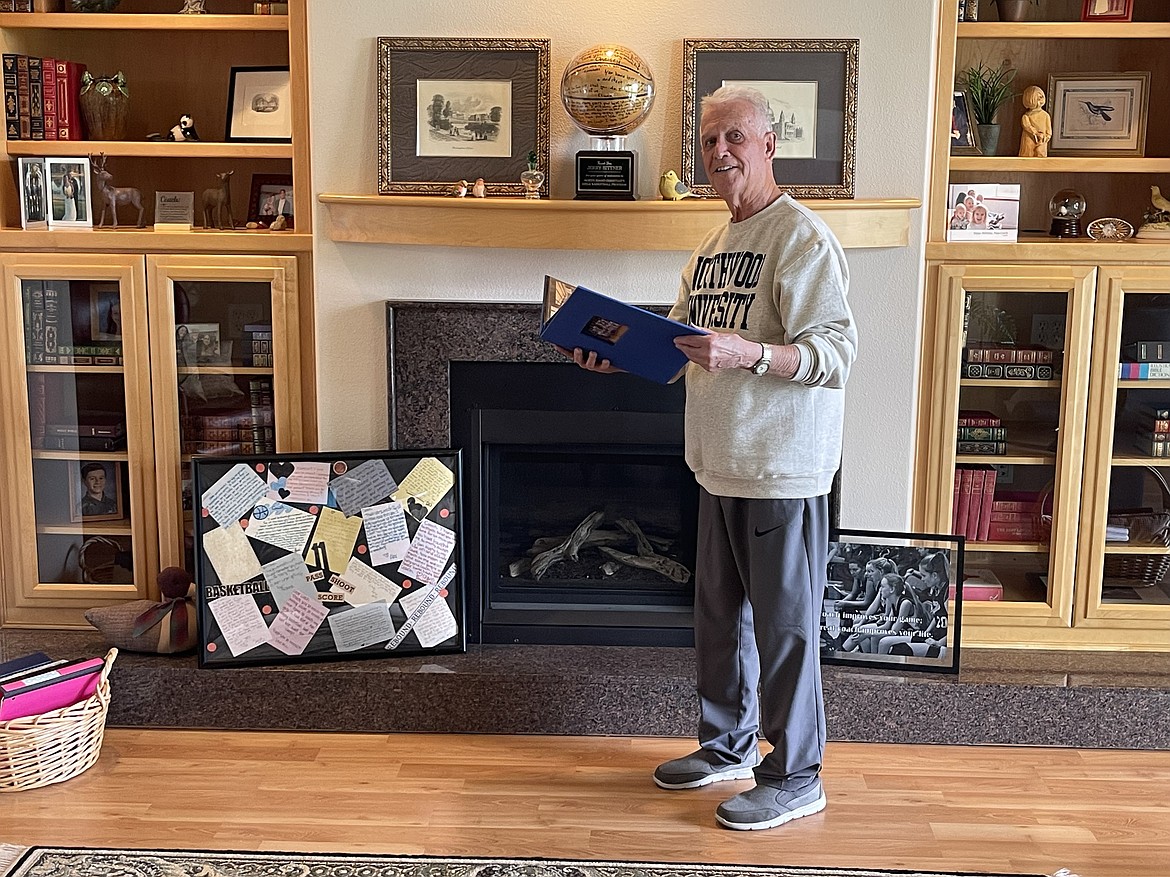
MARK NELKE/Press Surrounded by "love notes," photos and an autographed basketball following his retirement at girls basketball coach at North Idaho Christian School in Hayden, Jerry Bittner holds a scrapbook in his Post Falls home.
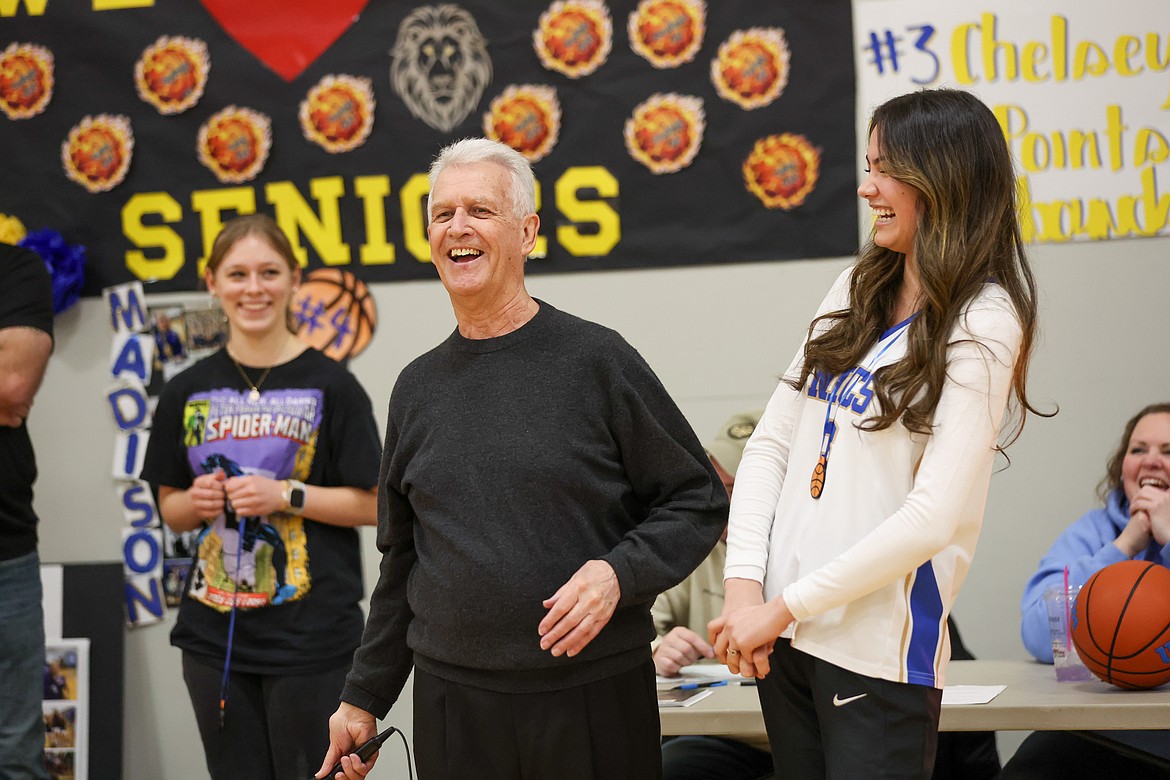
JASON DUCHOW PHOTOGRAPHY Jerry Bittner shares a laugh during North Idaho Christian School's senior night this past season. At right is Royals senior Chelsey Cate, who has played for NICS since fourth grade.
Jerry Bittner’s numbers as a high school girls basketball coach are impressive.
More than 400 wins, 383 of them coming in the last 21 seasons, when he was coach at North Idaho Christian School in Hayden, before retiring as coach at the end of last season.
Thirteen Mountain Christian League championships. Fourteen league tournament titles. Eighteen appearances in the tournament title game.
But there’s one number that’s harder to quantify, but is arguably the most impressive number.
Number of lives impacted over the years.
Number of girls saved from trouble.
Number of “love notes,” as he calls them, former players thanking him.
“Jerry is basically like my second father,” said Kylee (Kramer) Andrews, a 2011 North Idaho Christian School graduate, and his assistant coach for most of the seasons since then. “He’s who I go to when I don’t know what to do. He just is a very fatherly figure, he always went beyond basketball, making sure all of us girls were doing fine in life.”
“I love him,” said Kayla (Pleger) Brotherton, who attended NICS from preschool through 11th grade, and who has had two daughters play for Bittner. “He’s frustrating, and smart, and loving, and he just has a way to make you feel loved, and smile.”
“He’s got the grandfatherly feel about him,” said Kana Shanley, a 2013 NICS grad. “He cared, and we could always tell that he cared. We all had our own individual bonds with him, and they were all uniquely different.”
“He was a good girls coach ... he would jam out to Taylor Swift with us,” said Amanda (Hobson) Thompson, a 2012 NICS grad. "To me, he was like a grampa — he had grampa energy to me, and I always completely trusted him.”
Mary Cate has known the Bittners for years. Her son played on the NICS boys team years ago. Her granddaughter, Chelsey, was a senior on this past year’s team.
“She just adores him,” Mary said. “And he’s just had an impact on, well, all the kids’ lives. Positive, but so firm, which kids need nowadays. He’d be tough with them, but so stinkin’ loving, too, that it kinda gave them hope that, if he believes in me, maybe I can do it.”
BEFORE THERE was Jerry Bittner the girls basketball coach, there was Jerry Bittner, the successful businessman.
Now 84, Bittner grew up in Elkton, Mich., and was all-state in basketball at Elkton High. He also played football, and ran track.
He had offers to try out for pro teams in basketball, but ultimately decided to put to use his business degree from Northwood Institute (now University) in Midland, Mich., then a two-year Division II school, where he played basketball.
Jerry was recruited by three companies out of college, and chose to work for the Kresge Company, which had a new idea for a department store — something called Kmart.
At Kmart, Jerry started in the stock room and worked his way up, eventually to district manager, where he managed the 20th-largest store in the chain.
Eventually, Jerry went out on his own as a merchant, opening small warehouse clubs in Spokane ... then Missoula ... then Riverside, Calif. — only to see a merchant in charge of a much bigger warehouse chain come in and open one of his stores in the same towns, driving Jerry out of business.
Again looking for work, Bittner had two offers.
One was from Sam Walton.
He wanted Jerry to come to Rockford, Ill., where they wanted to open a Sam’s Club.
They met at a Walmart.
“He flew in just to see me,” Bittner recalled. “Spent the day with him; delightful man.”
Sam wanted Jerry to run the Sam’s Clubs in the eastern U.S.
He turned him down.
“I would only get to see my wife one day a week,” Jerry said.
YEARS EARLIER, Jerry was running a Kmart in Riverside, Calif., when he accepted a transfer to a better store in Spokane.
At the time, he was coaching a sub-varsity team at La Sierra High in Riverside.
In Spokane, Jerry caught on as an assistant coach at North Central High, where Ryne Sandberg and David Frigaard were two of the players he coached in basketball.
Spokane is also where he met Chrystal. They will celebrate their 49th wedding anniversary in July.
From Spokane, Bittner moved to San Diego as a district manager, looking after 19 Kmart stores.
Then it was on to Arizona, back to Spokane (where he managed a Costco), to Chicago, to Bellingham, to Saudi Arabia, and then to Alaska.
His first coaching job was at La Sierra, then at North Central. Then he didn’t coach again until 10-12 years later, in Alaska, in a league which included Mario Chalmers, Carlos Boozer and Trajan Langdon.
“Trajan Langdon was a friend,” Bittner said. “He’d go to villages after he retired, and I got to travel a little with him. Pepsi would give me a plane, in that plane they put a little floor and we’d go to a little village, put the floor out and he’d give instructions on basketball.”
IN 2005, Jerry retired and left Alaska, and he and Chrystal relocated to North Idaho — her family is from the region.
He wanted to continue coaching, so he cold-called some local schools, not knowing if they had openings or not.
He contacted Timberlake, and talked to Tim Cronnelly, the athletic director at the time.
Tim told Jerry he had just hired a young coach and his wife — Matt and Molly Miller.
Matt Miller just completed his 21st season as Timberlake girls coach, with 15 trips to state and four state titles.
Bittner then contacted Coeur d’Alene High and talked to Larry Schwenke, the Vikings’ AD at the time. He was told they had just hired a girls coach — Dale Poffenroth.
Poff took the Vikings to state 10 times in 12 seasons, winning four state titles.
Bittner contacted West Valley in Spokane Valley, but was told the Eagles had a junior varsity coach they planned to promote.
Then he tried Coeur d’Alene Charter Academy — but the Panthers had just hired a coach.
Bittner contacted North Idaho Christian, and talked to Brad Alden, the AD at the time. Alden said he wanted to talk to the folks at Lumen Christi, Bittner’s previous school in Alaska.
“He called me five minutes later ... you’ve got the job,” Bittner said.
His first season at North Idaho Christian, Bittner recalled his two senior captains going to the principal with a complaint.
"We don’t want to play for him,” the girls told the principal about their new coach. “He wants us to win, and wants us to get better, and if we wanted to be that good, we’d go to a big school.”
Bittner told his team to meet and decide if they wanted him to stay or go.
The majority wanted him to stay as coach.
“I think about that a lot,” Brotherton says now. “It wouldn’t have been the same at all (without him).”
Bittner had seven players on his first team at NICS. Three years later, there were 22 in the program.
One year, North Idaho Christian had an alumni game. Eighteen players came back, some from his first team.
“I could hear them talking to the new girls on the team ... ‘You don’t know how lucky you are. You didn’t have him when he first got here,’” Bittner recalled. “I kicked the basketballs up in the bleachers ... I was getting technicals every other game. I was a wild man for a while.”
“He knew he had certain girls that could take the heat; I was one of them,” Shanley said. “And I never once thought in my life that he was doing this just to be mean. He was just an amazing, amazing coach.
“He’s received technicals over me,” Shanley added. “I was the point guard and I used to just get absolutely beat up. Once, at Canfield Middle School, he ran out on the floor screaming, because I had just got thrown across the floor, and they didn’t call it. He had my back, and in turn got a technical for it.”
And?
“It made me happy,” Shanley said. “He stood up for what was right.”
“He pushed me just the right amount,” Brotherton said, “where it wasn’t going to break me, just enough to pull me out of whatever head space I was in.”
WHAT KEPT Bittner from pursuing a job at a bigger school?
“Age,” he said. “The 400 games I won all were after the age of 60. All my games here (Bittner won 383 games at NICS) were after the age of 64. Who’s going to take a coach that is 70 years old?”
How does he explain the closeness he has with his players, past and present?
“I ask God about that a lot ... I don’t understand that,” Bittner said.
A few years after taking the NICS job, he volunteered for CASA (Court Appointed Special Advocates, volunteers who advocate for abused and neglected children in the court system) for three years.
"They said ‘do you want infants, smaller children, older children ... ‘” Bittner recalled. “I said for some reason God gave me the ability to get along with teenage girls, and I don’t understand it.”
The interviewer said she had to go talk to her supervisor.
“I figure they’re thinking I’m a pervert, right?” Jerry said.
“She said, 'We’ve never had anybody ask for teenage girls.’”
“I don’t understand it, how I get along with these kids,” Jerry said. “Last week I had four (players) come to the door, just to see how I was doing.”
Andrews, his former player and assistant, will take over as head coach next season.
“I am intimidated,” Andrews said of taking over for Bittner as head coach, “but at the same time I’ve learned enough from him that I can do it. Whenever I think (I can’t do it), I get a letter from one of the girls ... gosh, I think I’m supposed to be here.”
JERRY BITTNER is downsizing.
In his home up on the hill, across the street from the old pro shop at The Highlands Golf Course in Post Falls, he can step out onto the back patio and enjoy a wonderful view of the rest of Post Falls, and onward toward Spokane.
Inside are plenty of memories, of basketball and otherwise.
A photo of Chrystal, his beautiful wife.
A plate celebrating a 31-2 team he coached in Alaska.
An autographed basketball on the mantel in his living room, presented to him following his recent retirement as girls basketball coach at North Idaho Christian.
He points to the corner of a small room off the kitchen, now barren except for a table and a couple of folding chairs.
“You see all those boxes?” he said. “Those are filled with love notes, I call them. From parents, kids ... “
All three boxes?
“One is a photo album, but there are love notes in there,” he said.
There’s a picture of a 67-pound fish he caught in Alaska.
A photo of a brother who has since passed away, a shortstop who apparently would have been drafted by the Tigers if he was only 2 inches taller.
In Saudi Arabia, he was hired by Sheikh Abdullah, former prime minister, and ran the Watani Trading Company in Jetta, Saudi Arabia, for two years.
“It would be like putting a Costco and a Walmart together,” he said. “The food section was like a Costco section, and the rest of the store was like what a Walmart would be.”
On the desk in his office sits a bottle of Jones Soda, with Jerry Bittner’s picture on it. It was a gift when he retired after serving as president and chief operating officer of the Alaska Commercial Company from 1997-2005, a company dubbed the “Fred Meyer of the North.”
“I think they made 20 cases, and it sold in stores all over,” Jerry said of the soda bearing his mug.
There’s a picture of Jerry, on the cover of an Alaska Airlines magazine in April 2000. A high-ranking company executive who also coached high school basketball. If you flew Alaska around that time, you might have pulled the magazine with his face on the cover out from the back of the seat in front of you.
A picture of the first team he coached up in Alaska, the freshmen boys at Dimond High, the largest school in the state, featuring a frontcourt of 6-10, 6-6, 6-5.
At Dimond, Jerry coached the freshmen boys, sophomore boys and junior varsity boys.
He was approached about coaching the girls varsity team.
“I said ‘No, I don’t coach girls,’” Jerry told them.
But later that season, the boys and girls teams from Dimond flew from Anchorage to Barrow, Alaska, a round trip of some 1,500 miles, for games there.
"When I got with the girls I really enjoyed them,” Bittner recalled. “And I said ‘OK, put my name in.’”
He got the job — then was told he couldn’t have the job. Someone working in the school system had to be the head coach.
So he left for the local Catholic School, Lumen Christi High. The year before, the girls team had won two games. His first season there, they reached the quarterfinals before losing by three points to the eventual state champion.
SAUDI ARABIA?
"When I was young, like 8 or 9, I knew I was going to Saudi Arabia,” he said. “I don’t know how, but I said someday I’m going in Saudi Arabia. ‘Lawrence of Arabia’ came out about that time, and for some reason I said, ‘I’m going there someday.’”
Bittner helped turn around a retail company in Michigan, then learned the owner was going to sell it.
He replied to an ad looking for someone to run a retail store in Saudi Arabia. He was told he was one of four finalists, and flew to London.
Sheikh Abdullah picked him up at the airport.
He got the job.
Why did you hire me?, he asked.
“He said ‘Jerry, the one thing I liked about you was, you were a coach, you understand how to teach people. Someday Saudi Arabia is going to run out of oil, and our people are going to have to learn how to run businesses, and I know you’re going to teach them that.’”
After two years in Saudi Arabia (Chrystal visited Jerry there for a week or so, and said she wouldn’t live there), Bittner left for Alaska.
Why did you hire me?, he asked.
“He said ‘Jerry, you’re a teacher for one thing. You know how to motivate people for another. And someday Alaska is going to run out of oil, and people are going to have to learn how to do that.’”
Jerry was a former swim instructor, and while in Saudi Arabia he taught the future king of Yemen how to swim.
At the hotel where Jerry lived, they brought in videos for the guests to take to their rooms and watch. The titles were in English.
One day, a big guy who didn’t speak English approached Jerry for help finding a particular type of video. Jerry told him to get lost.
Jerry later was told that big guy was Idi Amin, former president of Uganda.
“I’ve worked in 31 countries, and have friends in 62,” Bittner said.
He played golf with Sam Snead twice.
“Some people wanted me to run for governor,” Jerry said.
Think about it?
“Oh yeah.”
Why didn’t you?
“My wife didn’t want to live in Alaska,” he said with a laugh.
They were living in the Seattle area when he took the job in Alaska. She joined him there, but left Alaska three years before Jerry did, and returned to their home in the Seattle area, where she had a daughter and sisters in the area.
Jerry has three sons from a previous marriage, Chrystal one daughter from a previous marriage.
Three days a week, Jerry visits Chrystal at an assisted living place in Hayden. Chrystal suffers from rheumatoid arthritis, and has been in assisted living for seven years.
Naturally, when Jerry visits his wife, he stops by and chats with some of the other residents who seldom have visitors, just to make sure they’re doing OK.
As he prepares to move soon to a retirement home in Post Falls, Jerry looks at the few items still left in his home.
That desk? It’s going to a former player.
A bed? To another former player.
Why not sell them?
“What am I going to get out of them?” he said. “80 bucks? A hundred?”
Jerry Bittner has chatted with three U.S. presidents — Carter, Reagan and Ford.
He held Bob Hope’s cue cards one time at a Christmas show.
He’s eaten with Sammy Davis Jr., spent time with Bob Newhart and Jesse Jackson.
Bob Denver — aka Gilligan — was a personal friend. When Jerry ran a Kmart in Thousand Oaks, Calif., Bob would come in on Saturdays and eat breakfast with Jerry’s two young sons.
Sparky Anderson used to come into that same Kmart store and would talk baseball with Jerry.
Another customer at that store was Michael Douglas.
“Why me?” Jerry Bittner says.
“My whole life’s been that way. The guy upstairs gave me a fantastic life. And I don’t understand it.
“Even this basketball. Winning as many games as I’ve won after the age I am. Having the kids that I’ve been able to coach and fall in love with. That’s a real blessing.”
BACK TO that stat that’s harder to quantify, but is arguably the most impressive number.
Number of lives impacted over the years.
Number of girls saved from trouble.
Number of “love notes,” as he calls them, former players thanking him.
“What I’m most proud of is the eight girls,” Jerry said, starting to choke up, “the eight girls that called me during the week and told me ’Coach, I’m getting baptized on Sunday. You’re one of the reasons why; would you please come?
“Eight girls, in my 20 years. That, to me, means more than anything else. You can have all the championships, you can have all the wins, that’s ... a lot of times there’s girls that come play for me, I don’t care about the basketball, I care if I can build their self-esteem. If I can help them like themselves. If I can help them be better people.
“When you can turn a kid’s life around, then you’ve done something. Winning a basketball game, you can teach them those things.”
Bittner has turned many a life around over the years.
“The amount of times I’ve seen him cry, I couldn’t count,” Andrews said. “You could tell he just had a heart for us.”
Sometimes he hears about a player going through some problems, or the athlete contacts him.
Either way, they talk about it.
“That’s all they need,” he said. “If you treat them with the respect you expect them to treat you with, teenage girls are fantastic. They will talk to you.”
Bittner said he tried to build a culture in his program based on self-love and self-esteem.
He encouraged his team captains to make the players new to the program welcome.
“I thank God a lot that He has not made me attracted to young women," Bittner said.
Jerry Bittner was an old-school coach, especially years ago, before he was, well, old.
“And I wasn’t an easy coach at the beginning to play for,” he said. “But those kids came back and said 'Man, really appreciate how you got after us, coach.’
“I actually just wrote a little card to him on his retirement,” Thompson said. “And one of the things I said in there was, he was the first person to see any athletic ability in me whatsoever. He was really good about seeing that in people, and also ... he really made me believe I had athletic ability, and nobody had ever done that in my life.”
“You read those letters in there,” Bittner said, motioning to those three boxes in the corner of the mostly barren room. “I’ll bet 20 percent of them in there say ‘Thanks for being so tough.’
‘Thanks for caring.’
“They WANTED that discipline.
“I give it all to Him, because I wouldn’t have wanted to play for me.”
Mary Cate, mother to one former NICS player and grandmother to another, said kids are drawn to Jerry Bittner because of that discipline.
“Most kids these days aren’t raised with that,” Mary said. “Kids crave discipline, they crave structure. They want boundaries. That’s what gives them security, and that’s what Jerry gave them.
“He’s just leaving a great legacy.”
Mark Nelke is sports editor of The Press. He can be reached at 208-664-8176, Ext. 1205, or via email at [email protected]. Follow him on X (formerly Twitter) @CdAPressSports.
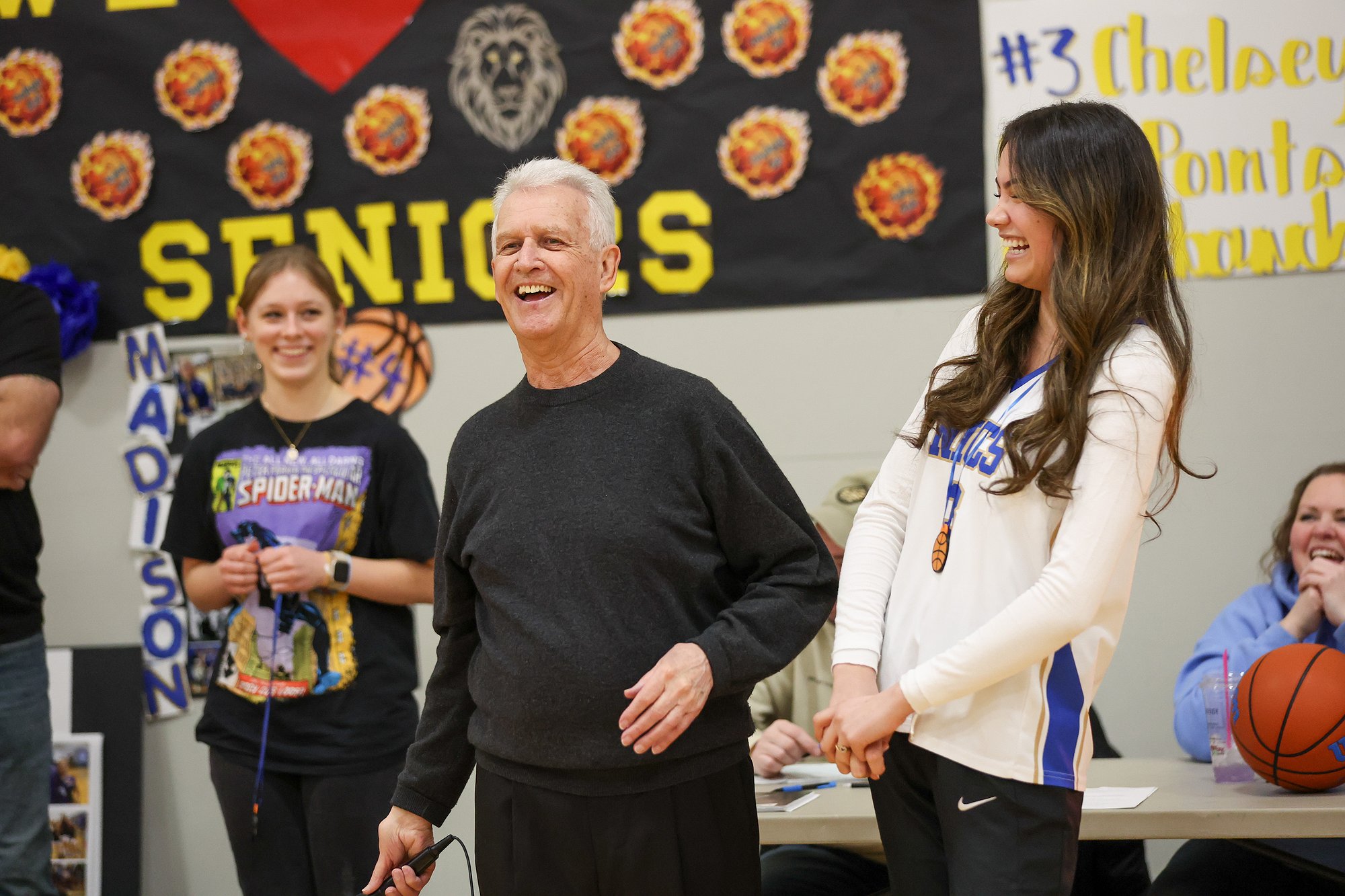 JASON DUCHOW PHOTOGRAPHY Jerry Bittner shares a laugh during North Idaho Christian School's senior night this past season. At right is Royals senior Chelsey Cate, who has played for NICS since fourth grade.