
Kalispell’s sewer, water system facility plans identifies over $300 million in capital projects over the next 20 years
JACK UNDERHILL | Hagadone News Network | UPDATED 3 months, 4 weeks AGO
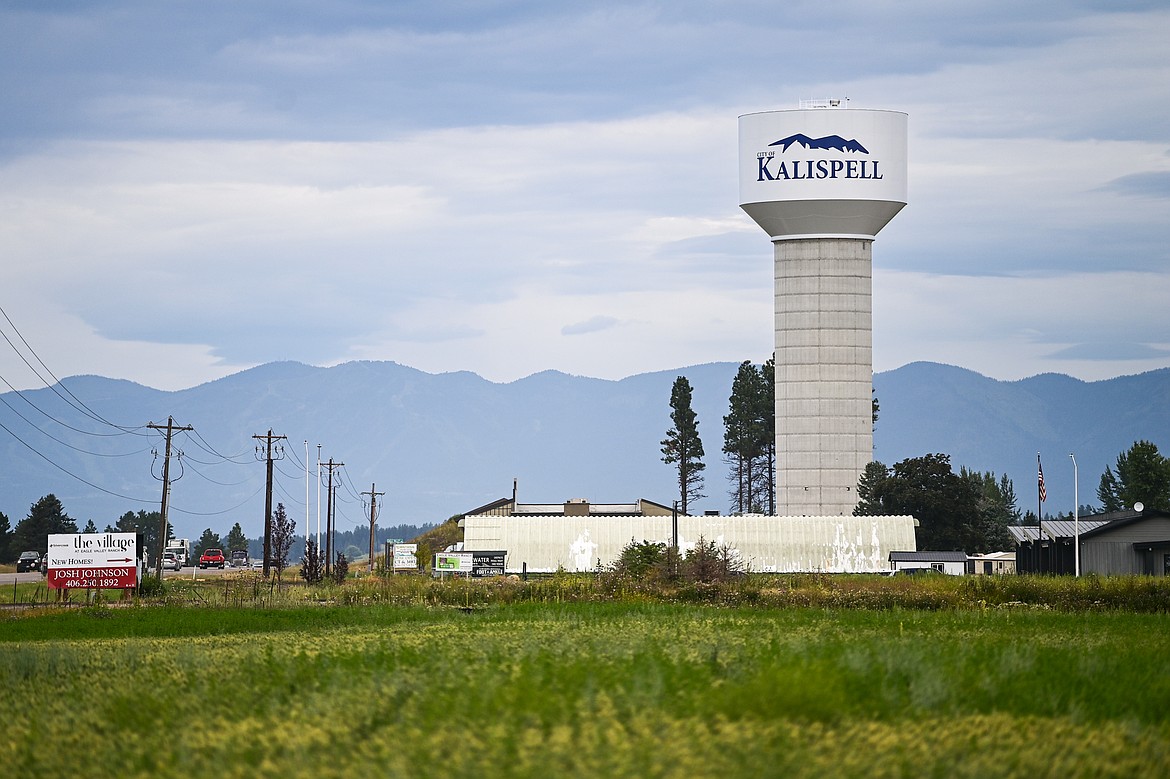
The water tower along US-93 north of Kalispell on Wednesday, Aug. 6. (Casey Kreider/Daily Inter Lake)
Casey Kreider
KALISPELL GOVERNMENT, HOUSING AND TRANSPORTATION REPORTER Jack Underhill covers Kalispell city government, housing and transportation for the Daily Inter Lake. His reporting focuses on how local policy decisions affect residents and the rapidly growing Flathead Valley. Underhill has reported on housing challenges, infrastructure issues and regional service providers across Montana. His work also includes accountability reporting on complex community issues and public institutions. Originally from Massachusetts, Underhill graduated from the University of Massachusetts, Amherst with a degree in Journalism before joining the Inter Lake. In his free time, Underhill enjoys mountain biking around the valley, skiing up on Big Mountain or exploring Glacier National Park. IMPACT: Jack’s work helps residents understand how growth, housing and infrastructure decisions affect the future of their community. | June 25, 2026 12:00 AM
Kalispell City Council on Monday mulled over updated plans for future improvements to the municipality’s water and wastewater systems.
The documents consider current challenges facing the city’s essential utilities and will serve as long-range planning documents to guide infrastructure improvements that support future growth, according to a memo from City Manager Jarod Nygren.
The updates to the city’s water, sewer and advanced wastewater treatment plant plans group future capital projects into near-, mid- and long-term categories. By 2044 — the city’s near-term planning horizon — Kalispell’s infrastructure will have to accommodate an estimated population of 51,000.
Kalispell’s Advanced Wastewater Treatment Plant was built in the 1990s, and several aging components need upgrades to keep pace with the city’s growth, according to Public Works Director Susie Turner.
Several key pieces of equipment are nearing the end of their lifespan, but maintenance has been deferred because the city still lacks clear guidance on how strict water quality standards for discharge into Ashley Creek will be.
“It’s a regulatory limbo,” Turner said.
State lawmakers shifted Montana toward nutrient standards that rely on site-specific assessments rather than strict numeric limits. The Montana Department of Environmental Quality adopted the standards, and the U.S. Environmental Protection Agency approved them, but a lawsuit is challenging that federal approval, according to Turner.
While the regulatory uncertainty has loomed over the wastewater treatment plant for years, Turner said that maintenance can’t be postponed any longer.
“We’re going to have to make some decisions because we’ve kicked the can down the road for 10 years,” Turner said.
Despite the uncertainty, the plan identified base improvements needed regardless of what standards will be imposed. The plan includes $81.8 million worth of improvements — including bioreactor and influent pumping upgrades — over the next 20 years.
Turner expects to get a clearer picture of how strict the standards will be in the fall. In the meantime, the plan outlines three possible scenarios for capital improvements depending on the stringency of the standards.
The first scenario assumes maintaining current compliance levels, which would require an additional $40.3 million on top of the $81.8 million baseline. The second scenario anticipates stricter nutrient standards requiring an additional $57.4 million. Under a third — and unlikely — scenario with highly restrictive standards, the city would need to put aside an additional $172 million.
Mayor Ryan Hunter and Councilor Wes Walker suggested the city commit to the second scenario so that the necessary advanced upgrades will be in place if standards become stricter down the road.
An energy conservation assessment was conducted to see where costs could be reduced, but Turner said that any project would have a low financial return because those costs are already low.
Hunter said that there were other benefits to increasing energy efficiency, such as reducing the burden on the grid. He asked for a study examining the effectiveness of installing solar panels on city-owned buildings to increase energy independence.
IN ITS updated sewer system plan, the city identified nearly $80 million in capital improvement projects between 2027 and 2040.
The system includes 120 miles of gravity sewers, 36 lift stations and 25 miles of force mains, with some of the oldest pieces of infrastructure coming in at more than 80 years old.
About 26% of what flows through the city’s sewage pipes comes from inflow and infiltration, which is stormwater or groundwater that seeps into the city’s sewer system. The plan recommends launching a separate study in 2028 to examine how this seepage affects the city’s wastewater collection system.
Councilor Dustin Leftridge asked why the study couldn’t be funded next year, but city officials said it isn’t a high enough priority. The study would add detail to planned capital projects but wouldn’t change them, according to representatives from the consulting firm AE2S.
KALISPELL’S PLANNED water system capital projects total about $117 million between 2027 and 2040. Projects include a new transmission main, new wells and upgrades to the downtown system.
While projects in the past have been boosted by Covid-era American Rescue Plan Act funds, Turner said that loan forgiveness through the State Revolving Fund program has been the primary source of aid in recent years.
The city’s water system is divided into two zones: lower and upper pressure. The upper pressure zone serves areas north of Two Mile Drive. About 70% of water use comes from residential development, with 40% from single family homes and the remainder from multi-family housing.
A third pressure zone is currently under development, according to Deputy Public Works Director Kieth Haskins. The plan also called for creating another pressure zone to improve service to the growing west side, which would eventually require a 4-million-gallon elevated storage tank, planned as a 2029 capital project.
From 2017 to 2023, the system produced an average of 4 million gallons of water per day. Some of that water is considered non-revenue, meaning it's produced but not metered, often due to leaks or overflows. However, the amount of non-revenue water decreased from 22% in 2021 to 15% currently, which Haskins described as a big win.
Turner said it’s impossible to account for all the water flowing through the system, but that the city proactively detects leaks, especially with the help of new meters and meter pits being installed in houses citywide.
Reporter Jack Underhill can be reached at 406-758-4407 or [email protected]. If you value local journalism, pledge your support at dailyinterlake.com/support.
ARTICLES BY JACK UNDERHILL
Kalispell clears way for tiny homes by adopting building standards
Councilors on Monday added tiny homes to Kalispell's city code in a bid to make it easier to build the simpler, low-cost housing alternatives.
Glacier Park International Airport earns spot among nation’s resort airports
Glacier Park International Airport was named one of the nation’s top resort airports in USA Today’s 10BEST Readers’ Choice Awards.

Kalispell City Council to consider tiny home regulations
Kalispell City Council on Monday will vote on whether to add tiny homes to city code, allowing the municipality to inspect them and enforce building standards.