
Montana delegation champions ‘America the Beautiful Act’ to fund public lands maintenance
MICAH DREW Daily Montanan | Daily Inter-Lake | UPDATED 2 months, 3 weeks AGO
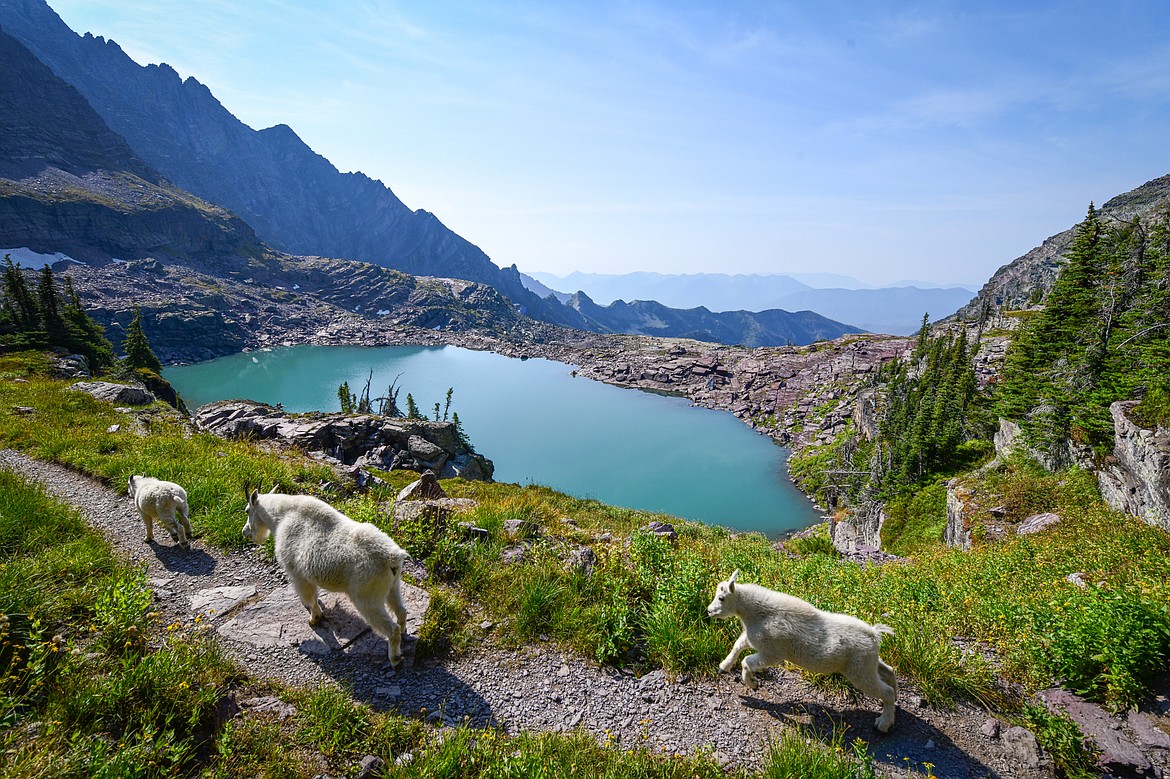
Mountain goats walk along the Sperry Glacier Trail above Akaiyan Lake in Glacier National Park on Monday, Sept. 1. (Casey Kreider/Daily Inter Lake)
Casey Kreider
A bill sponsored by Montana U.S. Sen. Steve Daines aimed at renewing a $2 billion investment in addressing deferred maintenance throughout the nation’s public lands is winding its way through Congress with a goal of receiving a presidential signature by July 4.
The America the Beautiful Act, S. 1547, was introduced by Daines and Sen. Angus King, I-Maine, on May 1 as a successor to the Great American Outdoors Act Daines sponsored in 2020.
That bill created the Legacy Restoration Fund, funded with $1.9 billion annually, to tackle a growing list of deferred maintenance backlog at national parks and other public lands. It expired in 2025.
The America the Beautiful Act passed out of the Senate Energy and Natural Resources Committee on June 17, and is awaiting a full vote in the Senate, where it has amassed 66 cosponsors, including Montana Sen. Tim Sheehy.
“As we look forward to America’s 250th anniversary, what better way to celebrate our national parks, the crown jewels of America, than by signing America the Beautiful into law?” Daines said in a statement when the bill cleared the committee.
King said taking the step to reauthorize the Legacy Restoration Fund would create lasting protections for public lands and demonstrate that “stewardship is not partisan.”
“People travel from across the globe to experience the natural beauty of America’s public lands – from Maine to Montana and across the nation,” King said in a statement. “However, deferred repairs on aging infrastructure like roads and trails can become unsafe and diminish the visitor experience for those enjoying our public lands and National Parks.”
According to Daines’ office, U.S. public lands face a more than $40 billion backlog of maintenance.
By agency, the breakdown of deferred maintenance includes:
U.S. Park Service: $23.26 billion
U.S. Forest Service: $8.695 billion
U.S. Fish and Wildlife Service: $2.65 billion
U.S. Bureau of Land Management: $5.72 billion
U.S. Bureau of Indian Education: $804.5 million
The reauthorization of the Legacy Restoration Fund would last through 2031, based on the latest version of the Senate bill.
According to the Department of the Interior, the Legacy Restoration Fund has funded 396 projects across all 50 states.
In Montana, 19 projects have been funded, including rehabilitating part of Going-to-the-Sun Road in Glacier National Park and replacing a bridge across McDonald Creek; replacing water, wastewater and utility systems in Glacier; repairing South Fork Dry Blood Creek and Grub dams, and restoring and repairing various Bureau of Land Management recreation sites.
Recently, reports that national park entrance fee revenue was being used for maintenance projects in Washington D.C., rather than retained at the park they were collected, have drawn criticism from national park advocacy groups as maintenance backlogs continue to grow.
A companion America the Beautiful Act bill is moving through the U.S. House with 149 cosponsors, including both Montana Reps. Troy Downing and Ryan Zinke, who introduced the bill.
The House Committee on Natural Resources voted to approve the bill on Wednesday.
“Montanans understand that our public lands are more than places on a map. They support jobs, strengthen gateway communities, and are central to our way of life,” Downing said in a statement. “The Great American Outdoors Act has already helped repair the roads, trails, and facilities that families rely on when they visit our national parks and public lands. Reauthorizing this initiative will build on that progress, improve access, and ensure these treasured landscapes are preserved and enjoyed for generations to come.”
More than 50 conservation and outdoors groups have also given full-throated support for the reauthorization bill.
“The America the Beautiful Act wouldn’t just fund maintenance on our national parks, forests, and refuges – it would require federal agencies to prioritize public access,” said Joel Webster, chief conservation officer at the Theodore Roosevelt Conservation Partnership. “That means better water infrastructure on refuges for waterfowl hunters, passable trails for turkey and big game hunters, and improved access points for anglers.”
Defenders of Wildlife senior counsel Chris Westfall said that while the bill is not perfect, the funding is “pivotal to habitat for imperiled species, protecting our wild and scenic rivers, and restoring trails to maximize public access.”
“We all benefit from this work through restored wildlife habitat and healthier ecosystems,” Westfall said.
Revenues for the Legacy Restoration Fund are derived from energy produced on non-park, non-wilderness public lands, and industry and trade groups also lined up their support.
Melissa Simpson, president of the Western Energy Alliance, said the structure of the fund fulfills the balanced use of public lands between extraction, conservation and recreation.
“As energy producers that operate on multiple-use public lands in the West, Alliance members support responsible land management policies,” Simpson said in a statement. “They recognize the important balance that exists between developing the natural resources our nation needs with conserving and restoring the iconic and historic landscapes that we all treasure. They are proud that our development of America’s natural resources will continue to sustain the LRF for years to come.”
Daines has said it is his goal to have the bill signed by President Trump by July 4, which puts both chambers of Congress on a tight deadline to pass their versions of the bill and reconcile them.