
Traffic troubles top of mind for Glacier National Park visitors, staff
HAILEY SMALLEY | Hagadone News Network | UPDATED 3 months, 3 weeks AGO
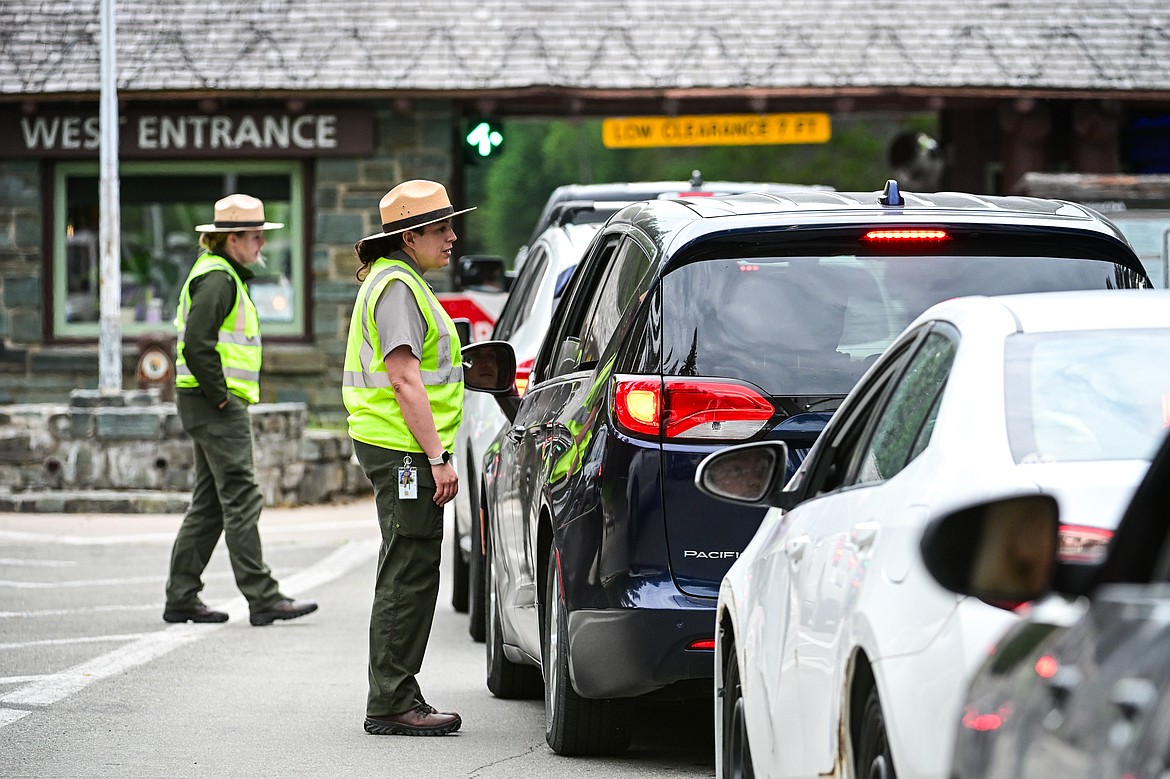
National Park Service ranger Sheryl Campbell, right, and ranger supervisor Macie Whittlesey greet visitors and answer questions as vehicles wait to enter the west entrance to Glacier National Park on Friday, June 26. (Casey Kreider/Daily Inter Lake)
Casey Kreider
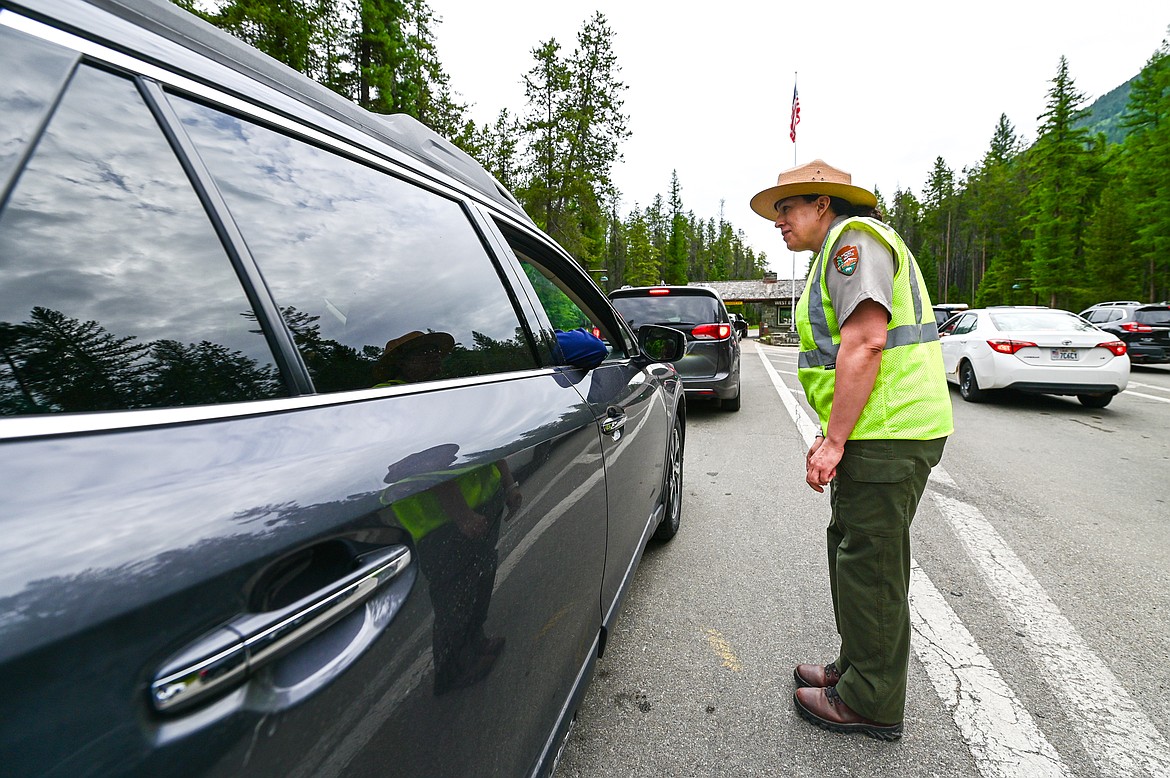
National Park Service ranger Sheryl Campbell greets visitors and answers questions as vehicles wait to enter the west entrance to Glacier National Park on Friday, June 26. (Casey Kreider/Daily Inter Lake)
Casey Kreider
Glacier National Park is prepping for another season of changes.
A year and a half of staffing shortages, funding cuts and executive orders have sowed uncertainty in Northwest Montana’s crown jewel, but the most pressing issue for the upcoming summer season is one that long predates the second Trump administration. Traffic is bound to be a problem this year, as the park forgoes a mandatory vehicle reservation system for the first time in years.
Opening week for Going-to-the-Sun Road hinted at the challenges ahead. Early on June 22, Marla Taylor was one of hundreds idling outside the West Entrance to Glacier National Park.
Her family of nine had tickets for a boat ride on Lake McDonald at 9:30 a.m., and Taylor planned for everyone to arrive at Lake McDonald Lodge by 8 a.m., with plenty of time to snag breakfast and take in the views. The extra time proved prescient, as the family waited in line outside the West Entrance for about 30 minutes.
“We’ll be building in extra time to get places,” said Taylor later that afternoon.
Park officials gave similar advice in a June 22 press release, warning visitors to expect lines up to two miles long outside the West Entrance of the park during peak times. The West Entrance is about one mile from the intersection of Glacier Route 1 Road and U.S. 2.
The Montana Department of Transportation added its own warning in a June 24 social media post, advising travelers “pack your patience” when traveling on U.S. 2 near West Glacier between 8 a.m. and 1 p.m., seven days a week.
Long lines on the two-lane highway have been a frequent headache for park officials as visitation to the western side of Glacier National Park boomed in recent years. More than 128,700 people passed through the West Entrance to Glacier National Park during May 2026 alone — a 45% increase from 10 years ago, when May visitation through the West Entrance totaled 88,577. Visitation in the park usually peaks in July and August.
The mandatory vehicle reservation system helped curb the congestion by distributing traffic throughout the day, but park Superintendent Dave Roemer said that strategy did little to solve parking constraints at Logan Pass. This year, officials nixed the reservation system in favor of a three-hour parking limit at Logan Pass and a revamped shuttle service, both of which begin July 1.
Sarah Lundstrum, the Glacier field representative for the National Parks Conservation Association, expressed doubts about the plan. Back in 2021, when the park first piloted the vehicle reservation system, Lundstrum partnered with the Utah State University to conduct a survey of visitor experiences. One of the questions asked respondents about the transportation options they least wanted to see in the park. The two most common responses, said Lundstrum, were parking time limits and mandatory shuttles.
She is partnering with the University of Montana to conduct a second survey this year, which will include similar questions on visitors’ perceptions of the new transportation system.*
Beyond visitor expectations, Lundstrum questioned how the park would meet the need for more staff at Logan Pass to monitor compliance with the parking time limit and issue parking tickets.
About 300 seasonal employees have been hired for the 2026 season, on par with previous years, but permanent staff are only operating at about 75% of the typical capacity. Key positions like deputy superintendent remain unfilled after several longtime employees took buyout options from the federal government or retired last year.
Roemer downplayed the empty positions at a February community meeting in the North Fork in February, saying ongoing staff shortage “hasn’t affected our ability to achieve our mission.”
“The average visitor is probably not going to notice the difference,” Lundstrum agreed. “But that’s short-term. What’s it going to look like long-term?”
In emphasizing access to national parks while cutting staff and funding, Lundstrum argued the second Trump administration has overlooked the part of the National Park Service’s mission that emphasizes protecting natural resources and cultural values for future generations.
“Your experience in Glacier is dependent on the Park Service protecting it, and we’re losing that protection piece,” she said.
THE NATIONAL Park Service is also implementing new fee structures this year at 11 of the most visited parks, including Glacier and Yellowstone national parks. Foreign visitors will be charged a $100 per person fee to enter the parks and will no longer be eligible for fee-free days, in accordance with an executive order President Donald Trump issued last year.
Visitors will self-select the pass they wish to purchase and do not need to provide documentation verifying U.S. residency, according to Glacier National Parks Public Affairs Specialist Autumn Sifuentes.
Reporter Hailey Smalley can be reached at 406-758-4433 or [email protected]. If you value local journalism, pledge your support at dailyinterlake.com/support.
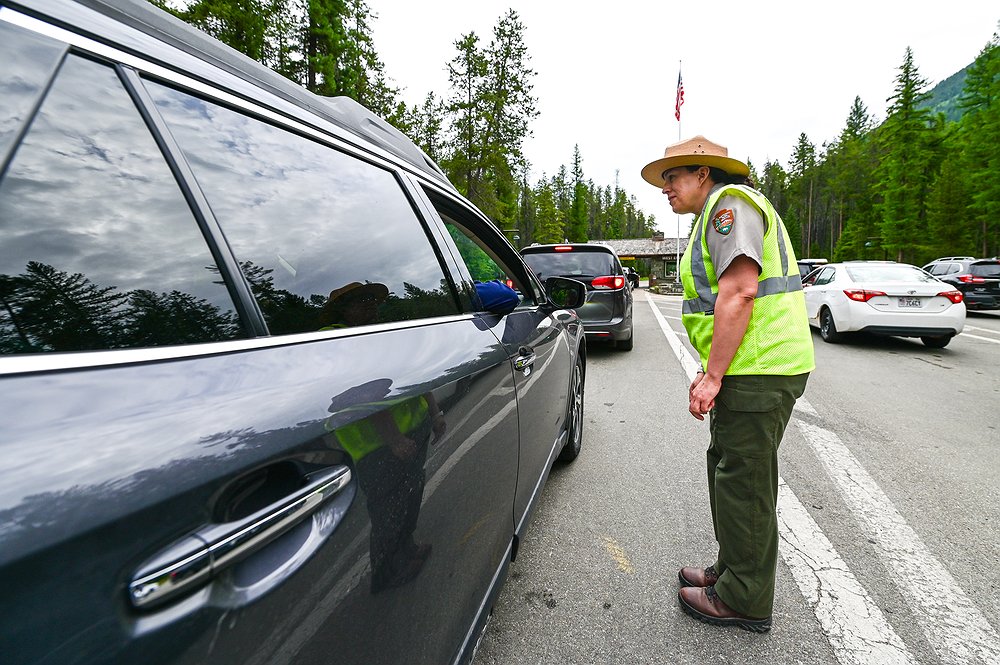 National Park Service ranger Sheryl Campbell greets visitors and answers questions as vehicles wait to enter the west entrance to Glacier National Park on Friday, June 26. (Casey Kreider/Daily Inter Lake)
Casey Kreider
*An earlier version of this story stated that both surveys were conducted in partnership with the University of Montana.
ARTICLES BY HAILEY SMALLEY

Trump stumps for Flint in Kalispell as Election Day nears
President Donald Trump, wearing a dark suit, red tie and red USA cap, ambled into the Majestic Valley Arena to the raucous roar of a crowd.
Flathead National Forest greenlights Swan Valley timber project
A 2,307-acre timber project is now under way in the Swan Valley.
Flathead National Forest greenlights Swan Valley timber project
A 2,307-acre timber project is now under way in the Swan Valley.