
Friends recount snowmobile crash in the backcountry, crawling for miles to reach safety
BILL BULEY | Hagadone News Network | UPDATED 1 week, 1 day AGO
Bill Buley covers the city of Coeur d'Alene for the Coeur d’Alene Press. He has worked here since January 2020, after spending seven years on Kauai as editor-in-chief of The Garden Island newspaper. He enjoys running. | March 1, 2026 1:09 AM
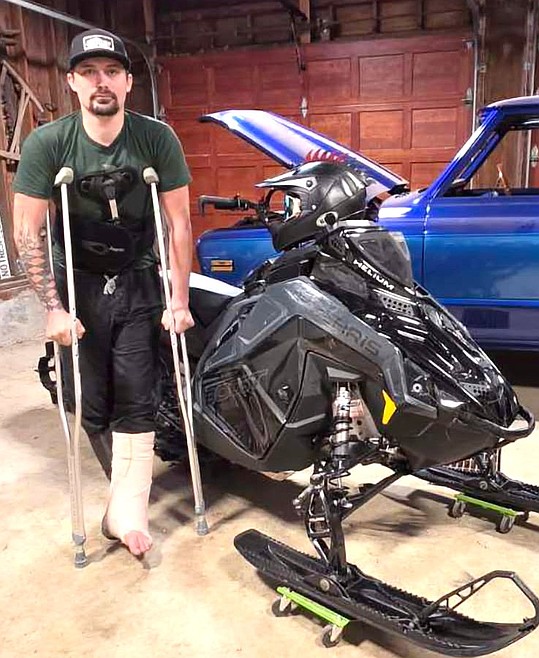
When Tyson Haynes crashed on his snowmobile in the backcountry beyond Lookout Pass, suffering a broken leg and a back injury, he knew he was in trouble.
The St. Maries man decided, after talking it over with friend and fellow rider Mike Gilmore, that there was one way out of this mess.
Crawl.
For the next four hours on a wet, cold afternoon, on all fours, he made his way through snow, over downed trees, and across streams.
It hurt.
“I knew come hell or high water I was going to get out of there as long as God let me,” Haynes said. “All I thought about was my wife and kids.”
Gilmore kept Tyson positive, focused and above all, moving.
“I tried to keep his mind off the shock of how hurt he really was,” Gilmore said. “He would have done the same for me.”
He’s replayed the crash in his head since it happened. In the end, he has no doubt they made the right choice to get out on their own rather than going for help.
“Someone was watching over us, that’s for sure,” Gilmore said.
Extreme riders
Haynes has spent most of his 32 years in and around the mountains of North Idaho, growing up in St. Maries and riding snowmobiles since he was 5 years old.
He considers himself “damn near a pro rider,” the kind of person who thrives in the backcountry where few others can go. On Sunday, Feb. 15, behind Lookout Pass on the Montana side, his confidence and experience were put to the test.
Haynes and Gilmore set out from their rig on a back road around 9:30 that morning, heading into the snow-packed terrain for a day of riding. It wasn’t ideal weather — rainy, foggy, windy, a “nasty day,” Tyson called it — but they were still having fun, pushing limits as extreme riders like to do.
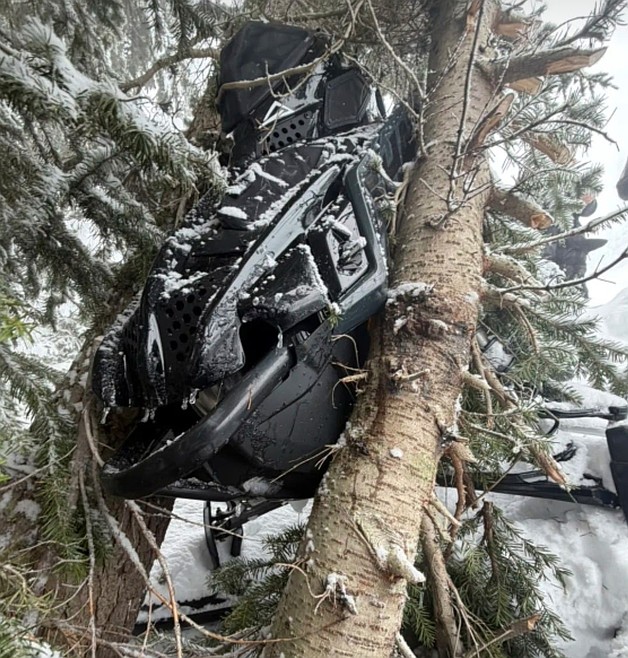
Around 1:30 p.m., Haynes pointed his 260‑horsepower machine up a steep hill. As he neared the top, the sled hit a patch of ice. In an instant it turned sideways and shot him in the wrong direction at nearly 60 miles an hour. He launched off a cliff and crashed through trees below.
The fall was later estimated at 120 feet.
“It was like a bad dream when you’re falling from the sky,” he said.
Both running boards on his snowmobile snapped. Haynes knew immediately something was wrong. His left leg was broken, his ankle nearly snapped and his back ached. The pain was so intense he nearly blacked out.
Haynes was soaked, shivering, and deep in the mountains.
Gilmore, snowmobiling behind when Haynes sailed off the cliff, took a different route down the hill to find his friend.
Gilmore said even with their experience, situations like this can arise.
“The backcountry can get you,” he said. “Things can go good to bad pretty quick.”
What to do
Gilmore shouted for him to hold on while he assessed their options. The crash had happened far off trail, in terrain so steep and rough that even the friends later sent to retrieve the snowmobile had to hike in on foot.
“And they’re some of the best riders I know,” Haynes said.
Gilmore figured a helicopter couldn’t reach them in that terrain. Some suggested later that they should have doubled up on the working sled, but with deep snow, uneven ground, and injuries, he said they would have tipped instantly, and Haynes could not have held on.
Waiting for help wasn’t realistic. Fog and cold were setting in, and neither man believed rescuers could reach them in time even if Gilmore raced out, reached the truck and made a phone call.
With his injuries, Haynes couldn’t ride Gilmore's sled, either.
Gilmore tried to drag him behind the sled, but the pain was unbearable.
That's when Haynes decided what he had to do.
“I told him I was going to start crawling,” Tyson said.
Going for it
The first 20 yards were through about 2 feet of snow. From there, Gilmore began carving a path: ride ahead, break trail, circle back, repeat. They moved like that for nearly a mile. When slopes dipped downward, Tyson was able to ride short stretches, but most of the journey was on hands and knees — or elbows — navigating snow, trees, a creek and a lake.
“Every time I moved, it hurt,” Haynes said. “I could feel my bones.”
At one stand of fallen timber, he couldn’t pull himself up and over, so Gilmore helped.
“He had to damn near pull me over them,” Haynes said.
At times, he had to stop and summon his strength. A video by Gilmore shows Haynes, head down, snow on his stocking cap, on all fours, taking deep breaths, doggedly forging ahead a few yards at a time.
What kept him going? Thoughts of his family — wife Sarah and their kids.
“I needed to make it home,” he said.
They reached Copper Lake, about a mile and a quarter from the crash, then pushed on. Both men knew they couldn't stop.
“If we quit moving, we were going to be in trouble,” Gilmore said. “We didn’t stop and take breaks. I was hell exhausted, too.”
Haynes said they cracked jokes and he tried “keeping the bitching to a minimum.”
“It’s easy to get in a bad state of mind out there,” he said.
Rescuer offers options
Robert Wheelock with Silver Valley Search and Rescue said while he was glad to hear the men made it out of the situation on their own, it wouldn’t be his first choice.
He said that aid calling 911, even when out of cell-tower range, should always be done.
Wheelock said that aid is necessary because the extent of the injuries is unknown in such a scenario; it could make them worse as they try to make it to safety.
If the injured party was dry and could be left in a covered area, Wheelock recommended the second party with a working snowmobile go for help.
He said rescue teams are trained to respond on short notice and knowing time is of the essence, have the capabilities to reach the backcountry quickly.
Making it back
By the time they reached the truck, it was nearly 6 p.m., about four hours after they started out.
Haynes estimates he crawled close to 2 miles, in addition to being on and off Gilmore’s snowmobile.
They sped to the emergency room at Kootenai Health, reaching it in about 90 minutes. Tyson spent two days in the hospital. His ankle required surgery, the leg is in a cast and he will need to wear a back brace for some time. Back surgery remains a possibility.
Despite everything, Haynes knows how much worse it could have been. He was wet, nearly frozen, severely injured, and miles from help. He had one thing going for him: A good friend.
“I’m surprised that my knees didn’t get frostbite,” Haynes said. “I’m just glad it wasn’t any worse. I’ll be able to heal from this.”
Back home, he was feeling better despite yet another blow. Earlier that morning, one of the semis from the garbage collection business he and his wife own burned.
“When it rains it pours, I’ll tell you what,” he said.
Haynes isn’t done riding. Once he’s through his 12‑week recovery — “if I’m lucky,” he says — he plans to be back on his sled.
“The Joe is my favorite,” he said of the St. Joe River country.
Even so, he knows the mountains can be unforgiving.
“That was its downfall that day,” he said. “But we love going where few others can go.”
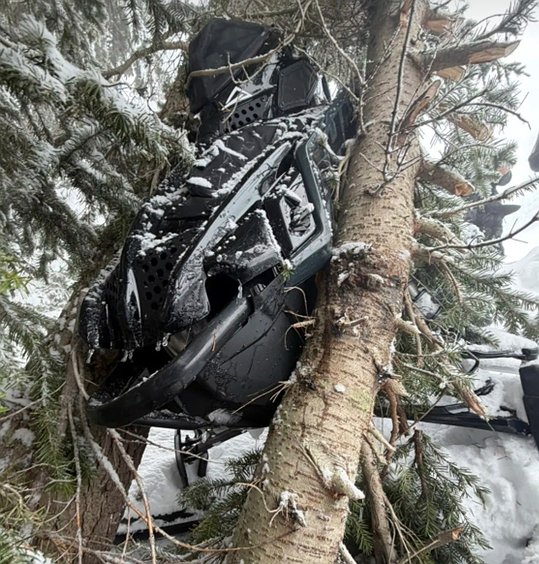 The snowmobile belonging to Tyson Haynes rests by trees after Haynes crashed in the backcountry beyond Lookout Pass on Sunday, Feb. 15.
ARTICLES BY BILL BULEY

Terry Gurno launches 'Unyielding Hope' nonprofit to encourage others
Terry Gurno launches 'Unyielding Hope' nonprofit to encourage others
At the center of this effort is Terry Gurno, whose own life journey shaped the heart behind the organization.
Panhandle drought conditions continue
Report: Snowpack well below normal at 60%
Idaho’s snowpack is well below normal on March 1. Normally by this time of year, the snowpack would have accumulated 80% of its typical peak amount, but this year, is only about 60% of the way there, the report said.
Panhandle drought conditions continue
Report: Snowpack well below normal at 60%
Idaho’s snowpack is well below normal on March 1. Normally by this time of year, the snowpack would have accumulated 80% of its typical peak amount, but this year, is only about 60% of the way there, the report said.