
Gonzaga, UW program designed to improve region's health care
CHERYL SCHWEIZER | Hagadone News Network | UPDATED 1 day, 7 hours AGO
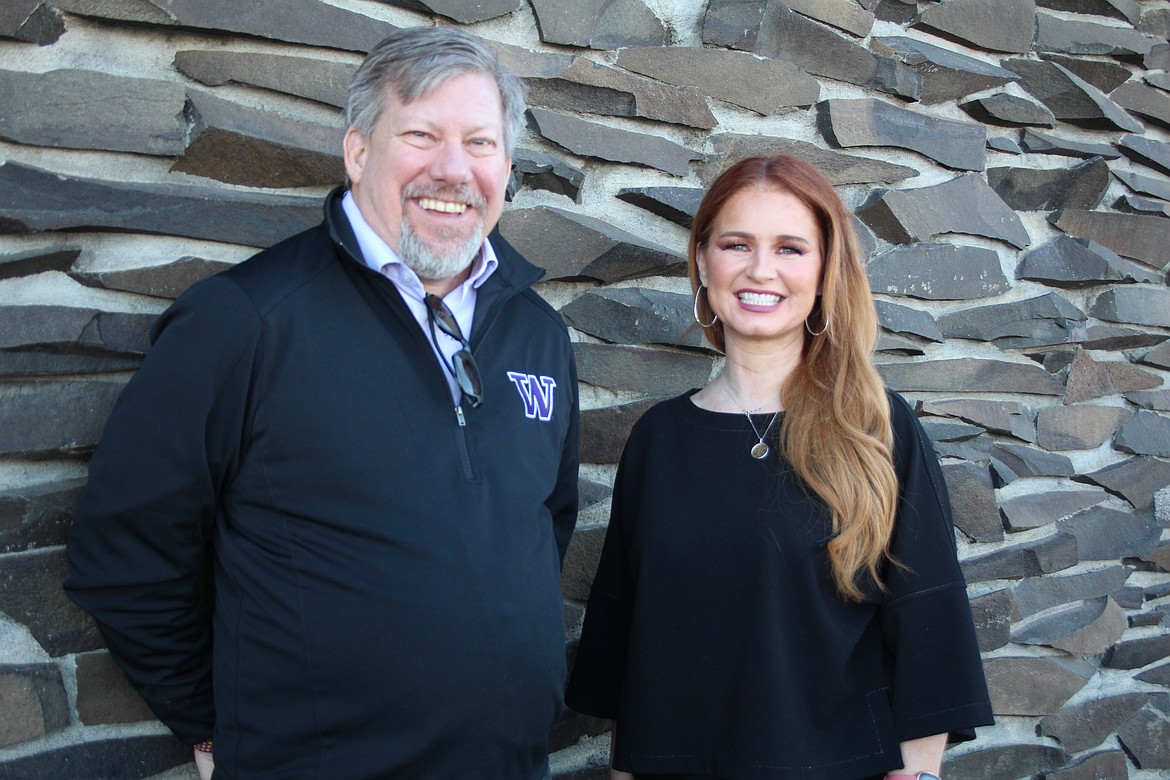
Dr. Geoff Jones of the University of Washington medical school and Dr. Robin Pickering, chair of public health at Gonzaga University, said medical facilities and colleges are most effective when they work together to solve healthcare challenges.
CHERYL SCHWEIZER/COLUMBIA BASIN HERALD
Senior Reporter Cheryl Schweizer is a journalist with more than 30 years of experience serving small communities in the Pacific Northwest. She began her post-high-school education at Treasure Valley Community College and enerned her journalism degree at Oregon State University. After working for multiple publications, she has settled down at the Columbia Basin Herald and has been a staple of the newsroom for more than a decade. Schweizer’s dedication to her communities and profession has earned her the nickname “The Baroness of Bylines.” She covers a variety of beats including health, business and various municipalities. | March 2, 2026 3:00 AM
MOSES LAKE — Geoff Jones, a physician and assistant clinical dean at the University of Washington Medical School, said giving medical students a wide variety of experience benefits both the students and their future patients.
“We think that educating learners with docs that are actually working in the communities is a much better way to train physicians. They’re going to learn exactly what they’re going to do, where they’re going to do it, what it’s like to live there and work there,” Jones said.
Jones and Dr. Robin Pickering, chair of public health at Gonzaga University, toured Central and Eastern Washington last week, meeting with medical professionals working with Gonzaga and UW in a jointly sponsored training program. Pickering said 2026 is the program’s 10th anniversary.
“As a partnership, we have come together, UW with GU, to address some of the regional healthcare and workforce needs,” Pickering said. “In coming together, we can really focus on the regional needs of our communities. There are a lot of workforce shortages that we’re facing in the region, in nursing and physicians – really, across the board. With this partnership, we can really address the needs of the region effectively.”
UW sends medical students to partnering hospitals and clinics throughout the region, a program that began in 1970, Jones said.
“Students are matched to a community before med school, before school even starts,” Jones said. “They go out to the community to work for about a week, and then they go back periodically throughout the first couple of years, including a monthlong experience. And then they do a six-month clinical rotation here during their third clinical year of med school. Moses Lake is kind of unique in that for the last three years we have had our students actually live in Moses Lake and commute to Spokane for their classwork.”
The university works with Confluence Health-Moses Lake Clinic in some medical disciplines like obstetrics, Jones said. Moses Lake Community Health is the site for a program designed to train physicians who want to work in underserved areas, he said. Othello is another site, along with Chelan, Grand Coulee, Newport and Ellensburg.
Gonzaga’s school of health sciences has added a bachelor’s program, Pickering said, and will add a masters program in 2027. Those programs have the potential to really help the region, she said.
“We have students who learn how to do grant writing. They learn how to do advocacy work. We have many who are interested in epidemiology. Following the pandemic, I think a lot of people became very interested in disease investigation,” Pickering said. “We have the opportunity for internships in those spaces, and a lot of folks now have the capability of doing even remote internships and grant writing experiences. We have a lot of community partners that really need those skills. I think it has the potential for a real win-win for our region.”
Jones and Pickering said jobs in medicine are still attractive.
“I don’t think there’s a shortage of people that want to go into medicine. We have not seen a decrease in applications at the University of Washington School of Medicine,” Jones said. “But medical school is only a part of physician training. After you graduate from medical school, you then have to complete a residency to be licensed to practice in a state. That’s where we’re seeing the real shortage, is residency slots.”
Pickering said training programs for nurses are experiencing the same trend.
“We have, quite literally, hundreds and hundreds of people applying every year to be part of the nursing program,” she said. “Where you see the bottleneck is typically in the clinical placement opportunities.”
Jones said there is an effort to increase residency opportunities, including through the UW-GU program in Spokane. Samaritan Healthcare is one of the hospitals working on a separate program with Washington State University to establish a residency program. Pickering said all the efforts are appreciated.
“That's part of why we come out to these communities, is to really express our gratitude to our clinical partners, because we really see the commitment,” she said. “We know that it takes work to supervise and to train up, and it is also a critical component of developing workforce.”
Cooperation will continue to be important in alleviating the regional challenges, she said.
“We’re not going to run out of health problems to address,” she said. “We need all hands on deck. The more effectively we work together, the more we can tackle (the challenges). People are living longer – they are living more years with chronic conditions, and we need to be working together.”
ARTICLES BY CHERYL SCHWEIZER
Moses Lake fiscal sustainability discussion kicks off
MOSES LAKE — The Moses Lake City Council and city officials are starting a process to determine what services the city should be providing – and paying for – and which could be reduced if necessary. It’s part of city officials’ attempt to eliminate a budget deficit in the city’s general fund, a deficit that’s projected to increase over time without changes to the way the city is spending its money.

Gonzaga, UW program designed to improve region's health care
MOSES LAKE — Geoff Jones, a physician and assistant clinical dean at the University of Washington Medical School, said giving medical students a wide variety of experience benefits both the students and their future patients.
Open house Saturday at new Samaritan Hospital
New facility set to open to serve patients March 7
MOSES LAKE — The final doors are being installed in the intensive care unit, one of two surgical robots is in the building, the signs are up – although they’re still covered – on Yonezawa Boulevard. The new Samaritan Hospital opens for patient care March 7.