
Residents press lawmakers on short-term rentals, budget cuts
CAROLINE LOBSINGER | Hagadone News Network | UPDATED 4 days, 14 hours AGO
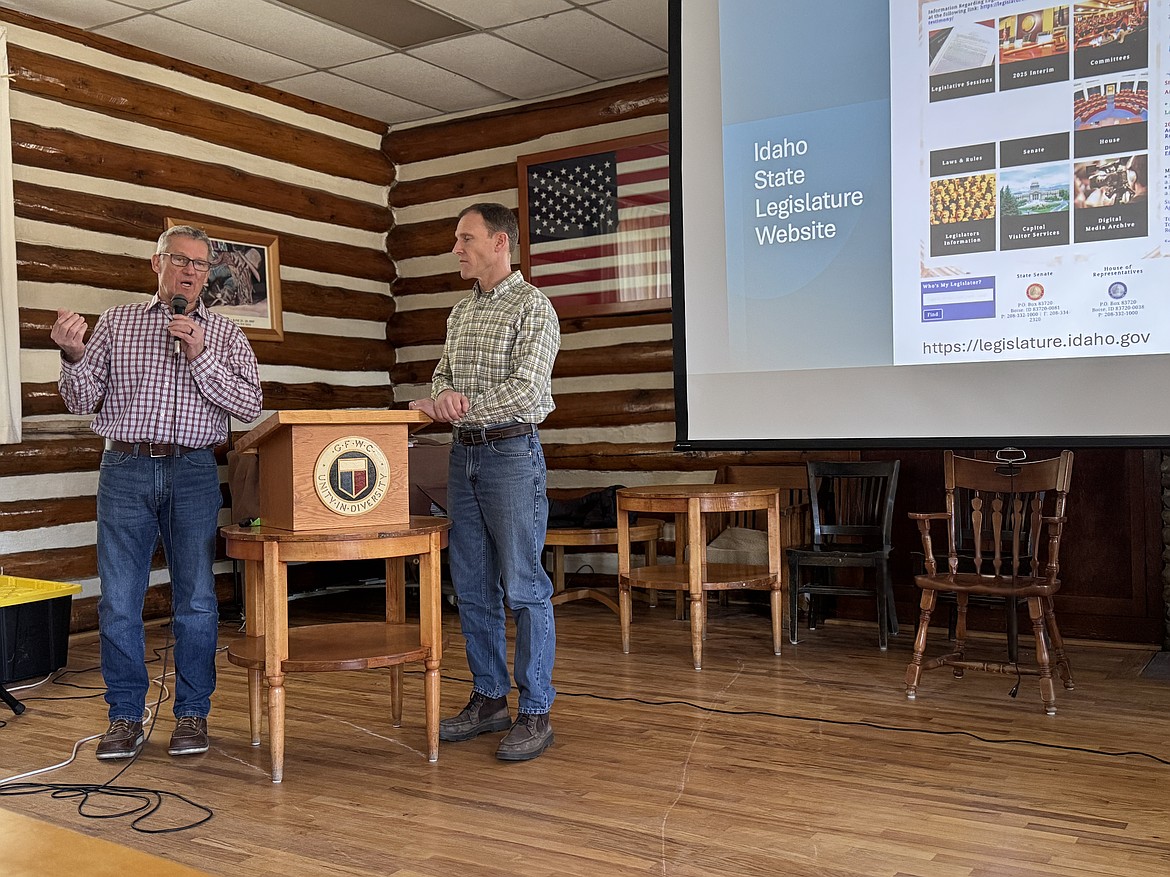
Rep. Mark Sauter, left, and Sen. Jim Woodward, right, talk to area residents about bills facing the Idaho Legislature this session at a Feb. 28 town hall meeting in Sandpoint. Similar events were held in Bonners Ferry and Priest River.
Photo by CAROLINE LOBSINGER
I grew up in the Tri-Cities, Wash., and have always loved to write. I attended the University of Washington, where I earned a double major in journalism and political science, with an area of emphasis in history. I am the fifth out of six kids — don't believe any of the stories that my siblings tell. To be able to tell others stories and take photos for a living is a dream come true — and I considered myself blessed to be a community journalist. When I am not working, I enjoy spending time with family and friends, hiking and spending time outdoors, genealogy, reading, and watching the UW Huskies and the Seattle Seahawks. I am a servant to my cat, Frankie, who yes, will eat anything and everything in sight … even wedding cookies. | March 5, 2026 1:00 AM
SANDPOINT — From short-term rental legislation to the state budget, area residents had a chance to ask questions about issues before the Idaho Legislature at a recent series of town hall meetings in the two northern counties.
A variety of issues were discussed, from the state’s budget to legislation on impact fees for agencies such as Idaho’s fire and library districts, to the latest on short-term rental bills.
“While the big argument among that committee was property owners should have the right to do with their property what they want; that it was violating the property rights,” one woman said in bringing concerns on the issue up at the town hall. “Well, I feel like with these short-term rentals, with no restrictions, they’re violating the property rights of those of us that live here year-round and have to deal with an unlimited, perhaps, number of short-term rentals in our neighborhood, which will destroy our neighborhoods and our communities.”
The woman also questioned why legislators don’t have to declare conflicts of interest or abstain from voting when individuals serving on community boards are required to do so.
“Several people stated on the committee that they own short-term rentals, but they did not recuse themselves from the vote or the discussion,” she said.
Idaho Sen. Jim Woodward, R-Sagle, and Rep. Mark Sauter, R-Sandpoint, said rules encourage declaration of potential conflicts but still allow lawmakers to vote because of the diluted nature of potential benefits.
Both told those gathered they shared residents’ concerns about the potential impact to communities of unlimited short-term rentals. On one side are companies such as Airbnb and Vrbo advocating for looser regulation; on the other are groups such as the Resort Cities Coalition, which advocate for the ability of cities to regulate the industry according to their communities’ needs and desires.
Several residents questioned why the issue was being viewed as a property rights matter instead of one that introduces businesses into residential neighborhoods.
“How do they get by with saying that it’s not a business?” one resident said. “I mean, if I’m renting out my house every week, and I’m getting income from it, isn’t that a business?”
While the pair said they shared concerns, Woodward said it may take court action to get a legal interpretation on the issue.
Among other issues discussed at the town halls were the homeowner’s exemption, the Idaho Public Utilities Commission and the state budget.
The state’s population has grown from 1 million in 1970 to 2 million in 2020. It is likely to double again, sooner than many might expect, Woodward told those who attended the Sandpoint town hall.
“So my point being that Idaho is different today, for me and for anybody who’s been here for some time, it’s different today,” the state senator said. “We have to acknowledge that it comes into play in this. This is really the conversation that we’ve been having about the budget.”
While there is a drive to cut “bloated spending” from the budget, Woodward said an analysis of general fund spending showed that spending over the past 20 years has been relatively flat despite the population increase.
Corrected for population and inflation, Woodward said the trend shows little to no increase in spending.
“We’re pretty flat. We’re pretty responsible,” he added. “We’re pretty Idaho.”
Different “bubbles” over the past 20 years are reflective of various state initiatives intended to maintain Idaho’s quality of life — from investments in infrastructure and education to Medicaid expansion and judicial reform.
“We’ve taken on some big tasks, and yet the spending line has still stayed relatively flat,” Woodward said. “So we are trying to acknowledge where we are, and probably still not quite getting there.”
However, the senator noted that claims of a bloated state government or booming spending by Idaho agencies or state offices are inaccurate.
“If you’re hearing the narrative of this booming state government spending, it’s not true,” he said. “They’re cherry-picking some data points.”
The state is working to address the Legislature’s decision to apply conformity to the federal Big Beautiful Bill retroactively. Not only are agencies mid-budget year, complicating potential cuts, but the decision is also affecting the current tax season as residents and businesses work to complete their 2026 tax returns.
“Everybody’s trying to figure out how to deal with that — the CPAs, the software providers, the Idaho State Tax Commission,” Woodward said.
Funds to cover the cost of conformity are coming from cuts to schools, higher education, wildland firefighting, transportation and state agencies.
“How does that come and hit home?” Woodward asked the crowd. “It hits us in some of the services that we’d like to see from the state. Without even talking about some of the others, it’s really those core services of schools and transportation and public safety.”
Woodward said some in the Legislature are working to ensure programs such as career-technical education, Idaho State Police and National Guard education assistance have the funding they need.
On the Idaho House side, Sauter noted the impact of tight budgeting by sharing the story of an ISP trooper assigned as a bodyguard to Gov. Brad Little.
The trooper left Idaho to work in Oregon, where he is making $15 to $20 more per hour than he made in Idaho.
“He’s a good, upstanding guy, but he had to make a business decision on what was good for his family, and he moved to Oregon to really drastically change his pay,” Sauter said.
Sauter said he is working on several insurance-related bills, including property insurance renewal and rate transparency, as well as a bill to reinstate license suspensions for unpaid traffic fines.
When the suspension was lifted about 15 years ago, unpaid fines totaled roughly $1 million. Now that amount has jumped to almost $24 million — money needed by the state’s courts, cities and law enforcement.
“It goes all across the board for all of these other services that have done without because they haven’t had that funding,” Sauter said. “So it’s not a tax increase by any means. It’s just really, for me, a public safety issue. It’s making sure that people know you’re driving within the speed limits, you drive properly, and this isn’t an issue — but if you want to act out, there are consequences.”
Town hall events were also held in Bonners Ferry and Priest River to give residents throughout District 1 a chance to visit with legislators, share concerns and offer input on bills before the Idaho Legislature.
Both Woodward and Sauter encouraged residents in the two northern counties to utilize the Legislature’s website — legislature.idaho.gov — to stay on top of what bills are being discussed and where they are in the process. They also encouraged residents to contact them to share their input on legislation and what, as Idaho voters, they want from their state government.
ARTICLES BY CAROLINE LOBSINGER

BCSA’s Gun 'n' Horn Show celebrates community, hunting tradition
The 43rd annual Gun ’n’ Horn Show brings antler displays, hunting gear, vendors, and community traditions to the Bonner County Fairgrounds this weekend. Hosted by the Bonner County Sportsmen Association, the event highlights regional hunting culture while supporting youth programs.

'Empty Bowl' helps fill up local food bank
Event blends art, soup and support for local families
The Empty Bowl fundraiser showcases handmade bowls from local students, soups from area businesses and a community focused on supporting food assistance efforts in Bonner County.
Residents press lawmakers on short-term rentals, budget cuts
Residents raised concerns over short-term rentals, budget impacts, population growth and tax conformity during North Idaho town halls.