
Warm February leaves Montana’s snowpack depleted
MATT BALDWIN | Hagadone News Network | UPDATED 3 weeks, 1 day AGO
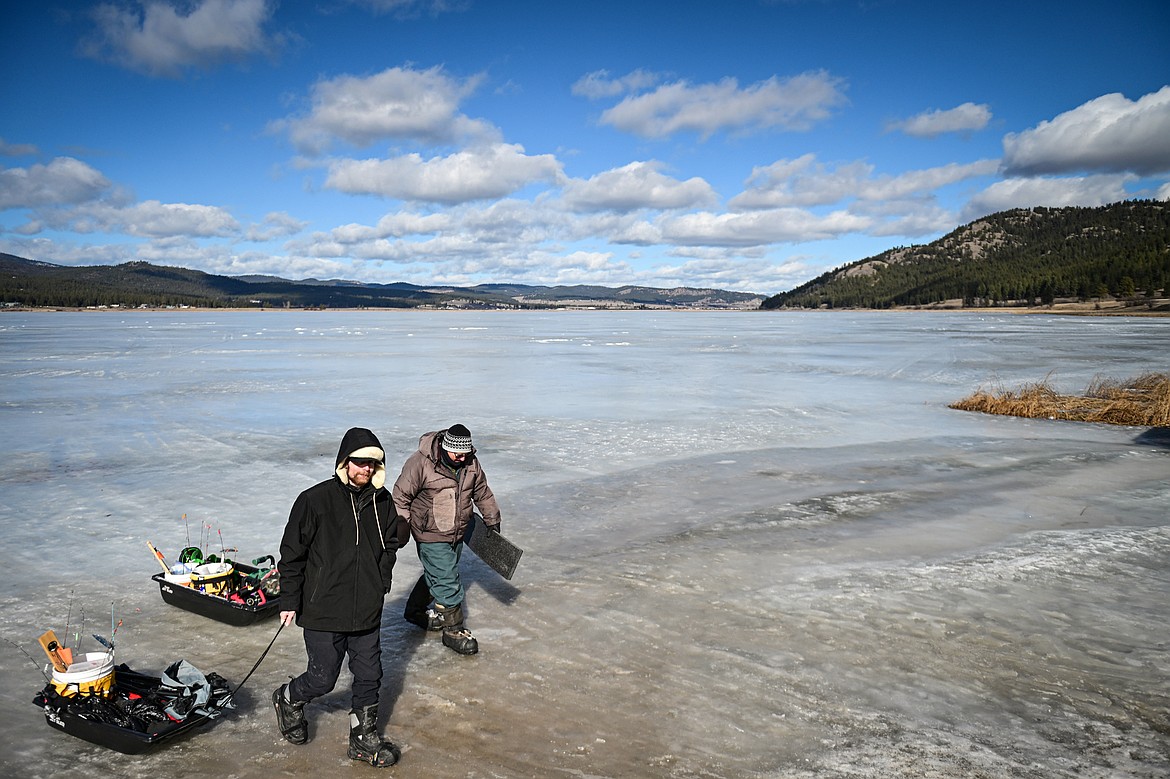
Brian and Bill Woodard tow their ice fishing gear back to shore at Smith Lake in Kila on Tuesday, Feb. 24. (Casey Kreider/Daily Inter Lake)
Hagadone Media Montana REGIONAL MANAGING EDITOR Matt Baldwin is the regional editor for Hagadone Media Montana, where he helps guide coverage across eight newspapers throughout Northwest Montana. Under his leadership, the Daily Inter Lake received the Montana Newspaper Association’s Sam Gilluly Best Daily Newspaper in Montana Award and the General Excellence Award in 2024 and 2025. A graduate of the University of Montana School of Journalism, Baldwin has called Montana home for nearly 30 years. He and his wife, Sadie, have three daughters. He can be reached at 406‑758‑4447 or [email protected]. IMPACT: Baldwin’s work helps ensure Northwest Montana residents stay connected to their communities and informed about the issues that shape their everyday lives. | March 7, 2026 10:00 AM
Western Montana’s mountain snowpack did little to make up for a historically dry January, with water basins statewide lagging behind average heading into March.
The entire state was baked by above-normal temperatures in February, which has led to a stark contrast in snowpack scenarios for valley locations compared to higher terrain, according to the March water supply outlook from the Natural Resources Conservation Service.
While the Stahl Peak weather station in the Whitefish Range of Northwest Montana is reporting above-normal snowpack, nearby Grave Creek in the lower elevations is experiencing its lowest snow year on record.
As of March, 24 of the 232 snow monitoring stations with 30 years or more of data in the region experienced the lowest March 1 snow water equivalent on record.
The Flathead Basin snowpack was 73% of average heading into March and the Kootenai was 84%. The weather station at Noisy Basin in the Swan Range showed 84 inches of snow as of March 7, while Flattop Mountain in Glacier National Park had 92 inches.
Overall, February precipitation ranged from near to well below normal across Montana. The Flathead Basin precipitation was 69% of average and the Kootenai was 78% for the month.
However, water year-to-date, Flathead precipitation is at 111% of normal and the Kootenai is 118% of normal, mostly due to the deluge of rain in December that led to damaging flooding in Lincoln County.
Still, drought conditions have expanded across the state, with Northwest Montana mostly classified as abnormally dry.
“The full influence of this early season moisture remains to be seen,” the water report states. “While December precipitation likely helped recharge groundwater sources and stock high-elevation snowpacks, warm temperatures and the lack of valley snow coverage may reduce those benefits.”
Snowpack accumulations over the next couple of months will determine if water supply deficits can be recovered.
“Given the inherent uncertainty of early spring forecasts, and the lack of valley snow, it could be prudent for water users to make conservative management decisions that take into account the full suite of forecast predictions, especially on the lower end,” explained NRCS hydrologist Florence Miller.
A change in weather is expected starting March 10 as below-normal temperatures and above-normal precipitation take root.
Heavy, wet snow accumulation`s above 5,000 feet are expected after Tuesday, with potentially 1 to 3 feet of snow by Friday, the National Weather Service in Missoula predicts.
ARTICLES BY MATT BALDWIN

PHOTOS: No Kings protest draws crowd to Whitefish
A No Kings protest against the Trump administration drew hundreds of people to Grouse Mountain Fields in Whitefish on Saturday, March 28, 2026. The event, hosted by Flathead Democracy, was one of thousands held across the U.S., according to national event organizers.
Avalanche danger high after 2 to 3 feet of new snow
Dangerous backcountry conditions prompted a special avalanche warning Friday morning after Northwest Montana mountains were buried in 2 to 3 feet of snow.
Avalanche danger high after 2 to 3 feet of new snow
Dangerous backcountry conditions prompted a special avalanche warning Friday morning after Northwest Montana mountains were buried in 2 to 3 feet of snow.