Service and Tradition: Inside Kellogg High’s Marine Corps JROTC Program
JOSH McDONALD | Hagadone News Network | UPDATED 1 day, 10 hours AGO
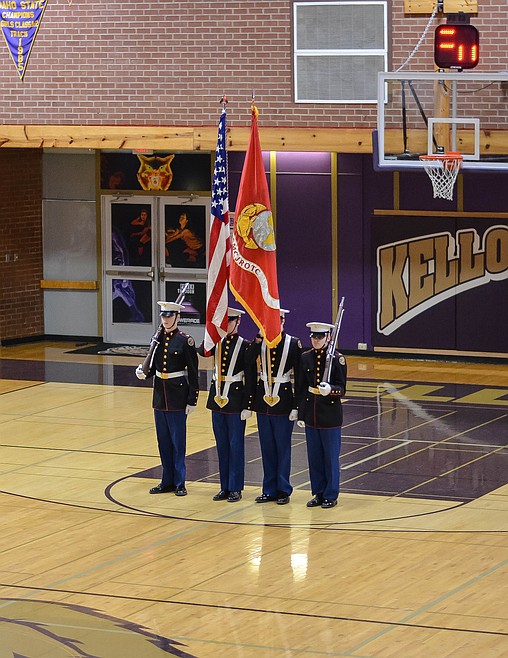
The Color Guard has become an important tradition before all Kellogg High School home contests. The Color Guard is made up of student cadets from Kellogg High School's Marine Corps JROTC program.
Courtesy photo
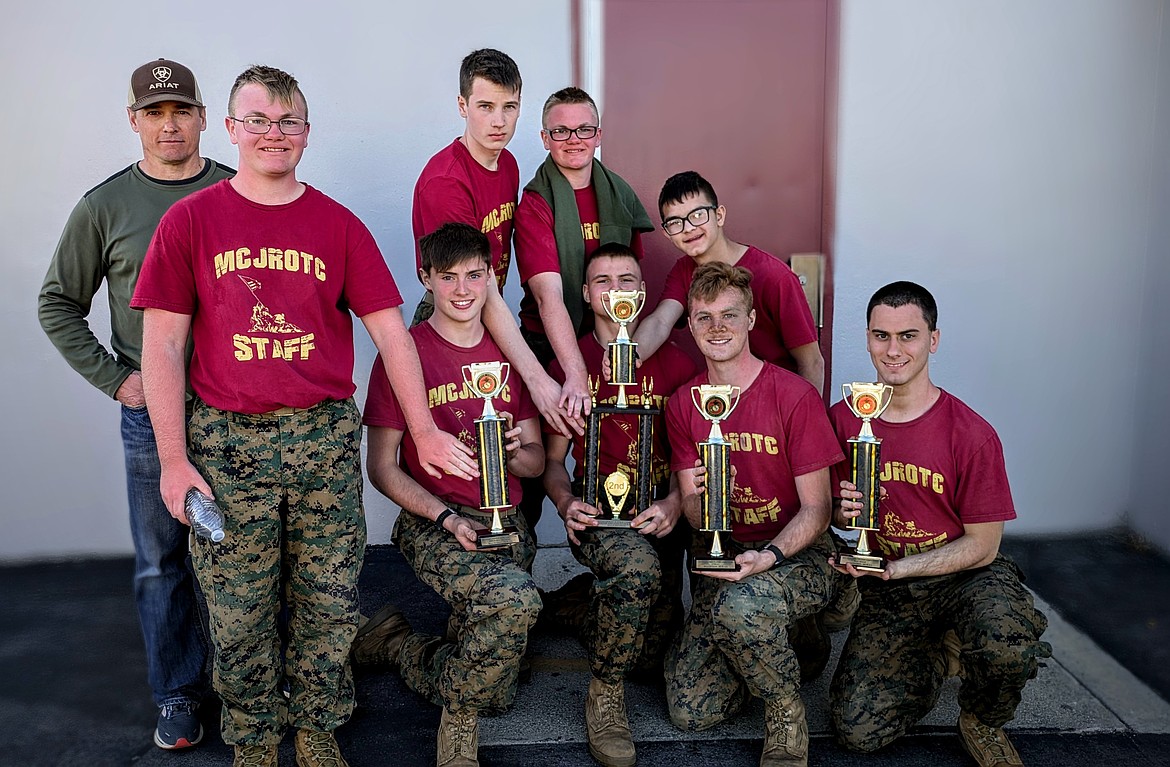
The 2025 Kellogg High School Marine Corps JROTC Raider Team with their third-place trophy. Pictured are SgtMaj. Jeff Smith and team members Ryken White, Nolan Harju, Mattix Harris, Aiden Flynn, Joni Knight, Eavin Knight, Spencer Strange, and Gage Pierce.
KELLOGG — For 55 years, students at Kellogg High School have had the opportunity to get a close-up look at the United States Marine Corps through the Junior Reserve Officer Training Corps.
Over the decades, Kellogg’s JROTC program has become woven into the fabric of the Silver Valley. From color guards at sporting events, parades and ceremonies to thousands of volunteer hours at community events, residents have come to expect seeing the program’s cadets out in the community.
According to Maj. Craig Petersen, the program’s senior Marine instructor, the KHS MCJROTC was established in 1971 after the family of Lt. Frank Reasoner and the Kellogg School Board requested that the Marine Corps establish a JROTC program at the school.
Reasoner, a Kellogg graduate and posthumous recipient of the Congressional Medal of Honor and a Purple Heart, was killed in action July 12, 1965, during a reconnaissance mission in Vietnam.
“All the military services sponsor these programs in high schools that qualify and request them,” Petersen said. “There are currently 235 MCJROTC programs throughout the country, but Kellogg has the only Marine Corps JROTC program in the state of Idaho.”
Petersen said the goal of all JROTC programs is to teach cadets the foundations of citizenship and leadership in a structured environment.
“Student enrollment in these elective programs is voluntary, and student cadets incur no military obligation,” he said. “Programs supply government‑issued uniforms and require their wear once a week. Cadets can be enrolled from one semester to four years. Cadets learn about discipline, drill and ceremonies, marksmanship, land navigation, leadership and other related academic subjects.”
While that may be the 1,000-foot view of a standard JROTC program, the class at KHS offers something different from the traditional elective. While some students gravitate toward physical education or arts‑based classes, JROTC offers a unique mix of skills and experiences.
“Cadets receive opportunities for personal development and community service that are not available to the average high school student,” Petersen said. “Through performance, cadets can earn promotions, ribbons, badges that parallel those of an active‑duty Marine Corps unit. Instructors help cadets learn how to motivate and lead their peers to accomplish goals through teamwork.”
Community service is one of the program’s largest components.
Over the past 12 years, the program has averaged more than 900 hours of community service annually.
“This type of engagement in the community, along with the numerous color guards, is why Kellogg High School has been nominated as a Naval Honor School,” Petersen said. “This recognition signifies we are in the top 20% of all JROTC units in the country. It’s quite unique for such a small unit to receive this kind of recognition, but it’s a testament to the quality of cadets in the JROTC program.”
In recent years, the KHS program has entered the competitive arena by creating a Raider Team.
Raider competitions pit JROTC units against one another in events focused on strength, endurance, teamwork and problem‑solving. The U.S. Army created the Raider program, but other branches, including the Marine Corps, now participate. Raiders are the JROTC equivalent of the Army’s Ranger competitions.
Last year, Kellogg’s Raider Team placed third at a competition in California. They will return to that event in a few weeks.
Petersen and Sgt. Maj. Jeff Smith emphasize that participating in JROTC does not obligate students to join the military, although there are benefits for those who choose that path. Their goal is to help students enter adulthood with foundational skills they may not gain elsewhere.
“Since my time here, many students have joined a military service, went to a service academy, but the majority have gone on to college or entered the job market,” Petersen said. “The JROTC program has awarded tens of thousands in scholarship money over the years to assist those pursuing higher education. We as instructors just try to get our upper‑level cadets to set a goal and go after it. It’s OK to deviate and adjust course. Just set goals and do your best to achieve them.”
Maintaining a JROTC program can be challenging for small schools due to financial demands and strict participation criteria.
Schools must maintain at least 100 cadets or 10% of enrollment, whichever is lower. They must employ certified, usually retired military instructors who serve as full‑time faculty. Required facilities include a classroom, secure storage for uniforms and equipment, and space for drill and physical training. Programs are subject to routine inspections and must comply with the updated 2023 congressional rules on misconduct reporting and student safety.
Petersen and Smith's compensation is different from that of other KHS teachers. The Marine Corps sets their salaries and pays half. The Kellogg School District covers the remaining 50% and provides full benefits.
“We have two outstanding individuals in these positions; Mr. Peterson and Mr. Smith are worth every dime,” KSD Superintendent Lance Pearson said. “Unfortunately, the state does not allocate any money toward this program and it does cost the district upwards of $150,000 to run the program.”
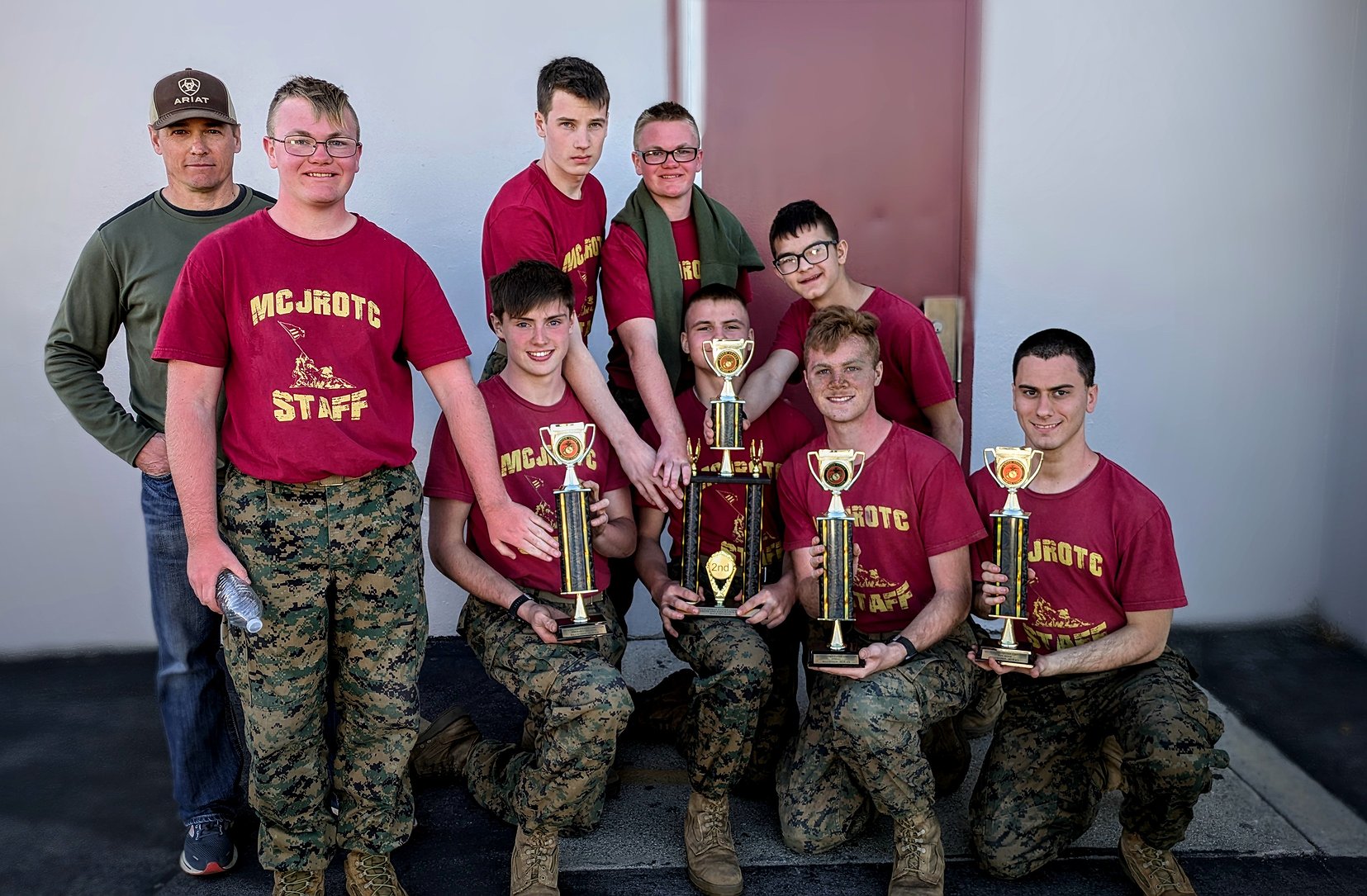 The 2025 Kellogg High School Marine Corps JROTC Raider Team with their third-place trophy. Pictured is Sgt. Maj. Jeff Smith and team members Ryken White, Nolan Harju, Mattix Harris, Aiden Flynn, Joni Knight, Eavin Knight, Spencer Strange, and Gage Pierce.
ARTICLES BY JOSH MCDONALD

Two rescued following Friday avalanche at Silver Mountain
Two people were rescued Friday afternoon after an avalanche at Silver Mountain, according to the resort.
Two rescued following Friday avalanche at Silver Mountain