
Montanans receive grants for adaptive recreational equipment
JULIE ENGLER | Hagadone News Network | UPDATED 1 week, 4 days AGO
Julie Engler covers Whitefish City Hall and writes community features for the Whitefish Pilot. She earned master's degrees in fine arts and education from the University of Montana. She can be reached at [email protected] or 406-882-3505. | March 18, 2026 1:00 AM
Twenty years ago, Kelly Brush started her namesake foundation to inspire and empower people with spinal cord injuries to lead active and engaged lives. Thus far, the Kelly Brush Foundation has supplied over $6 million in adaptive equipment grants.
The Foundation’s Active Fund provides grants for individuals with paralysis caused by spinal cord injury to purchase adaptive sports equipment. Whitefish resident Domonic Corradin and Jack Racicot from Whitehall recently received Active Fund grants.
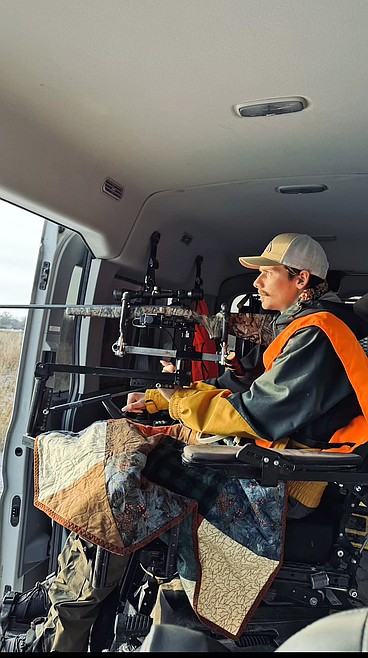
A hunter and outdoorsman, Racicot was born in Helena and now lives with his parents in Whitehall, and works on the family’s flower farm. He used the Active Fund grant to purchase a straw trigger system which allows him to shoot more accurately.
Racicot spent most of his early years with his dog, enjoying the outdoors in Montana. Seeing red-winged blackbirds in the wetlands and white-tailed deer always brought him overwhelming joy.
Seven years ago this week, when Racicot was 20 years old, he had a snowboarding accident at Great Divide Ski Area, his home slope. He sustained a cervical spinal cord injury at the C5 level which changed the trajectory of his life.
“Before my injury, I was just immersed in the outdoors, so those parts were definitely part of my identity,” he said. “Losing that physical function meant more than adapting to a wheelchair, it meant confronting the possibility of losing the lifestyle that shaped who I was.”
He attended Neuroworx, an outpatient rehabilitation facility in Sandy, Utah, for six months, working with his therapist three hours a day to make his body stronger and to rebuild independence.
During his time in the rehabilitation facility, he addressed his physical, mental and emotional well-being. While forced to confront his limitations, he was also introduced to the possibilities.
“I was really naive at the beginning of my injury thinking it's going to be like a muscle and I can just train and get stronger and I'll be back pedaling a bike in three weeks on my own,” he said. "I developed a close relationship with my therapists ... they came to understand my back story, how I was injured, and the life I lived before.
“We often talked about the outdoor activities and it always grounded me, especially looking through these big glass picture windows at the Neuroworx facility, up at the Wasatch Mountains,” he said. “You can't help but just daydream to get up there.”
One of his therapists introduced him to the Kelly Brush Foundation and other organizations that could assist with critical adaptive treatment. The staff encouraged Racicot to apply for adaptive equipment grants. He was resistant at first.
“I was very stubborn. My doctor at the University of Utah, Dr. Rosenbluth, had said that I was probably one of the most stubborn young patients he's ever had,” he said. “I tried to take it as a compliment.
“I wasn't really ready to accept that adaptive equipment might become a permanent part of my life,” he said. “My focus at that time was to move forward, try and regain strength and independence and holding on to the belief that I could return to an independent lifestyle that I once was accustomed to.”
Just a few months out of the hospital in 2019, Racicot undertook his first outdoor recreational activity, despite being advised by the doctors not to do it. He went paragliding in Utah with his brother. Since he has some sensation on his neck, he was able to feel the temperature changes brought on by thermals.
About two years of depression followed. Then, Racicot attended the Beaver Creek Rendezvous, a hunting camp, in Ekalaka in 2021. It was the first time he’d been hunting since his injury. The atmosphere, the people and the small-town vibe, along with his success in filling his tag, combined to reignite his passion for hunting.
“I was hooked. I was just ready to get back on to the to the saddle and enjoy hunting again,” he said. “In my mind, anytime I can get into the outdoors, it's my antidepressant.”
He investigated organizations that could help with adaptive equipment and was methodical about the gear he chose to purchase. He rented gear rifle mounts and an adaptive trigger system from MonTECH for three years.
MonTECH is an organization at the University of Montana in Missoula that provides technology, support and services to improve the lives of Montanans with disabilities. It also rents adaptive gear of all kinds, from computers to wall tents.
“Once I used that trigger system for the first time it was a game changer,” Racicot said. “I was able to make really precise and ethical shots on game. Going out for target practice and just clinking metal targets was a complete breeze.”
The Sip-n-Puff Trigger Mechanism is an adaptive trigger system that works by sipping on a straw which sends an electrical impulse to an actuator that pulls the trigger. It will fire as fast as the shooter can sip.
Before getting the new system, Racicot tried using his finger to trip the trigger and he and his friends devised a syringe system to actuate the gun. While he says both methods were OK, neither produced the results he’s had with the adaptive system.
“I have wrist extension, but I don't have wrist flexion and then everything below my collar bones is paralyzed and I have very limited sensation,” he said. “So my hands are basically fists, 24/7. I have biceps and shoulders and when I was first trying to shoot, I would just shove my finger in there and try to pull the trigger.
“It is an incredible piece of equipment,” he said of the trigger system. “Anyone from a paraplegic or a normal person to a C2 quadriplegic who can't move anything other than their lips is able to operate it.”
A couple of friends fabricated a custom rifle mount for Racicot using scrap metal and pieces off a broken ATV. Racicot says it works fantastically, and that those types of projects fill the hearts of everyone involved.
In addition to working at the Public Service Commission in Helena, Racicot was recently made president of the board for Ability Montana, a center for independent living in southwest Montana.
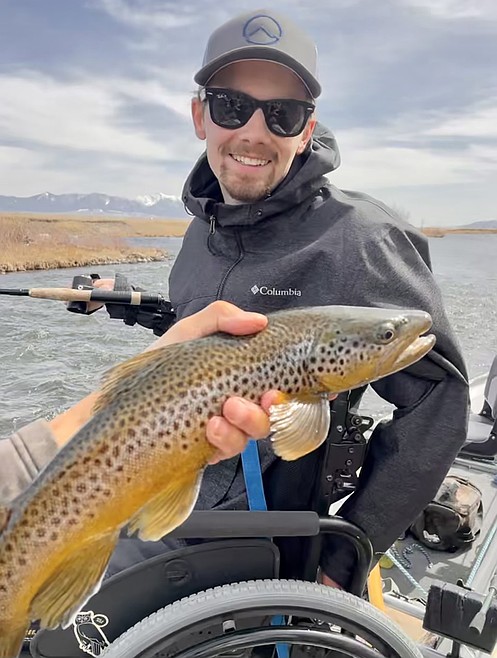
The nonprofit recently acquired a fishing property on the Madison River called Camp BullWheel. Taking people out on the water has become a major passion for Racicot.
“When you have an individual who is not in a great spot, they’re depressed and don’t have that sparkle in their eye -- when they come back from a day float, it’s like something rejuvenated their soul," he said. "It's so fulfilling to witness that.”
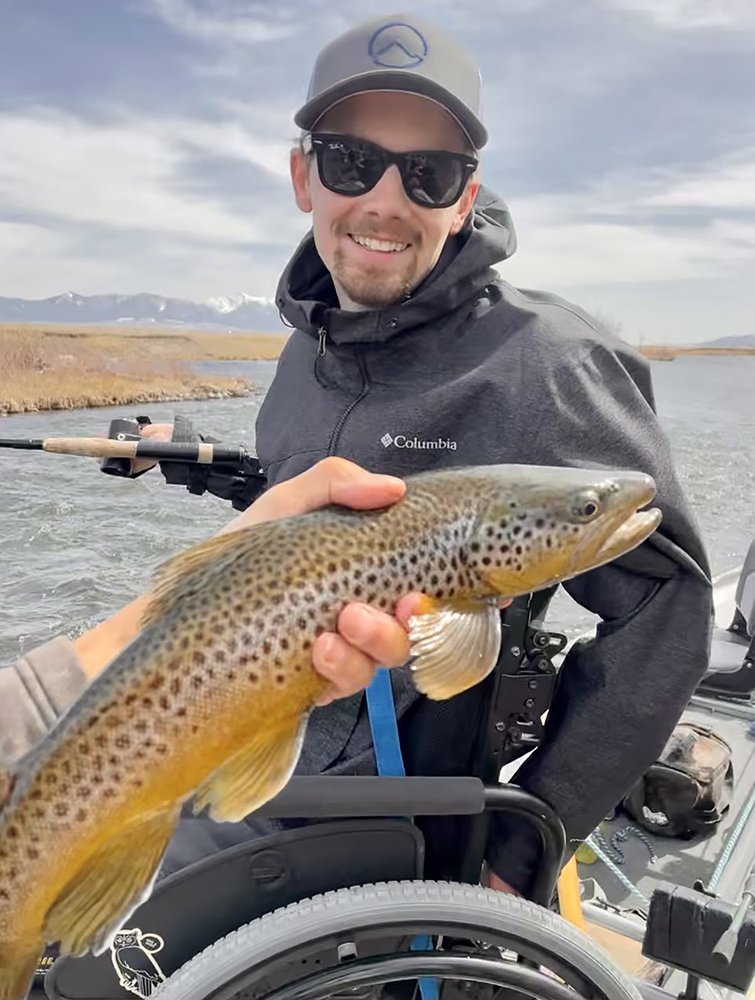 Jack Racicot takes people fishing on the Madison River with Camp BullWheel. (Photo provided)
ARTICLES BY JULIE ENGLER
Full send: Young skiers huck their carcasses with style
Several skiers in the Flathead Freeride Club this year rank among the top freeride skiers in the world.
Wild shredders support outdoor recreation for everybody
DREAM Adaptive Recreation’s seventh annual Shred Fest brought some wild characters to Whitefish Mountain Resort Saturday, with participants in animal prints, tails, ears and whiskers, reflecting this year’s theme, Wild Thangz.
Whitefish wrestler reflections
The Whitefish High School wrestling team was strong this year, with seven girls and seven boys on the squad, including four seniors, Jasper Jungwirth, Kacee Orvis, Taylor Dorvall and Sam Akey