
Opinion: Salamander in the snow illustrates marvels of natural world
CHRIS PETERSON | Hagadone News Network | UPDATED 3 days, 12 hours AGO
Chris Peterson is the editor of the Hungry Horse News. He covers Columbia Falls, the Canyon, Glacier National Park and the Bob Marshall Wilderness. All told, about 4 million acres of the best parts of the planet. He can be reached at [email protected] or 406-892-2151. | March 18, 2026 7:15 AM
The boy, the dog and I go for a hike just about everyday in the Flathead Forest. It’s a nice little walk in the woods and depending on which fork you pick it’s a quick loop or a longer walk up into the hills.
There are no views whatsoever so not many people hike these trails, which makes sense because a lot of people think the woods are boring.
I’m not one of those people, of course. The woods have plenty of birds, almost all of them the common sort, though I expect it will get way more diverse come summer.
On Friday it was snowing and the varied thrush were calling. The varied thrush has that one long mournful note of a call which is unmistakable. They typically return this time of year, but this year, it seems they never really left, as I heard and saw them most of the winter.
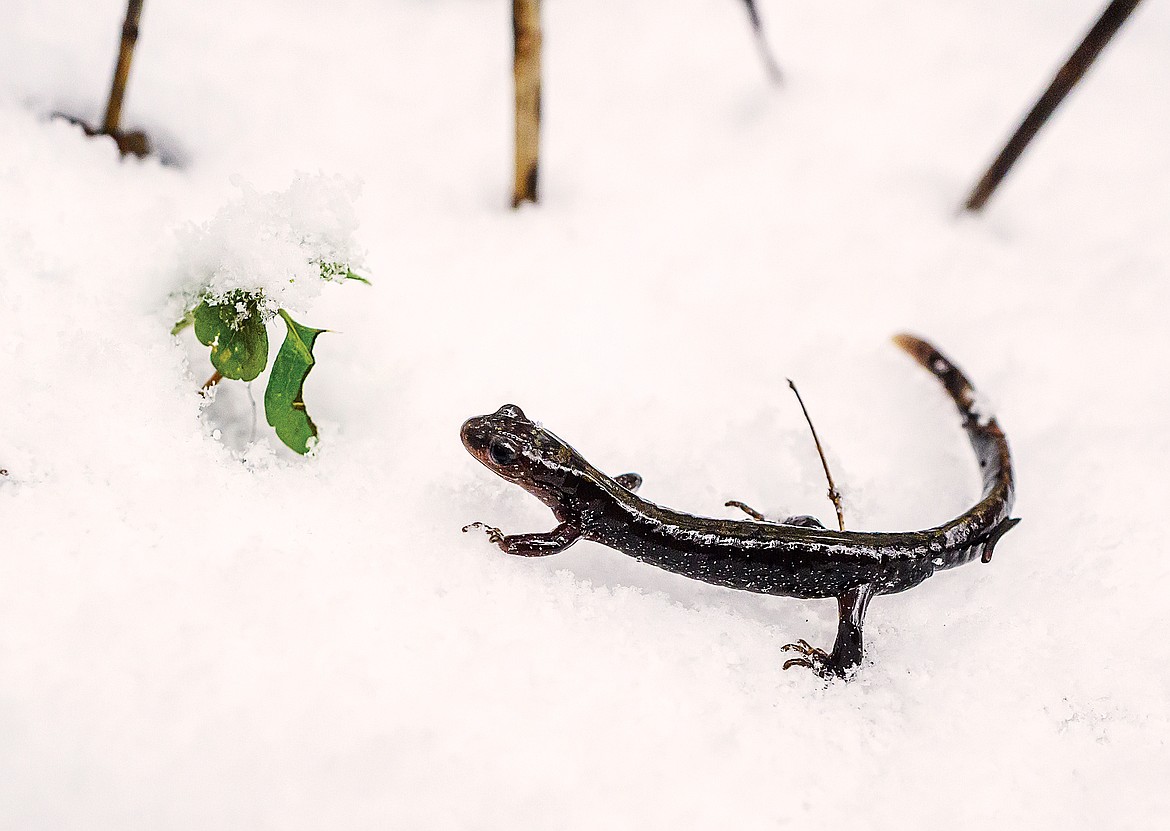
At any rate, we were walking along and I looked down and there was a salamander, walking along on top of the snow.
I posted a short video I took of the critter walking through the snow on Fakebook and someone said it was a Tiger salamander, but after checking the Montana Field Guide online it clearly was not a tiger.
It was either a newt, which is nonnative, or a long-toed salamander, which made more sense because its toes match the description, which reads: “Fourth toe on the hind foot is elongate and longer than the sole of the foot.”
It also was in the sort of habitat that long-toed salamanders are known to frequent, which is to say, not far from a small pond, which I suspect goes dry in the summer, but maybe not, I don’t know.
This one was a juvenile, as the adult has a yellow stripe down its back.
But how does a naked cold-blooded animal walk in the snow? (It was about 32 on the nose when saw it.)
Well it turns out science has looked into this and salamanders have the ability to operate with body temperatures as low as 25 F and salamanders in Siberia can survive temperatures as low at -40 F.
At this point, scientists aren’t entirely sure how this works, but the wood frog, another amphibian, which freezes completely each winter, has super high amounts of glucose in its blood, which acts as antifreeze. But the mechanism that awakens it isn’t entirely clear.
It doesn’t take much of an imagination to see how this physiology could be useful to humans, particularly in space travel. You could “freeze” an astronaut and then thaw them out at their destination, at least in theory.
It’s also important that we protect these sensitive wetland areas, even the ephemeral ones.
Who knows, there may be a creature lurking around in the woods, with secrets that could help all of mankind someday.
Learn more on how to support local journalism at www.hungryhorsenews.com/support
ARTICLES BY CHRIS PETERSON
Blankenship Fire Department welcomes ‘new’ fire truck
An old engine for Columbia Falls is a welcome new rig for the Blankenship Fire Department. Blankenship in December bought Columbia Falls 1994 HME Central States engine for $16,000, which was a great deal, noted Blankenship Chief Terry Wiegand.
CFAC Damage Assessment Plan finalized; will test for 'forever chemicals'
The final natural resource damage assessment plan for the Columbia Falls Aluminum Co. Superfund site has been released, a plan that will take another and perhaps closer look at contamination at the site and ways to mitigate and compensate for the long-term impacts to the natural environment from operation of the former aluminum smelter.
Opinion: Salamander in the snow illustrates marvels of natural world
The boy, the dog and I go for a hike just about everyday in the Flathead Forest. It’s a nice little walk in the woods and depending on which fork you pick it’s a quick loop or a longer walk up into the hills.