
Sewage sludge dewatering could cost cities
HANNAH SHIELDS | Hagadone News Network | UPDATED 1 week, 4 days AGO
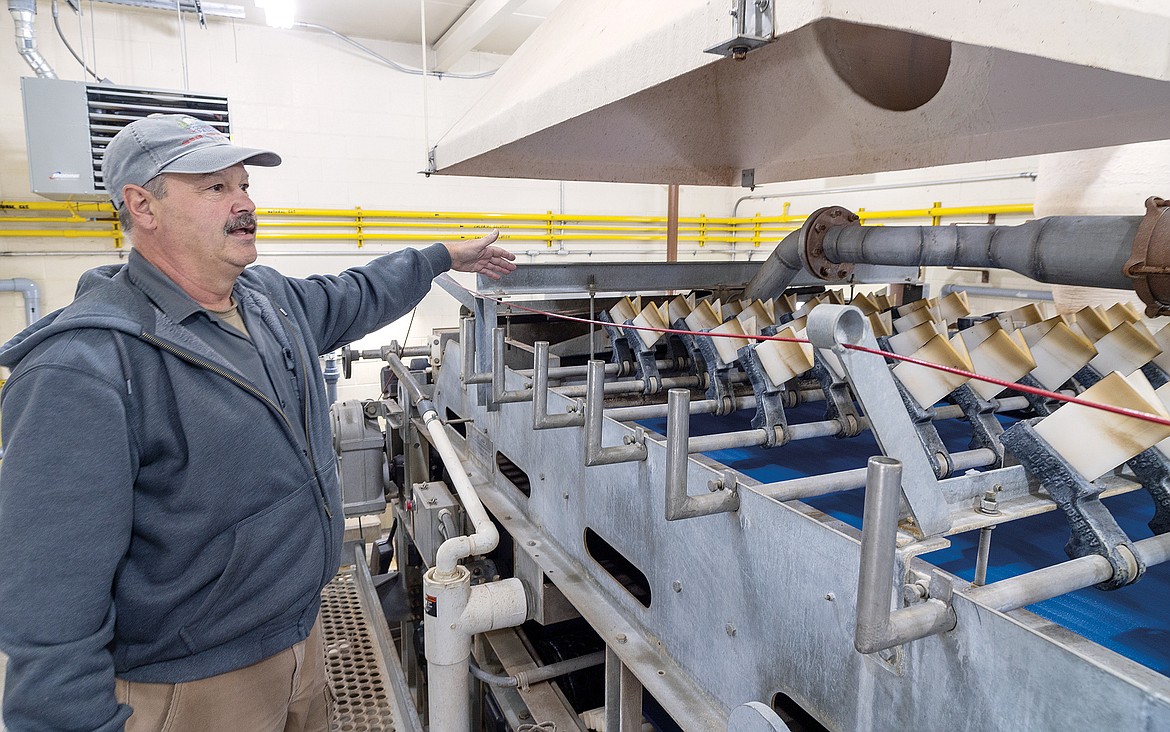
The city's sewage solids get a big squeeze to wring the water out before the solids are hauled to the landfill. Grady Jenkins talks about how the machine that does that works in this 2021 photo.
RURAL GOVERNMENT REPORTER, REPORT FOR AMERICA Hannah Shields covers rural government and accountability reporting for the Daily Inter Lake and Northwest Montana weekly papers as part of the national Report for America program. Her reporting focuses on transparency, public spending and the impact of local government decisions on small communities. Shields has covered issues ranging from school district finances to development disputes and rural infrastructure projects. She regularly uses public records and investigative reporting to examine institutions that affect local residents. Her work helps bring greater oversight and visibility to rural government across Northwest Montana. IMPACT: Hannah’s work strengthens transparency and accountability in rural communities that often lack consistent watchdog coverage. | March 18, 2026 6:55 AM
A growing concern at the Flathead County landfill is the amount of water entering the site through biosolids.
Biosolids, commonly known as treated sewage sludge, are the solid organic materials derived from the treatment of wastewater. Kalispell, Columbia Falls and Whitefish dispose of biosolids at the landfill.
David Prunty, director of Flathead County Public Works, describes Kalispell’s biosolids as “really loose pudding.”
“It comes out just like pudding. You don’t see liquid in it, but it flows,” Prunty said. “That causes us problems, operationally, within the [Flathead County Landfill]. We don’t want liquids in there. We try to keep liquids out.”
Historically, only 30% of Kalispell’s biosolids, roughly 1,500 tons, were dumped at the landfill annually, and the remaining 4,200 tons were sent to a Glacier Gold Compositing facility in Olney.
The biosolids are accepted at the county landfill because they passed a paint filter test, Prunty said. The sludge is dumped into a filter, and if no water drips from the bottom, the product is considered acceptable.
But Kalispell’s contract with Glacier Gold terminates on Sept. 30, when the Olney facility shuts down. City officials warned Flathead County a year and a half ago that they anticipate dumping all biosolids at the landfill after the compost facility closes.
“That got our brains going,” Prunty told the Inter Lake.
The expected increase of up to 5,000 tons of biosolids from Kalispell by the end of 2027 has prompted the county to consider a new requirement based on the U.S. Environmental Protection Agency’s recommendation that biosolids be at least 18% solid.
Kalispell’s biosolids are around 14% solid, and Columbia Falls’ biosolids are around 16% solid. Though Kalispell is working to improve its treatment process, officials are uncertain whether the benchmark can be met, and Columbia Falls says it can’t meet it without expensive upgrades.
The federal guideline is a preventative measure to protect solid waste landfills from heat-related chemical reactions, which have cost landfill operators millions of dollars in damages and take years to repair. While a cause has not been determined for these chemical reactions, large amounts of moisture trapped in the layers of garbage are known to be a common element.
“Scientists are still trying to figure out what’s going on,” Prunty said. “We know that water is one of the leading factors causing these things. So, the industry is hypersensitive.”
One of the most extreme examples is the Chiquita Canyon Landfill in California, where a heat-related chemical reaction in 2022 caused the release of noxious odors and millions of gallons of contaminated water to leak out of the landfill, which was eventually forced to close.
“We don’t want to get to that stage,” Prunty said. “If you have a problem at this facility, the next closest facility is Missoula.”
Rain in the first half of the year has historically brought more moisture than the landfill can handle, Prunty said during a Jan. 27 meeting with the Flathead County Solid Waste District Board of Directors.
“We’re already exceeding our capacity of moisture in the landfill from precipitation,” Prunty said. “In a wet summer, we’re producing more than the landfill can handle.”
The county recently invested a million dollars to build a leachate pond, which catches contaminated water filtering through the piles of trash. In the summer, crews will empty the pond into a water truck, carry it back to the landfill and spray it on top, letting it evaporate under the sun.
“The treatment plants won’t take [the leachate] off of our hands,” Prunty told the Inter Lake. “I’ve got to deal with this on site, so the less we have of that, the better.”
Before new regulations are adopted, the county this fall is launching a two-year project to gather data on the landfill’s moisture content.
Engineers will record moisture levels from monthly rainfall, the landfill’s hydroseed mulch cover and biosolids from Columbia Falls and Kalispell. Whitefish isn’t a concern, Prunty said, because the city uses a drying bed system that reduces its biosolids to 40 to 50% solid.
Information gathered from the study will inform parameters around biosolid acceptance.
Columbia Falls City Manager Eric Hanks said the city doesn’t have the budget to invest in a new dewatering system. Its biosolids average 15.3% solid in colder months, and 16.4% solid in the summertime, when temperatures are higher. Columbia Falls dumps around 950 tons of biosolids at the landfill each year.
The current treatment system can’t guarantee a solid percentage higher than 17%, Hanks said. The city is considering investing in water boilers to optimize the polymer process, but the technology is limited.
“It’s not gonna be 18%. I just don’t think this style of equipment we have can get to that level,” Hanks said. “We’ve talked to the engineers of optimizing that system with the rest of our processes. But the likelihood of getting up there would be unlikely.”
The city’s primary concern is studying the capacity of its wastewater treatment system amid a growing population.
Hanks said officials first learned about the county’s proposed 18% standard for biosolids last July.
“My wastewater supervisor with nearly 30 years of experience was like there’s no way we’re gonna get to that level. That’s gonna be a problem,” Hanks said. “We’ve been having those conversations. I think it’s important to understand that this would not be an issue if Kalispell wasn’t increasing their delivery.”
He suggested the county assist in helping Kalispell and Columbia Falls invest in dewatering processes, such as drying beds, if it wants to put a new restriction in place.
“We recognize the issue for the cities,” Prunty said during the landfill board meeting. “But we also have to recognize the issues at the landfill.”
Learn more on how to support local journalism at www.hungryhorsenews.com/support
ARTICLES BY HANNAH SHIELDS

Flathead Library director to retire after her contract expires in 2028
Flathead Library Director Teri Dugan will retire at the end of her contract, which was extended through 2028 by trustees on Thursday.
Flathead County Library continues negotiations for new Kalispell branch
Flathead County Library trustees are re-negotiating the purchase of property at the Kalispell Center Mall for a future Kalispell branch.

'We know we can do the job:' Smith Valley Fire Department deploys all-woman volunteer shift
Smith Valley Fire Chief Amy Beick walked into the station one December day and saw something she’d never encountered in her two decades at the department.