
CFAC Damage Assessment Plan finalized; will test for 'forever chemicals'
CHRIS PETERSON | Hagadone News Network | UPDATED 19 hours, 55 minutes AGO
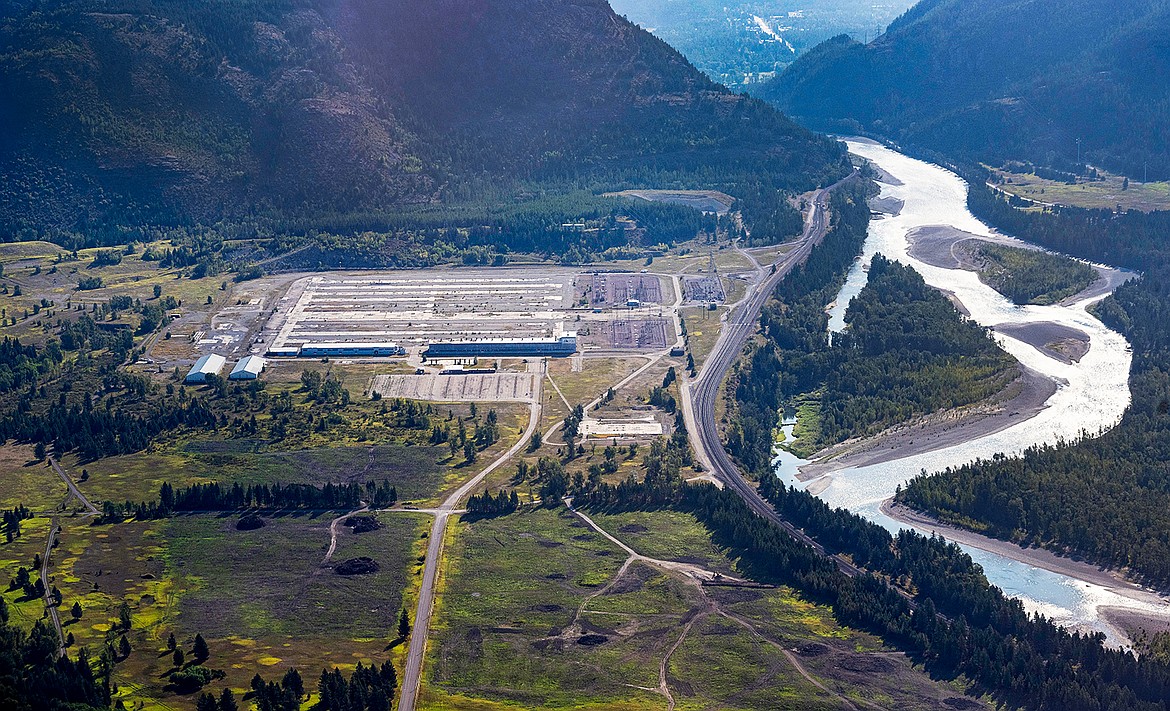
The CFAC site as seen from an airplane on Aug. 27, 2025. (Seth Anderson photo)
SETH ANDERSON PHOTOGRAPHY
Chris Peterson is the editor of the Hungry Horse News. He covers Columbia Falls, the Canyon, Glacier National Park and the Bob Marshall Wilderness. All told, about 4 million acres of the best parts of the planet. He can be reached at [email protected] or 406-892-2151. | March 21, 2026 12:00 AM
The final natural resource damage assessment plan for the Columbia Falls Aluminum Company Superfund site has been released, a plan that will take another look at contamination there and ways to mitigate and compensate for the long-term impacts to the natural environment from operation of the former aluminum smelter.
The effort is part of Superfund law and is collectively done by the state of Montana, the Confederated Salish and Kootenai Tribes, the Department of Agriculture and the Department of Interior, collectively known as the “trustees.”
The investigation could go above and beyond what’s already been done by the Environmental Protection Agency and CFAC, perhaps most notably investigating per- and polyfluoroalkyl substances, also known as PFAS or “forever chemicals.”
It does not look to duplicate previously performed testing, the plan notes
But the EPA has conceded that when the initial investigations were completed, forever chemicals were not included in testing. The company has previously said the smelting process does not create PFAS, but an engineer who formerly worked at the plant disagreed.
But just getting existing data has been challenging, staff noted.
Once the data is collected, it has to be shared with the trustees under Superfund law, noted Katherine Hausrath, chief legal counsel for the trustees.
Among other things, trustees are interested in the connection, if any, between groundwater and surface water at the site and wanted to accompany staff when they collected samples at seeps from the plant site that flow into the Flathead River.
The site has already been found to have high concentrations of cyanide and fluoride in the groundwater near old dumps, which have been leaking since at least the early 1990s. Previous tests, however, have shown the contaminants are at low levels by the time the water reaches the river.
CFAC has declined to participate in the damage risk assessment process, according to a letter written to trustees on March 8, 2024.
“CFAC is not being given the opportunity to participate in the (assessment) process ... but rather is only being asked to foot the bill,” the company charged at the time.
It also claimed the effort, at least at that time, was premature.
In letters since, the company has been less than willing to work with staff from the damage assessment program, claiming in one letter last year that the actual cleanup was outside the scope of the damage assessment program.
Cooperation or not, the damage assessment will continue, though Hausrath was hesitant to outline an exact timeline.
“Our goal is to move as quickly as we can and still have good science,” she said in an interview last week.
To be clear, the assessment does not have any impact on the actual cleanup of the site, which is expected to start in 2027, as crews will move contaminated soils at the site to one landfill and then put a slurry wall around the former wet scrubber sludge pond and west landfill. The wall, which will be about three feet thick, is supposed to keep the cyanide-laden groundwater from seeping out of the landfills. It’s been approved by the Environmental Protection Agency.
The cleanup is expected to cost about $57 million
The Damage Risk Assessment is separate from the Superfund cleanup of the defunct smelter. Instead, it looks to recoup damage done to the human environment by historic polluters, in this case CFAC and the Atlantic Richfield Co., both previous owners of the site.
Settlements often range in the millions. In Libby, for example, the program saw about $18.5 million in restitution.
The program has also done key work in the Upper Clark Fork Superfund site and in Anaconda. Not all settlements are simply cash payments, either. Sometimes they result in land swaps. For example, in Helena, a settlement with Asarco resulted in 322 acres of company land being converted into trails and parkland for the city in 2020 under the Damage Risk Assessment Program.
The program is administratively attached to the Montana Department of Justice and is funded through the state.
The damage assessment also has no impact on proposed plans for residential development at the east end of the property outside the Superfund footprint, but formerly owned by CFAC.
Developer Mick Ruis bought the property from the company and has plans for multiple housing units along Aluminum Drive. That project, which includes more than 400 housing units of various types, is slated to go in front of the Columbia Falls City Planning Commission in April.
The damage assessment also does not look directly at human health impacts, if it finds them. If they find a potential human health concern, it would be referred back to the EPA.
The next step in the damage assessment will look at the data and any data gaps, noted project manager Sydney Stewart.
Stewart said staff will then quantify the injury and eventually translate that into a dollar amount.
“The trustees’ overall approach to restoration ... will be to target restoration actions that directly benefit natural resources and the public. Where timely restoration of injured natural resources is not feasible (e.g., removal of contaminated sediments to restore all the services that would be provided absent the release of hazardous substances), projects that replace or offset service losses may be undertaken ... The trustees intend, therefore, to address restoration at the habitat scale by focusing on restoration projects that will compensate the public by providing resource services in or near the assessment area,” the assessment plan notes.
That could be a variety of alternatives, from restoration or preservation of habitat at the site to an in-kind remedy.
As far as the Confederated Salish and Kootenai Tribes is concerned, “A suite of restoration actions may be scaled as needed to ensure the adversely affected CSKT tribal members are compensated with services of the same nature and scope as those services determined to have been lost during injury quantification. While it is possible that ecological-focused restoration actions may serve to restore some cultural service losses of injured natural resources, it is possible, if not likely, that specific actions targeting the restoration of tribal cultural use of injured natural resources and associated practice, language, or resource access may need to be conducted.
“As with scaling restoration and damages to the resources themselves, care will be taken to avoid double counting,” the plan notes.
The entire final plan, along with a host of other documents is available at: www.dojmt.gov/nrdp/new-claims#columbia-falls.
ARTICLES BY CHRIS PETERSON
Blankenship Fire Department welcomes ‘new’ fire truck
An old engine for Columbia Falls is a welcome new rig for the Blankenship Fire Department. Blankenship in December bought Columbia Falls 1994 HME Central States engine for $16,000, which was a great deal, noted Blankenship Chief Terry Wiegand.
CFAC Damage Assessment Plan finalized; will test for 'forever chemicals'
The final natural resource damage assessment plan for the Columbia Falls Aluminum Co. Superfund site has been released, a plan that will take another and perhaps closer look at contamination at the site and ways to mitigate and compensate for the long-term impacts to the natural environment from operation of the former aluminum smelter.

Opinion: Salamander in the snow illustrates marvels of natural world
The boy, the dog and I go for a hike just about everyday in the Flathead Forest. It’s a nice little walk in the woods and depending on which fork you pick it’s a quick loop or a longer walk up into the hills.