
State audit breaks down MLSD budget issues
NANCE BESTON | Hagadone News Network | UPDATED 3 days, 14 hours AGO
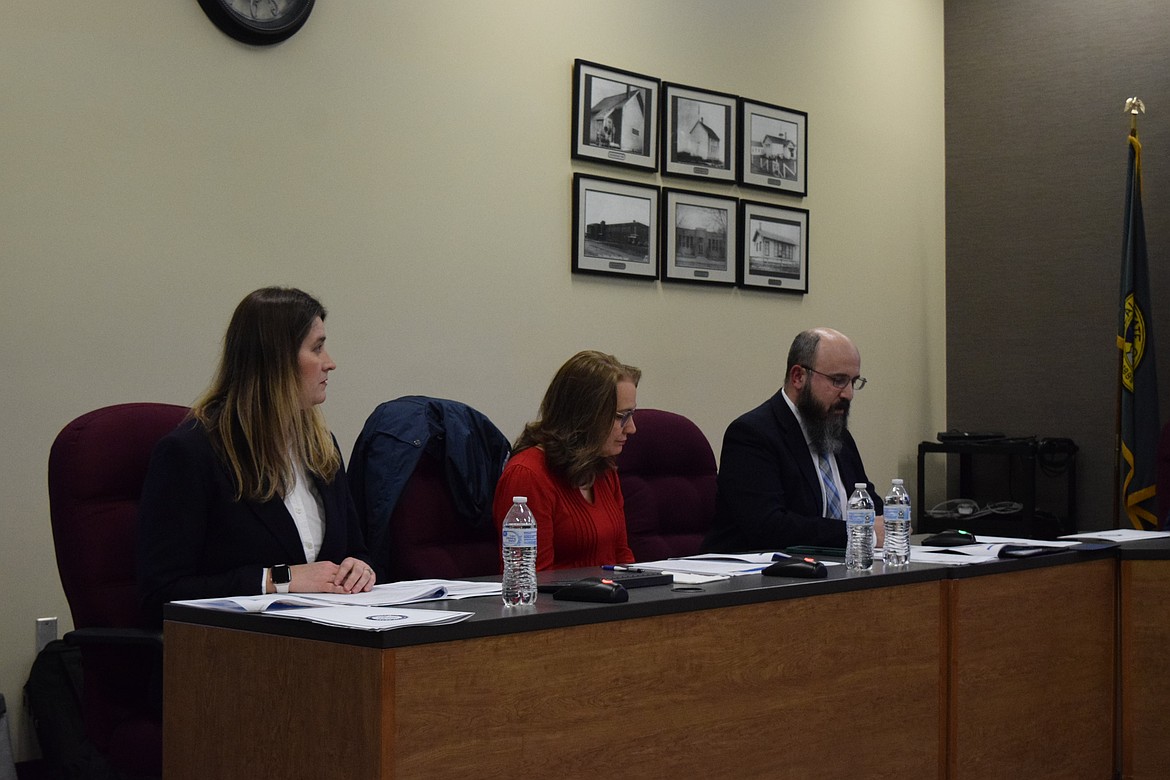
The Washington State Auditor's Office presented the findings from the two-year Moses Lake School District accountability audit. From left to right is Assistant State Auditor Ruth Walker, Assistant Audit Manager Kathleen Lince and Audit Manager Jake Santistevan.
NANCE BESTON/COLUMBIA BASIN HERALD
MOSES LAKE — A two‑year accountability audit of the Moses Lake School District found the district repeatedly overspent its legally adopted budgets, failed to obtain required state approval for a 2024 enrichment levy, and lacked adequate controls over purchasing, credit cards, fuel use and asset tracking, according to a report released March 19 by the Washington State Auditor’s Office.
The findings were presented during a special board meeting Thursday evening, where auditors outlined four formal findings and five additional concerns detailed in a management letter. District leaders acknowledged the issues and said many corrective actions have been implemented or are underway.
The district also issued a public statement Friday emphasizing its commitment to “continuous improvement and transparency” and outlining steps taken to strengthen oversight.
Budget non-compliance
The first finding concluded that the district’s financial condition deteriorated sharply between 2022 and 2024, leaving it with only 27 days of operating expenditures at the end of the 2023‑24 fiscal year, less than half of the 60‑day benchmark auditors consider a reasonable minimum, explained audit manager Jake Santistevan.
The district also exceeded its legally adopted general fund budgets by $4.46 million in 2022‑23 and $4.09 million in 2023‑24, despite internal reports warning of overspending months before year‑end.
Auditors said delayed and inaccurate budget reports, staff turnover and incomplete financial monitoring contributed to the problem.
One excerpt from the report states that “delayed and inaccurate budget status reports in addition to an ineffective review process failed to identify the District might exceed its approved budget before year‑end.”
District leaders informed auditors that they have since overhauled financial reporting, expanded oversight, and restored the general fund balance to healthier levels as of August 2025.
In its press release, the district said it has “strengthened monthly financial reporting,” increased budget‑to‑actual reviews, and added board‑level scrutiny of accounts payable.
Levy failure
A second finding determined the district placed enrichment levies on the February and April 2024 ballots without obtaining the required pre‑ballot approval from the Office of Superintendent of Public Instruction. State law requires OSPI to approve a district’s levy expenditure plan before the measure goes to voters.
“The district placed an enrichment levy … without first obtaining OSPI’s approval,” Santistevan said.
The district attributed the lapse to turnover in key administrative positions. OSPI granted retroactive approval in June 2025.
In its response, the district said it has created a formal levy‑submission checklist, assigned clear responsibility for compliance, and successfully obtained OSPI approval for its 2025 levy.
Purchasing controls
A third finding cited $693,000 in 2023 and $751,000 in 2024 in purchases using credit cards. Additionally, $695,000 in 2023 and $652,000 in 2024 were spent using fuel cards.
“We saw credit card statements, and there was nothing with that,” said Assistant State Auditor Ruth Walker.
Auditors also found the district used a cooperative purchasing agreement to buy $1.6 million in school furniture, but failed to document whether the cooperative met legal requirements or whether the district received the correct items at the correct prices.
Staff turnover and lack of training contributed to the breakdown, auditors said during the March 19 meeting.
The district said it has updated procurement procedures, expanded staff training, and created centralized recordkeeping for bids and quotes.
Expenditure oversight
A fourth finding identified widespread weaknesses in oversight of credit card purchases, open purchase orders and fuel transactions.
Auditors reviewed 135 transactions totaling about $200,000 and found: 78 transactions lacked detailed receipts or purchase orders, 16 transactions had no supporting documentation at all, seven transactions lacked proof the district received the items, one $16,520 purchase had no purchase order, and two others were approved after the purchase.
Fuel oversight was also inadequate. The district did not track who was authorized to dispense fuel, did not reconcile fuel tank levels, and lacked procedures to monitor usage patterns.
In its response, the district said it has discontinued open purchase orders, increased board review of expenditures, and provided staff training on documentation requirements.
Additional issues
Beyond the four formal findings, auditors issued a management letter outlining additional concerns:
Payroll, leave monitoring
Auditors found a former technology director misrepresented jury duty leave, resulting in a $2,056 misappropriation, and four employees exceeded bereavement leave limits.
The district has since revised Policy 5400, implemented new tracking procedures, and separated the employee involved, according to a statement from the district.
Supplemental contracts, coaching leave
Some supplemental contracts lacked required documentation, and three employees traveled out of state for a sports event, though only one had a coaching contract.
The district has created standardized templates and new oversight procedures, according to MLSD Executive Director of Employee Services Michelle Musso.
Enrollment reporting
The district could not initially provide bell schedules needed to verify instructional minutes for 2024‑25, though auditors ultimately confirmed compliance using bus schedules. The district has since standardized bell schedule templates and trained principals on documentation, according to Superintendent Carol Lewis.
Associated Student Body
Auditors found $185,319 in Future Farmers of America revenues, and $160,855 in expenditures were recorded in the general fund instead of the ASB fund, leaving $24,464 owed to ASB. The district has transferred the funds and implemented new procedures, according to MLSD Director of Finance Ruby Perez.
Cash handling
The district made only five deposits into a bank account over two years, contrary to state law requiring weekly deposits, and two former employees remained as authorized users. The district has since transferred funds to the county treasurer and updated access controls, according to the statement to the auditor from the district.
Asset tracking
Auditors could not locate several IT assets, found others untagged or in the wrong location, and identified missing inventory controls in both IT and maintenance. The district is reinstating annual inventories and updating tagging procedures, according to a statement from the district.
Next steps
In a statement read aloud at the meeting, Board Vice President Paul Hill said the findings reflect practices under prior administrations and that “there is not a single board member or administration (employee) that was responsible for this…still with this district.”
The district’s press release emphasized that many corrective actions were implemented during the audit itself and that leaders “remain committed to continuous improvement and transparency.”
The next audit will begin in April, SAO staff said during the meeting.
ARTICLES BY NANCE BESTON
Ephrata, Port awarded CERB grant economic development planning
EPHRATA — The city of Ephrata and the Port of Ephrata have secured a state planning grant to jointly develop a long‑range economic development strategy aimed at improving infrastructure and attracting new businesses.
State audit breaks down MLSD budget issues
MOSES LAKE — A two‑year accountability audit of the Moses Lake School District found the district repeatedly overspent its legally adopted budgets, failed to obtain required state approval for a 2024 enrichment levy, and lacked adequate controls over purchasing, credit cards, fuel use and asset tracking, according to a report released March 19 by the Washington State Auditor’s Office.
Soap Lake council tables tourism committee plan, debates planning services
SOAP LAKE — Soap Lake City Council approved several administrative resolutions Wednesday but postponed decisions on tourism funding and planning services after an hours‑long discussion over staffing, contracts and oversight.