
Glacier National Park starts spring plowing Wednesday
CHRIS PETERSON | Hagadone News Network | UPDATED 21 hours, 17 minutes AGO
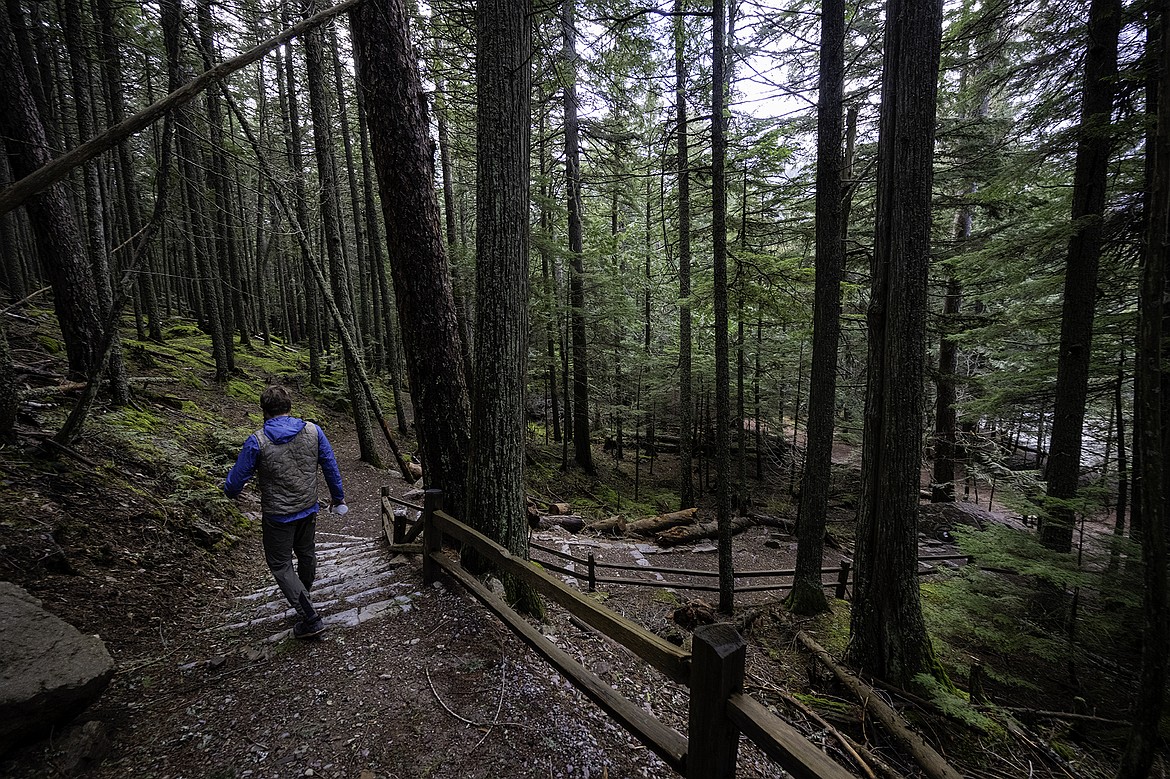
A hiker walks in the snow-free woods at Avalanche Creek last week. (Seth Anderson photo).
Chris Peterson is the editor of the Hungry Horse News. He covers Columbia Falls, the Canyon, Glacier National Park and the Bob Marshall Wilderness. All told, about 4 million acres of the best parts of the planet. He can be reached at [email protected] or 406-892-2151. | March 23, 2026 1:35 PM
The spring plowing of Glacier National Park’s roads will start March 25 with the Two Medicine Road, while the Camas, Going-to-the-Sun and Many Glacier roads will start April 1, according to park spokeswoman Autumn Sifuentes.
But unless the weather takes a rapid turn in the next week, the amount of snow they’ll have to plow at the lower elevations is nil.
The Hungry Horse News staff traveled to Avalanche Creek in the past week, where there is no snow.
Most years there’s a foot or two of snow at Lake McDonald Lodge this time of year and a massive slide just beyond Avalanche Creek at Red Rocks that crews have to punch through.
But low elevation snow was almost nonexistent this winter; as December saw mostly rain, while January and February were dry and abnormally warm.
March has been wet and saw some good snowfalls, particularly in the higher terrain, but it has since gotten into the 50s and near 60 in the past week, and low elevation snows, with no compaction, have been melting rapidly.
As such, the Camas Road also has little to no snow. The overall snowpack in the Flathead River Basin , however, did reach 100% of median earlier in March, but has since slipped a few percentage points to 92% as of this writing.
Glacier has two remote SNOTEL sites which monitor snow in the park. The West Flattop site is 93% of median, but Many Glacier is just 5% of median, meaning the valley has almost no snow. The Flathead River Basin total precipitation, however, is 118% of the median.
Many Glacier’s SNOTEL is east of the divide and at a lower elevation, 4,930 feet, while the Flattop site is at 6,280 feet.
Still Many Glacier typically has 12.8 inches of snow water equivalent by this time of year. This year it has just 0.6 of an inch. Many Glacier’s total precipitation is at 135% of median so far this winter. It’s just that it has fallen as rain.
Having said that, gated roads in Glacier are still currently closed to bicycles according to signage in the park. Once road crews start plowing, road sections will open up to hikers and bikers as plowing proceeds. In areas where crews are working, the roads are closed (and clearly marked as such), but usually there’s at least a few miles open for hikers and bikers, particularly on the Sun Road. When crews aren’t working, roads, even gated ones, will open to biking April 1 and thereafter.
Typically the road to Avalanche Creek opens Mother’s Day to motor vehicle traffic.
ARTICLES BY CHRIS PETERSON
Glacier National Park starts spring plowing Wednesday
But there's already no snow at lower elevations
The spring plowing of Glacier National Park’s roads will start March 25 with the Two Medicine Road, while the Camas, Going-to-the-Sun and Many Glacier roads will start April 1, according to park spokeswoman Autumn Sifuentes.
Blankenship Fire Department welcomes ‘new’ fire truck
An old engine for Columbia Falls is a welcome new rig for the Blankenship Fire Department. Blankenship in December bought Columbia Falls 1994 HME Central States engine for $16,000, which was a great deal, noted Blankenship Chief Terry Wiegand.
CFAC Damage Assessment Plan finalized; could test for 'forever chemicals'
The final natural resource damage assessment plan for the Columbia Falls Aluminum Co. Superfund site has been released, a plan that will take another and perhaps closer look at contamination at the site and ways to mitigate and compensate for the long-term impacts to the natural environment from operation of the former aluminum smelter.