
Bears awake from winter slumber ready to eat
CHRIS PETERSON | Hagadone News Network | UPDATED 3 days, 22 hours AGO
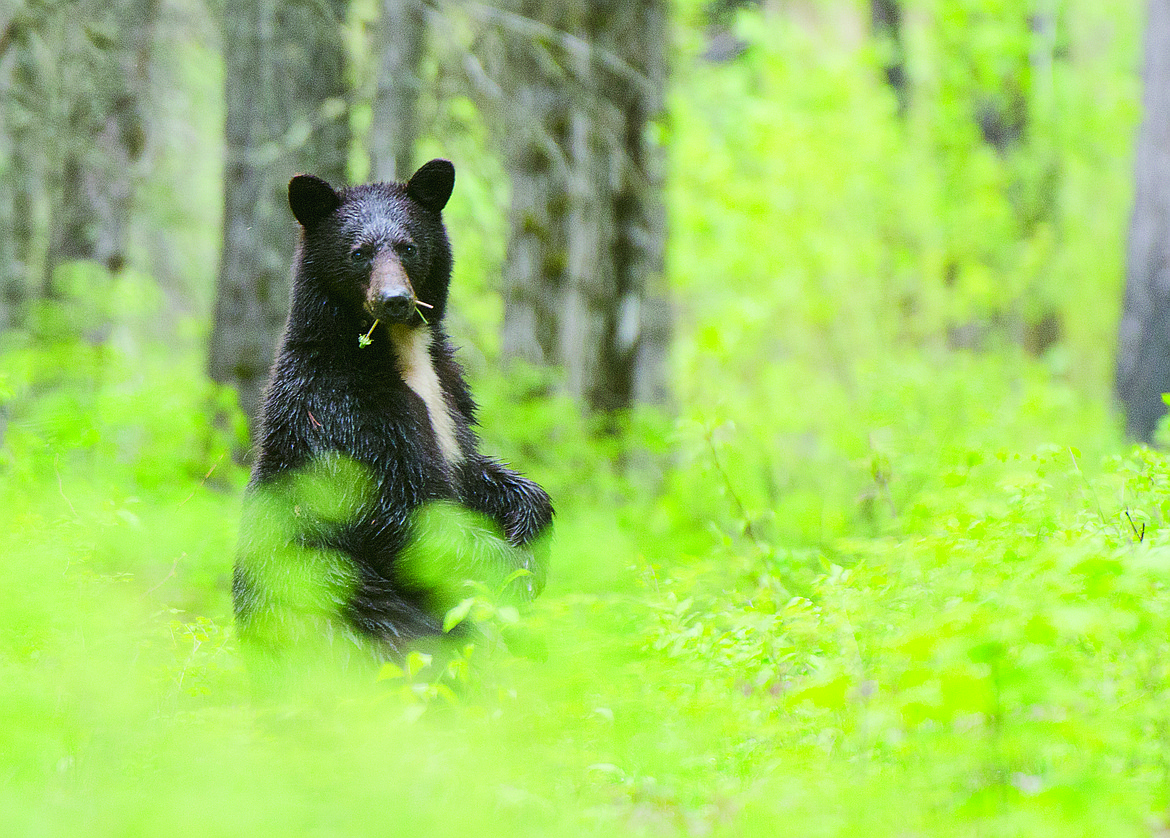
Sporting a distinctive white belly, a black bear stands up while eating dandelions near Apgar. Photo was taken with a 600 mm equivalent lens. (Chris Peterson/Hungry Horse News)
Chris Peterson is the editor of the Hungry Horse News. He covers Columbia Falls, the Canyon, Glacier National Park and the Bob Marshall Wilderness. All told, about 4 million acres of the best parts of the planet. He can be reached at [email protected] or 406-892-2151. | March 26, 2026 12:00 AM
One of the most gratifying chapters of spring is seeing the first bear of the season. For most folks that means seeing a black bear (though grizzlies are often awake a bit earlier, especially some males, which can barely slumber at all during the winter).
Black bears are more ubiquitous, however. For one, there is simply more of them, and two, they like feeding alongside roads, particularly when dandelions are blooming.
Dandelions may be considered a weed to some lawn lovers, but for bears, they’re often breakfast, lunch and dinner in the spring.
According to Kerry Forseman’s “Mammals of Montana,” black bears are widely distributed in Montana and can be confused with grizzlies, as they run the gamut of colors, from chocolate brown to blonde to a rich, shiny black.
But there are key differences. Black bears do not have the distinctive shoulder hump, their noses are straight and pointed and their front claws have a curve from toe one through five, while grizzly’s are almost straight across, which is evident in a clear track.
Males in Montana weigh as much as 250 pounds, with females being smaller. They have their offspring in their winter dens and the cubs spend a first full year with their mother and disperse the following spring. In theory, a female can have cubs every other year, but that typically doesn’t happen.
Black bears are omnivores, though meat typically makes up a fraction of their diet.
They mostly eat plants, and in Montana, are typically less aggressive than grizzly bears. In our experience, black bear encounters in the backcountry are brief, usually with a short woof and then a bear sprinting away, particularly in areas where they don’t often come into contact with humans, like deep in the Bob Marshall Wilderness or the less traveled areas of Glacier National Park.
Still, they will come into a dirty camp and try to help themselves to human foods, so it is always pertinent to hang food when camping anywhere in Northwest Montana and to make sure all cooking utensils are clean and kept out of harm’s way as well. Bears are also attracted to deodorants, soaps, toothpaste and anything else that might smell like it’s food, so hang up that as well.
The best bear encounters are the ones where you can sit and watch them at a safe distance in a meadow or up on a slope.
Black bears aren’t true hibernators. Their body temperature drops 3 to 5 degrees (typically to 100F) and their heart rate drops about 35% as well. A true hibernator, by comparison, actually sees a much-reduced body temperature to the point of being cold, as well as a very reduced heart and breath rate,
A black bear can be awoken at a den site and actually burns about 4,000 calories a day in fat reserves, Forseman noted.
ARTICLES BY CHRIS PETERSON
Glacier National Park starts spring plowing
March has been wet and saw some good snowfalls, particularly in the higher terrain, but it has since gotten into the 50s and near 60 in the past week, and low elevation snows, with no compaction, have been melting rapidly. As such, the Camas Road also has little to no snow. The overall snowpack in the Flathead River Basin , however, did reach 100% of median earlier in March, but has since slipped a few percentage points to 92% as of this writing.
Bears awake from winter slumber ready to eat
One of the most gratifying chapters of spring is seeing the first bear of the season.

Track has returning talent, looks to youth as well
Columbia Falls tracks squads should be in the top five again this year as they have some returning talent from last year and a host of upcoming athletes ready to make their mark.