
Business groups sue to stop proposed ban on political spending in Montana
HAILEY SMALLEY | Hagadone News Network | UPDATED 7 months AGO
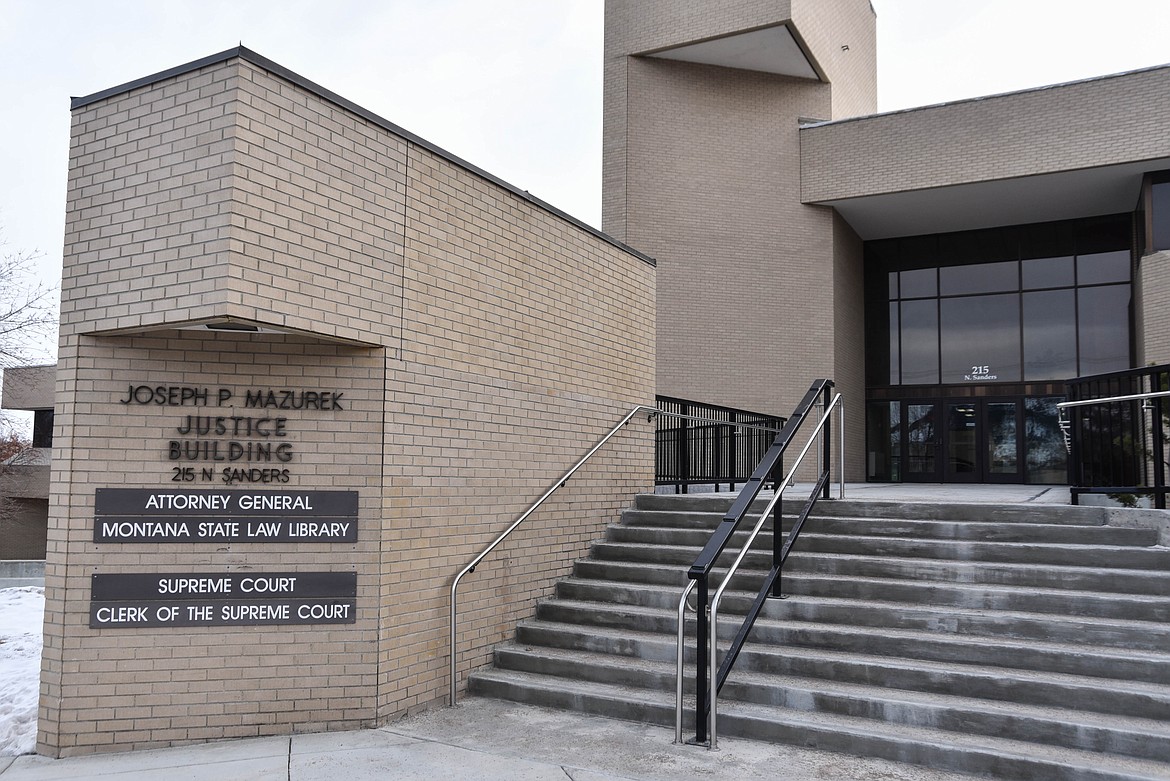
The Montana Justice Building is seen on Jan. 19, 2023 in Helena. The Attorney General's Office, Montana State Law Library, and Supreme Court Offices are located in this building. (Kate Heston/Daily Inter Lake)
The Kalispell Chamber of Commerce is one of several organizations to file suit over a proposed ballot initiative to ban corporate spending in politics, arguing it infringes on the free speech rights of businesses.
The suit is the latest hurdle facing the Montana Plan, a movement headed by the Transparent Election Initiative that aims to staunch the flow of dark money into local, state and federal elections by finding workarounds to a 2010 Supreme Court ruling known as Citizens United. The case effectively overturned local and state government prohibitions on corporate spending in politics, including a century-old ban on corporate spending in elections in Montana.
Campaign expenditures have skyrocketed in the years since the ruling, culminating in a $260 million standoff between Senate candidates Jon Tester and Tim Sheehy in 2024.
The Montana Plan would bypass Citizens United by stripping corporations, including nonprofits, unions and for-profit entities, of political spending rights altogether. The strategy draws on the fact that corporations are created under state law. Proponents of the Montana Plan argue that, unlike the unalienable right to free speech held by all residents of the United States, a corporation’s right to political speech is imbued by the state government.
The Montana Plan is set to appear on election ballots in November as Ballot Issue 10, pending the collection and approval of petition signatures.
Nine commercial interest groups are now asking the Montana Supreme Court to strike the initiative before it can appear for a vote. Plaintiffs in the case include the Montana, Kalispell and Billings chambers of commerce and the Montana Mining, Montana Contractor’s, Montana Trucking, Treasure State Resource, Montana Stockgrowers and Montana Petroleum associations.
The groups argue that Ballot Issue 10 is facially unconstitutional because it restricts the free speech rights of corporations and other “artificial persons.” While the Montana Plan provides a novel path to limit corporate spending, the groups assert that the outcome is fundamentally the same as the corporate spending bans overturned by Citizens United.
The groups also argue that the language of the ballot initiative is unconstitutionally vague.
“That was where our rub came,” said Lorraine Clarno, CEO of the Kalispell Camber of Commerce.
Clarno said she wasn’t opposed to the intent of the Montana Plan, but she worries about the way the ballot initiative's wording will be construed, should the measure pass. As written, the initiative would ban artificial persons, including nonprofits, trusts, corporations and trade associations, from “contributing anything of value candidate elections, supporting or opposing political parties, or supporting or opposing state or local ballot issues.”
In the past, the Kalispell Chamber of Commerce has promoted local bonds and levies and hosted candidate forums, with the goal of increasing participation in local government.
“Is that going to be considered anything of value?” said Clarno. “Our guess is yes. If they’re going to restrict to that degree, our hands are really tied from an informational and educational standpoint.”
Lawyers for the groups echoed Clarno’s concerns in their petition to the Montana Supreme Court, arguing that the vague language of the initiative will deter businesses from participating in any political activity and lead to a “massive chilling on political discourse in Montana.”
The ongoing lawsuit is not the first stumbling block that the Transparent Election Initiative has faced while promoting the Montana Plan. Attorney General Austin Knudsen sidelined the group’s first ballot initiative in January, arguing it affected multiple parts of the state constitution and therefore could not be considered a single voting measure. The current draft, which received approval in early March, focuses on language in state statutes rather than the constitution.
Proponents of the Montana Plan must submit about 30,000 valid petition signatures by June 19 to ensure the initiative appears on the ballot in November. Jeff Managan, the founder of the Transparent Election Initiative, confirmed that the group will continue to canvass for signatures as the Montana Supreme Court considers the lawsuit.
“We are confident the Montana Supreme Court will stand with Montanans and uphold the right of the people to decide this issue at the ballot box, as our constitution provides,” he said in a March 19 statement. “Montanans deserve their say.”
Reporter Hailey Smalley can be reached at 406-758-4433 or [email protected]. If you value local journalism, pledge your support at dailyinterlake.com/support.
ARTICLES BY HAILEY SMALLEY

Trump stumps for Flint in Kalispell as Election Day nears
President Donald Trump, wearing a dark suit, red tie and red USA cap, ambled into the Majestic Valley Arena to the raucous roar of a crowd.

Flathead National Forest greenlights Swan Valley timber project
A 2,307-acre timber project is now under way in the Swan Valley.
Flathead National Forest greenlights Swan Valley timber project
A 2,307-acre timber project is now under way in the Swan Valley.